





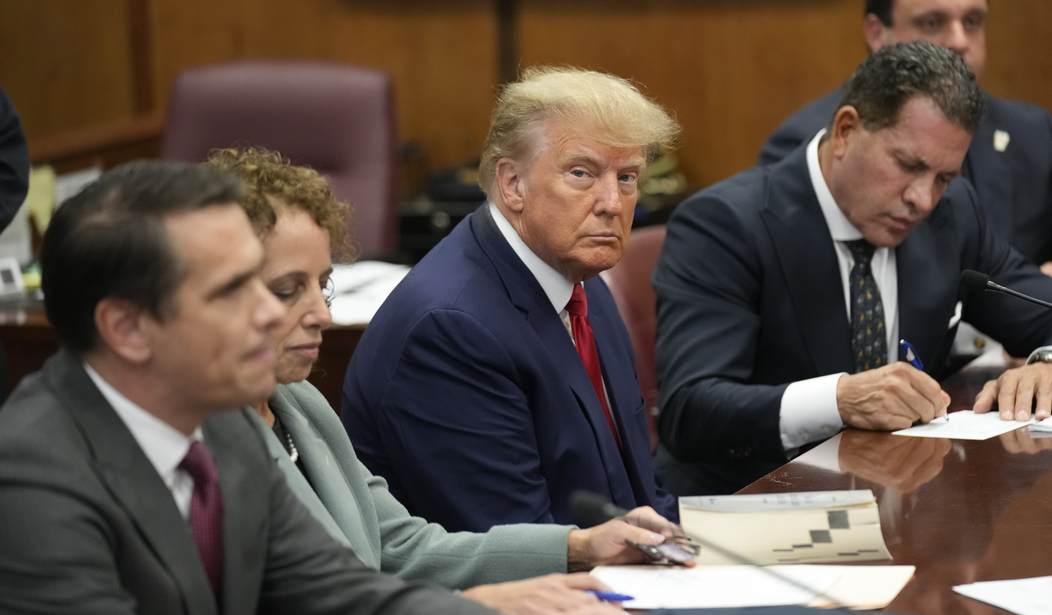
Since the New York indictment of Donald Trump was unsealed last week, critics across the political spectrum have noted the legal problems with transforming one hush payment into 34 felonies. But in assessing the seriousness of this case, it is also relevant to ask who was injured by the former president's actions, a question that poses more of a puzzle than Manhattan District Attorney Alvin Bragg suggests.
Bragg says Trump "violate(d) state and federal election laws" when he instructed attorney Michael Cohen to pay porn star Stormy Daniels $130,000 shortly before the 2016 presidential election. In exchange, Daniels agreed to refrain from talking to the press about her alleged 2006 affair with Trump.
Federal prosecutors viewed that payment as an illegal campaign contribution, and Cohen accepted that characterization in a 2018 guilty plea. But that plea hardly proves that the Justice Department's interpretation of the law was correct, since Cohen, who ultimately received a three-year sentence, was facing charges that could have sent him to prison for decades.
"The best interpretation of the law," former Federal Election Commission Chairman Bradley Smith wrote after Cohen's guilty plea, "is that it simply is not a campaign expense to pay blackmail for things that happened years before one's candidacy -- and thus nothing Cohen (or, in this case, Trump, too) did is a campaign finance crime." At the very least, Smith said, "it is unclear whether paying blackmail to a mistress is 'for the purpose of influencing an election,' and so must be paid with campaign funds, or a 'personal use,' and so prohibited from being paid with campaign funds."
Even UCLA law professor Richard L. Hasen, who is skeptical of Bragg's case but thought there was enough evidence to federally prosecute Trump for accepting an illegal campaign contribution, concedes that proving he "knowingly and willfully" violated the law "would not have been a slam dunk." In any event, federal prosecutors conspicuously declined to try, even after Trump left office and Merrick Garland replaced William Barr as attorney general.
Assuming the Justice Department could have made that case but for some reason decided it was not worth the effort, the question remains: Who was victimized by the hush payment? Bragg thinks voters suffered because they were deprived of "damaging information" that might have influenced their choice between Trump and Hillary Clinton.
Yet Trump had a long, widely familiar history of extramarital affairs. It seems unlikely that yet another one would have swayed voters who were otherwise inclined to support him.
Suppose Trump had used campaign money to directly pay off Daniels, as the Justice Department's theory in its case against Cohen suggests he should have, rather than using personal funds to reimburse Cohen. The result would have been the same: Daniels would have kept quiet for the time being, and any scandal would have been postponed until after the election.
To convert Trump's uncharged and unproven violation of federal law into a state crime, Bragg is relying on a New York statute that makes it a misdemeanor to falsify business records "with intent to defraud." Trump did that, Bragg says, by misrepresenting his reimbursement of Cohen as payment for legal services.
Trump allegedly committed that offense 34 times -- once for each invoice, check and ledger entry recording the payments. And because those records were aimed at concealing "another crime," prosecutors say, each qualifies as a distinct felony.
In common parlance, "intent to defraud" implies that Trump was trying to rip someone off. But according to New York appeals courts, it is enough to show that a defendant acted "for the purpose of frustrating the state's power" to "faithfully carry out its own law."
The victim, in other words, was the government, which had an interest in prosecuting debatable violations of state election law that hinge on debatable interpretations of federal law. It is hard to muster much indignation at that injury, let alone enough to support 34 felony charges.
Jacob Sullum is a senior editor at Reason magazine. Follow him on Twitter: @JacobSullum. To find out more about Jacob Sullum and read features by other Creators Syndicate writers and cartoonists, visit the Creators Syndicate webpage at www.creators.com.

Join the Conversation
VIP members get the ability to comment on articles.