







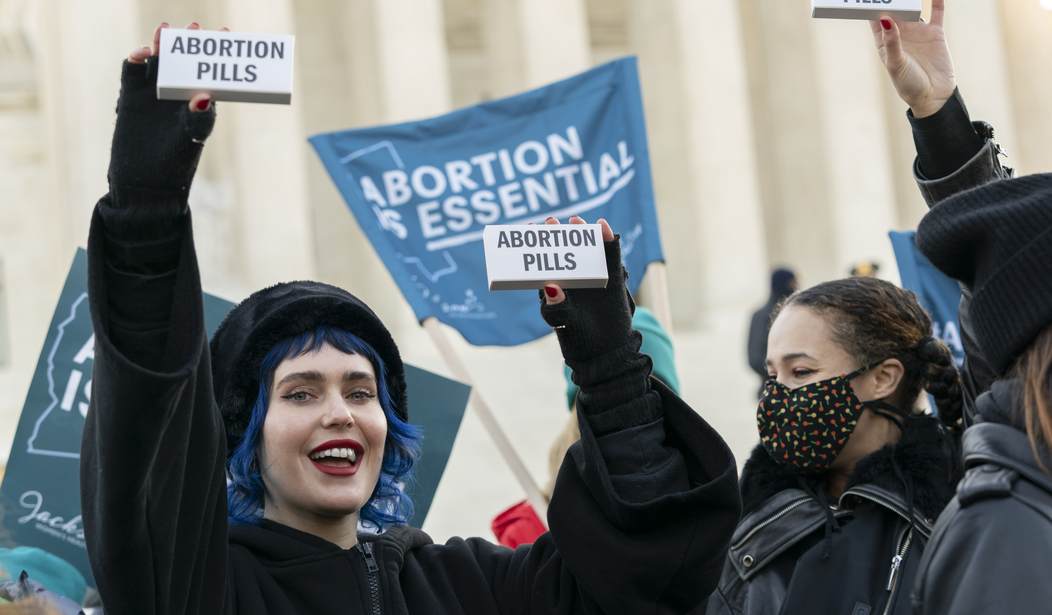
When Texas imposed strict limits on abortion last fall, the number of abortions performed by clinics in that state fell by half. But the actual decline in abortions was much smaller because many women traveled to clinics in other states or used readily available drugs to end their pregnancies at home.
Those workarounds, recent research suggests, drastically limited the law's impact. That finding underlines the daunting challenges that opponents of abortion will face even if the Supreme Court gives states wide leeway to restrict the practice, as it seems inclined to do.
The Texas law prohibits abortion after fetal cardiac activity can be detected, which typically happens about six weeks into a pregnancy. During the first month after the law took effect at the beginning of September, the Texas Policy Evaluation Project reported, Texas clinics performed 50% fewer abortions than they did during the same month in 2020.
At the same time, however, the number of Texas women seeking abortions in nearby states rose dramatically. The same research group counted 5,574 out-of-state abortions obtained by Texas residents from September through December, more than 10 times the number during the same period in 2019.
That's an average of about 1,400 out-of-state abortions per month, which represents nearly two-thirds of the drop in reported Texas abortions. And that cross-border tally is surely an undercount because it is limited to 34 clinics in seven states.
Meanwhile, Aid Access, which allows women to obtain mifepristone and misoprostol abortion pills from abroad based on prescriptions written by a doctor in Austria, saw a huge increase in requests from Texas. According to a Feb. 25 report in JAMA Network Open, the daily average rose to 138 in the first week of September, up from 11 in late 2020 and early 2021.
That number fell sharply after the first week but remained far above the baseline, averaging 37 for the rest of September and 30 in October, November and December. Overall, Aid Access received more than 4,500 requests from Texas between Sept. 1 and the end of the year, or about 1,100 a month.
It's not clear how many of the women who obtained abortion pills via Aid Access actually used them, and there may be some overlap with the women who ultimately obtained surgical abortions in other states. But Aid Access is by no means the only source of abortion pills, which can be obtained through various websites, purchased over the counter in Mexico or received in states that (unlike Texas) allow delivery by mail after an online consultation.
The Food and Drug Administration has approved the use of mifepristone and misoprostol up to 10 weeks into a pregnancy. The method has potentially broad appeal in the U.S., where four-fifths of abortions are performed at nine weeks or earlier.
Last December, the FDA permanently lifted a longstanding requirement that abortion pills be dispensed in person, opening the door to prescriptions via telemedicine and home delivery. That decision is apt to accelerate a preexisting trend: Based on preliminary data, the Guttmacher Institute reports that "medication abortions" accounted for 54% of the U.S. total in 2020, up from 39% in 2017.
The FDA still views abortion pills shipped from other countries as "misbranded and unapproved new drugs." In 2019, the agency sent Aid Access a warning letter to that effect. The organization was undeterred.
Even when drug-induced abortions have FDA approval, they may run afoul of state law. Texas, one of 19 states that restrict such abortions to medical facilities, recently acknowledged the failure of that rule by making it a felony to supply the requisite drugs for unsupervised use.
The fact that self-managed abortions are often illegal does not mean they can be stopped. Since the pills are legal in most jurisdictions, the challenge is even more formidable than the difficulties encountered by the war on drugs, which has a track record that no one should be keen to copy.



Join the Conversation
VIP members get the ability to comment on articles.