





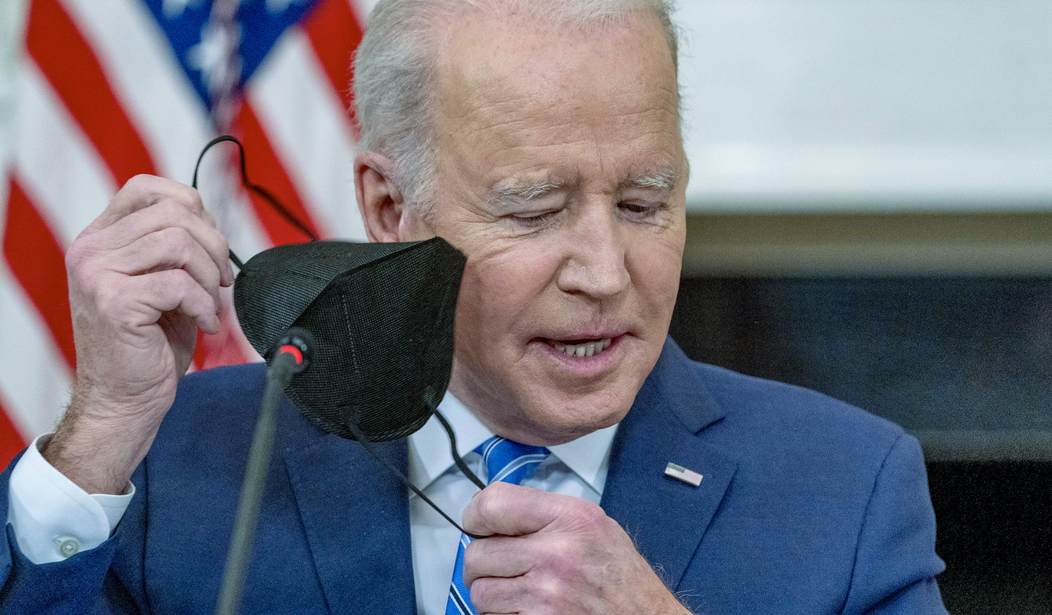
A recent NPR report quotes a Maryland mother who complains that you risk being tarred as "a psychotic, anti-vax right-winger" if you dare to question whether children should be forced to wear face masks in day care and K-12 schools. That attitude is based on the premise that rejecting mask requirements is tantamount to rejecting science.
The truth is closer to the opposite. Supporters of school mask mandates assume they are effective at reducing COVID-19 transmission, then desperately search for evidence to validate that conviction. That process bears little resemblance to science.
NPR says, "mask proponents ... point to the many studies associating mask mandates with lower COVID-19 rates in schools." But those studies are mostly imaginary.
The Centers for Disease Control and Prevention began recommending "universal masking" in schools a year ago. At that point, there was no solid empirical basis for the CDC's advice, and that is still true.
Most of the studies cited by the CDC did not even compare schools with mask mandates to schools without them. One exception was a study of Georgia elementary schools published last May, which found that masking of teachers was associated with a statistically significant reduction in COVID-19 transmission, but masking of students was not.
A subsequent study, reported last September, found that "counties without school mask requirements experienced larger increases in pediatric COVID-19 case rates after the start of school compared with counties that had school mask requirements." But that study did not take into account vaccination rates or other COVID-19 safeguards, both of which are potentially important confounding variables. Since "this was an ecologic study," the researchers noted, "causation cannot be inferred."
Another study published the same day found that COVID-19 outbreaks were more common in Arizona schools that did not require masks. Again, that study did not control for vaccination rates or other mitigation measures, and critics pointed out various other weaknesses.
"You can't learn anything about the effects of school mask mandates from this study," Arizona State public health economist Jonathan Ketcham told science writer David Zweig. Noah Haber, a Stanford postdoctoral fellow who had co-authored a systematic review of research on COVID-19 mitigation measures, described the study as "so unreliable that it probably should not have been entered into the public discourse."
CDC Director Rochelle Walensky nevertheless repeatedly cited the Arizona study as proof that her agency's advice was well-grounded, and her slippery response to the criticism was revealing. During a Fox News appearance in December, she said "study after study" has "demonstrated that our layered prevention strategies, including masks in schools, are able to keep our schools safely open."
While those studies show that schools with mask mandates can operate "safely," they do not show that mask mandates are necessary to achieve that goal. Data from Florida, Tennessee, North Dakota, Texas, the U.K. and Spain suggest they are not.
Laboratory studies provide compelling evidence that masks -- especially N95 respirators -- can reduce virus transmission, assuming they are used properly. A randomized trial in Bangladesh found that surgical masks reduced COVID-19 cases by 11%, but cloth masks -- the kind most commonly used in schools -- did not have a statistically significant effect.
Uncertainty about the real-world impact of masking is compounded when mandates apply to children as young as 2, as the CDC recommends -- a stance that is extreme by international standards. And the theoretical, unsubstantiated benefits of school mask mandates have to be weighed against the burdens they impose, which include interference with communication, learning and social interaction as well as daylong discomfort.
That calculus should take into account the vanishingly low COVID-19 fatality rate among children (about 0.002%, according to the CDC); vaccines and treatments that dramatically reduce the risk of severe symptoms; and the availability of high-quality masks that immunocompromised children and adults can use to protect themselves from infection. In this context, the CDC's continued insistence on "universal masking" looks less scientific every day.


Join the Conversation
VIP members get the ability to comment on articles.