





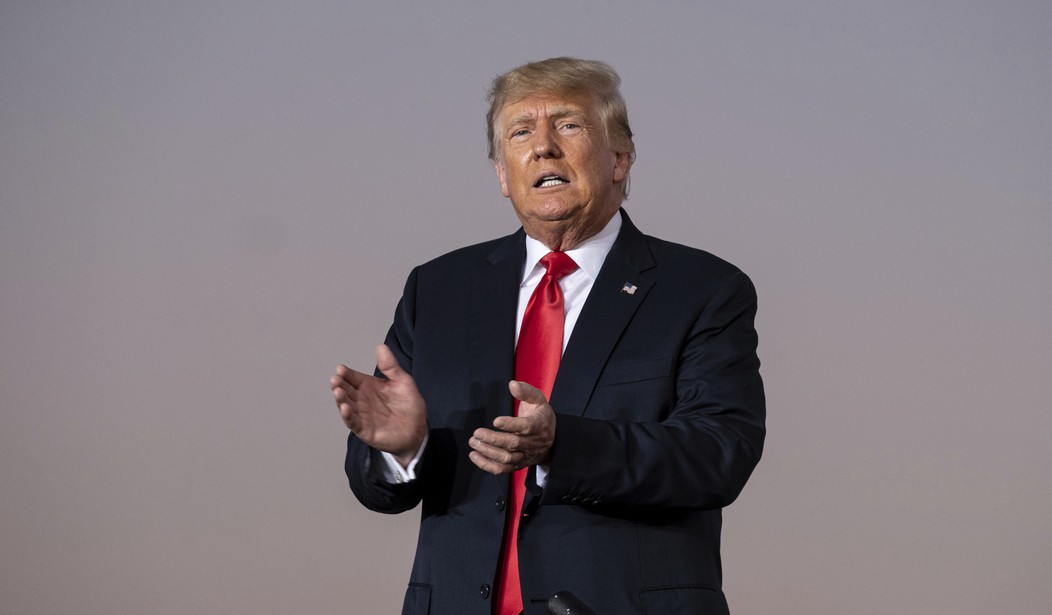
After Donald Trump's second impeachment trial ended in acquittal, Senate Minority Leader Mitch McConnell (R-Kentucky) suggested that the former president could still be held civilly or criminally liable for his role in the Capitol riot that happened a year ago last Thursday. But as three lawsuits that a federal judge considered this week show, those options require proving that Trump deliberately provoked the violence that day, which is a tall order.
The Trump supporters who broke into the Capitol, interrupting the congressional tally of the presidential election results, came to Washington, D.C., at his behest. They were motivated by Trump's fantasy of a stolen election, which he had been promoting for months and reiterated in a fiery pre-riot speech at a rally a mile and a half from the Capitol.
"I know that everyone here will soon be marching over to the Capitol building to peacefully and patriotically make your voices heard today," Trump said. While he did not advocate violence, it was foreseeable that at least some of his supporters would interpret his exhortation to "fight like hell" in defense of a supposedly imperiled democracy as a justification for the use of force.
Still, there is a big difference between reckless rhetoric, which is protected by the First Amendment, and the criminal conspiracy described in lawsuits filed by Rep. Eric Swalwell (D-California), other House Democrats and two Capitol Police officers. All three complaints allege that Trump violated the Ku Klux Klan Act of 1871 by conspiring to use threats, force and intimidation to stop government officials from carrying out their duties.
To prove that claim, the plaintiffs must do more than show that Trump ginned up his supporters' outrage with false election fraud claims, or even that he did so in circumstances where he should have known violence was likely. They have to show that the Capitol riot was the culmination of a plan to violently disrupt the ratification of Joe Biden's victory, a scheme in which Trump himself intentionally participated.
Capitol Police officers James Blassingame and Sidney Hemby also claim that Trump violated a provision of the D.C. Code that "makes it a criminal offense to willfully incite or urge other persons to engage in a riot." In addition to the requirement that the offense be committed "willfully," prosecution for incitement is constrained by the First Amendment.
Even advocacy of illegal behavior, the Supreme Court ruled in the 1969 case Brandenburg v. Ohio, is constitutionally protected unless it is not only "likely" to incite "imminent lawless action" but also "directed" at doing so. Another exception to the First Amendment, for "true threats," involves "statements where the speaker means to communicate a serious expression of an intent to commit an act of unlawful violence to a particular individual or group of individuals."
In a brief supporting Swalwell's lawsuit, three law professors, joined by legendary First Amendment attorney Floyd Abrams, say these exceptions "likely apply here." But whether that is so hinges on what we surmise Trump was thinking when he gave his speech.
Trump explicitly urged Mike Pence, for instance, to reject electoral votes for Biden, a power the vice president did not actually have. But Trump did not threaten Pence with "an act of unlawful violence," and inferring such a threat requires speculation about what Trump meant to communicate in light of what his supporters did afterward.
It is likewise not at all obvious that Trump wanted to cause a riot, an outcome that failed to accomplish his ostensible goal, led to his second impeachment and provoked harsh criticism from Republican legislators such as McConnell. If this was all part of a plan, it was a pretty stupid plan.
The urge to punish Trump for his reckless rhetoric is understandable but dangerous. If his opponents succeed, they may regret establishing a precedent that speakers who neither practice nor preach violence can be held legally liable for the conduct of listeners inspired by their words.
Join the Conversation
VIP members get the ability to comment on articles.