







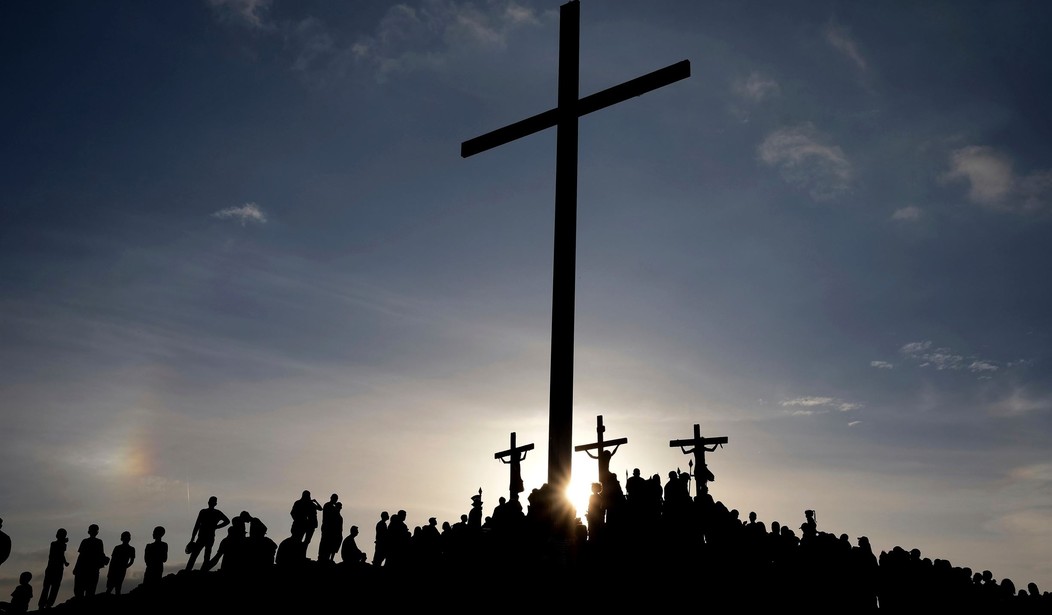
As Christians enter Holy Week, we are invited to reflect not only on the final days of Jesus’ earthly life, but also on a dramatic and unsettling shift in public perception.
On Palm Sunday, Jesus is welcomed into Jerusalem with cries of “Hosanna”—which means, “save us,” or “bring us salvation.”
Within days, though, the same crowd, or at least a crowd drawn from the same population, shouts “Crucify him!”
The speed of this reversal is striking. It raises a question that is as relevant now as it was then: How does public opinion change so quickly, and who has the power to change it?
A common answer points to influence—specifically, the influence of elites. In first-century Judea, that elite was represented by the religious authorities, the Sanhedrin, who possessed both institutional authority and social credibility. They interpreted the law, guided religious life, and, crucially, mediated between the Roman occupiers and the Jewish population.
In other words, they had the power to shape the narrative: to define what counted as truth, righteousness, and blasphemy.
But, it’s crucial to grasp, influence alone is not the whole story.
The events of Holy Week suggest something deeper and more unsettling: narratives are not sustained merely by persuasion. They are perpetuated by manipulation and, importantly, coercion. This coercion may be subtle or not, but it is not infrequently there. And it was certainly there during Holy Week.
The elites of Jesus’ day did not simply argue against him; they moved decisively to eliminate Him. And in doing so, they created an atmosphere in which dissent was not merely unpopular.
It was dangerous.
Crucifixion was designed not only to punish but to send a message. It said, unmistakably: this is what happens to those who challenge authority. The cross would eventually become the most powerful of religious symbols for Christians. Originally, though, it was a political one, a warning etched in flesh.
And the effect of such a warning extends beyond the immediate victim. Jesus’ closest disciples scatter. Peter, who had vowed unwavering loyalty, denies even knowing him. Why?
Fear.
This is not some abstract fear. It is embodied, visceral, embedded in and animating every thought, every movement. It is intense, as it is the fear that Peter too could be arrested, tried, and executed. The same threat that silences Peter would have been felt by countless others—sympathizers, curious onlookers, and quiet believers alike.
This is the crucial point: fear shapes perception.
When the cost of dissent becomes high enough, people begin to see the world differently—reason be damned. What once appeared admirable may now seem dangerous. What once seemed true may now seem safer to deny.
In this way, the narrative is not only told, but enforced.
And this dynamic is not confined to the ancient world. While we in the modern West often pride ourselves on being more enlightened, less prone to overt coercion, to succumbing to fear, the underlying mechanism remains recognizable. Elites today—whether political, cultural, or institutional—shape narratives. They define what is acceptable to say, what is beyond the pale, what is to be praised, and what is to be condemned.
This shaping of public perception does not always involve explicit threats of violence. Not infrequently, the coercion is more subtle: the risk of social ostracism, of reaping ruinous professional consequences, and of reputational damage drives those who are skeptical of the conventional wisdom to, at the very least, acquiesce to it. Yet make no mistakes, these pressures are species of the same primal emotion of fear that fueled Jesus’s disciples to turn upon Him.
Fear of exclusion, fear of loss, fear of becoming a target—fear is a powerful motivator to follow the prevailing orthodoxy.
As in Jesus’s time, people may begin by self-censoring, by choosing to refrain from expressing those of their beliefs that undercut the consensus. Over time, however, something more profound can occur: People may begin to doubt what they once held with confidence. They may even begin to acquire beliefs that they never would’ve adopted had it not been for the pressures to conform that had been brought upon them. The line between genuine conviction and adaptive conformity becomes blurred.
This does not mean that all modern narratives are false, nor that all authority is illegitimate. It does mean, however, that we should be attentive to the ways in which narratives are sustained—not only by reason and evidence, but also by the pressures, implicit or explicit, that surround them.
Holy Week, then, offers more than a story of betrayal and redemption. It offers a lens through which to examine the dynamics of power, perception, and fear. The crowd that cries “Crucify him” is not simply fickle; it is situated within a context shaped by authority and reinforced by the threat of consequences. Their voices of the crowds do not emerge in a vacuum; they echo within a system that has already determined what must be said.
For the Christian, this realization carries both a warning and a challenge. The warning is that it is all too easy to be swept up in a narrative that one has not critically examined, especially when dissent carries a cost. The challenge is to cultivate a form of courage that resists such pressures—a willingness to see clearly and to speak truthfully, even when doing so is uncomfortable or risky.
In the end, the events of Holy Week remind us that the struggle over truth is never purely intellectual. It is also moral and, at times, deeply personal. It involves not only what we think, but what we are willing to risk in order to think—and to say—it.
And that is as true today as it was in Jerusalem two thousand years ago.
Editor’s Note: Do you enjoy Townhall’s conservative reporting that takes on the radical Left and woke media? Support our work so that we can continue to bring you the truth.
Join Townhall VIP and use promo code FIGHT to receive 60% off your membership.

Join the Conversation
VIP members get the ability to comment on articles.