





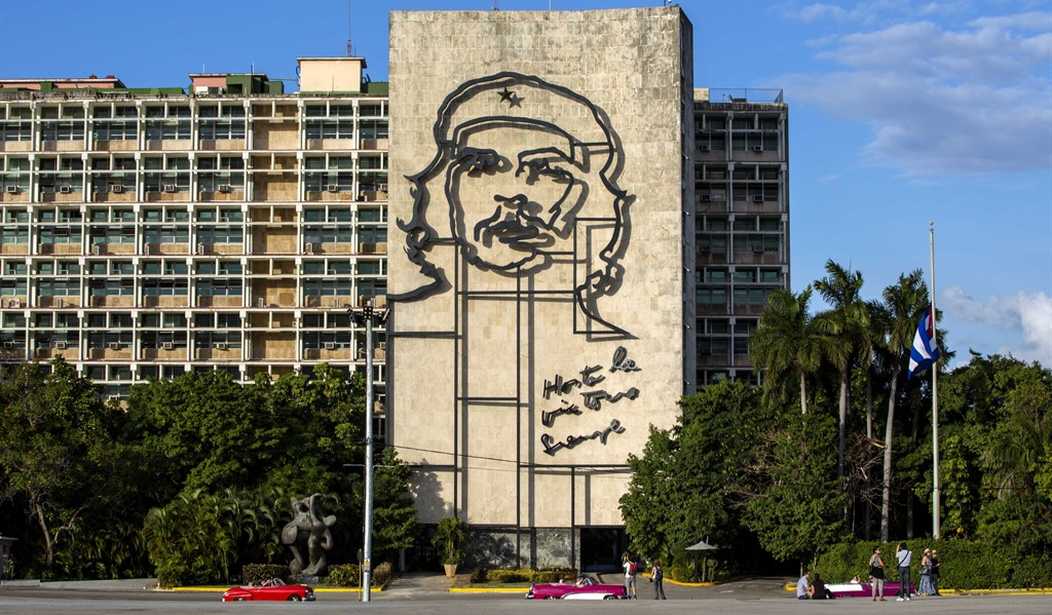
“Mexicans are mostly a rabble of illiterate indians,” (Che Guevara, 1955)
In the historic annals of unrequited love few cases rival the affair by Chicanos with Che Guevara. I trust Che’s iconization is sufficiently documented by U.S. Chicano groups in their murals (i.e. graffiti.) They seem to plaster this lily white Argentinian racist’s mug on practically everything they paint to celebrate their Amerindian Aztec culture. Go figure.
Perhaps a word with some Bolivian Amerindians who actually experienced Che Guevara’s plans to Stalinize their culture would help. In 1967 these (overwhelmingly indigenous) Bolivians (with help from U.S. Green Berets) made short work of this Chicano hero. If a picture’s worth a thousand words than this one’s worth a million. Please note the obvious ethnic compositions of the gentlemen proudly and triumphantly holding their guns over their vanquished European would-be enslaver.
At any rate, if any doubt remains about Che Guevara’s iconization by Chicanos I give you “The Last Supper of Chicano Heroes." This paining “ is a re-construction of da Vinci's painting "The Last Supper," replacing religious figures with Chicano activists. Artist José Antonio Burciaga polled Chicano students and activists to determine who would be depicted.”
You guessed it. Che Guevara sits at the head of the table.
You see, amigos: Prior to “invading” Cuba, Castro’s “guerrillas” “trained” in Mexico. Some of these former “guerrillas” later defected to the U.S. and revealed how the sneering Ernesto “Che” Guevara constantly insulted his Mexican hosts. Hence, the quote at the top of this article.
It was in 1955 that a Cuban criminal named Fidel Castro linked up with an Argentine hobo named Ernesto Guevara in Mexico City. Minus this historic hook-up everything points to Ernesto (shortly known a “Che”) continuing his life of a traveling hobo, panhandling, mooching off women, staying in flophouses and scribbling unreadable poetry.
Alas! Instead this thoroughly unimposing vagabond and psycho named Ernesto Guevara had the magnificent fortune of linking up with modern history's top press agent, Fidel Castro, who over half a century had the mainstream media anxiously scurrying to his every beck and call and eating out of his hand like trained pigeons. His brother’s not doing too bad at this either.
Fidel and Raul were in Mexico putting together a guerrilla band to invade Cuba and overthrow the black Cuban head-of-state Fulgencio Batista. With the financial help of his wealthy lily-white Cuban backers of the time, Castro hired a Cuban Korean war veteran named Miguel Sanchez to train his guerrilla band. None of the trainees had the slightest combat-experience so their extra-curricular curiosity on the matter did not surprise Sanchez.
But one of the trainees struck Sanchez as a bit strange, especially the gleam in his eye regarding the act of killing. “How many men have you killed?” this trainee constantly asked Sanchez. “What does it feel like to kill a man?”
“Look Ernesto (he was not yet known by his moniker “Che,”)” Sanchez would reply. “It was a war. I was in combat. It wasn’t a personal thing. Most soldiers don’t make it a personal thing. You aim at an enemy uniform and pull the trigger. That’s it.”
“But did you ever come upon a wounded enemy and kill him with the coup de grace?” A wide-eyed Ernesto Guevara would continue. “What did it feel like? I want to know what it feels like.”
“It became obvious to me that the man who would shortly become known as “Che” wanted to kill for the sake of the act itself,” recalled Sanchez later from exile in Miami, “instead of-- as in the case of most others, and this includes Fidel and Raul Castro themselves—as a means to an end. That end for Castro, of course, was absolute power,” Sanchez quickly recognized. “His power lust fueled his killing, and it didn’t seem to affect him one way or the other. With Ernesto Guevara, however, it struck me as a different motivation, a different lust.”
“On Sundays in Mexico I would often dine with Guevara and his Peruvian wife, a great cook,” recalls Sanchez. “Ernesto was a voracious reader and loved poetry. I’ll never forget his favorite poem “despair” by Jose de Espronceda.
“I love a sullen-eyed gravedigger crushing skulls with his shovel!
I would love to light the flames of a holocaust which spreads devouring flames that pile up dead and roast an old man until he crackles
What pleasure! What Pleasure!”
“Ernesto Guevara would close his eyes dreamily and recite it from memory during all of my visits, even at the dinner table, recalled Sanchez.
“He went into convulsions for a while and was finally still,” gloats Che Guevara in his Cuban diaries. He was lovingly describing the death agonies of a bound Cuban peasant he had just shot in the temple with his pistol. “Now his belongings were mine.” (Unwittingly here Che Guevara defines Communism in a nutshell: cowardly murder and theft.)
Another item Sanchez recalls about Ernesto Guevara was his constant belittling of his hosts: Mexicans. “These Mexicans are nothing but a rabble of illiterate Indians,” Che Guevara often snickered.


Join the Conversation
VIP members get the ability to comment on articles.