





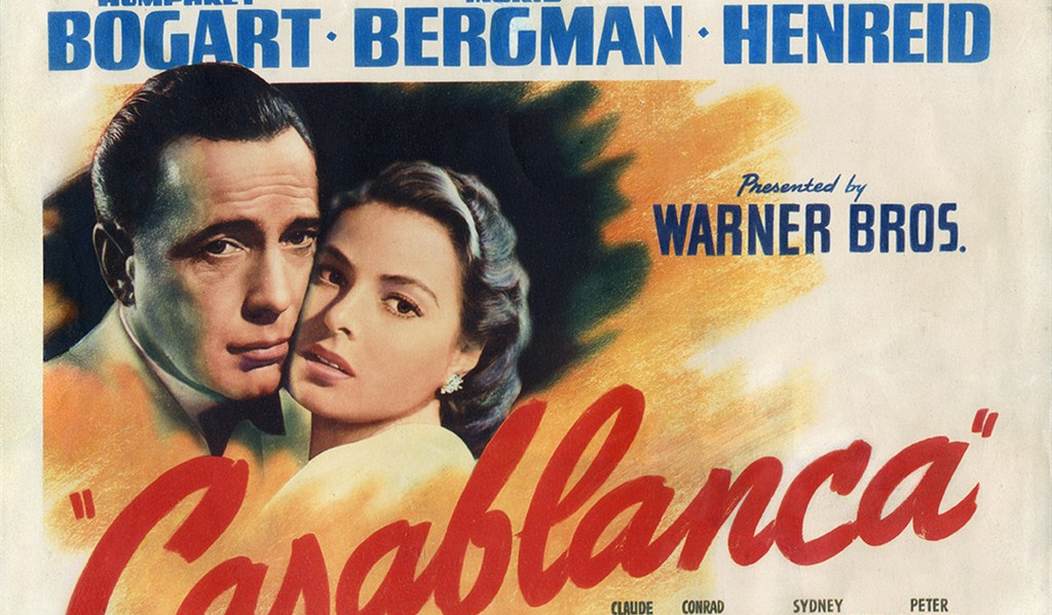
“Here’s looking at you, kid.” “Round up the usual suspects.” “I think this is the beginning of a beautiful friendship.” These lines, of course, come from “Casablanca,” which premiered 75 years ago this month and whose denouement contains a crucial moral for our narcissistic age.
Let’s recall how the film ends. The year is 1941. Rick Blaine (Humphrey Bogart) has rekindled his love for Ilsa Laszlo (Ingrid Bergman), whom he first met in Paris when her husband had been thought dead. A year later, Rick now holds in his possession two priceless “letters of transit” that can be used to leave Casablanca. He plots with Ilsa to give one to her husband – a leader in the anti-Nazi resistance movement who desperately needs to return to Europe. With her husband out of the way, the two will be able to live happily ever after in romantic bliss.
But Rick doesn’t follow the plan. At the last moment, he gives the second transit letter to Ilsa and insists she leave Casablanca with her husband. “I’m no good at being noble,” he tells her, “but it doesn’t take much to see that the problems of three little people don’t amount to a hill of beans in this crazy world.”
Don’t amount to a hill of beans? In 2017, romantic love is not just a hill of beans but practically Mount Everest. It is the rock and savior of modern man. “I stand alone without beliefs\The only truth I know is you,” Paul Simon sang in 1966 in reference to his girlfriend. God no longer stands at the center of man’s universe. Love does. “There but for the grace of you” – i.e., his girlfriend – “go I,” Simon proclaims at the conclusion of that song.
“Casablanca” portrays Rick as loving Ilsa more than life itself. What would a post-modernist have him do? Deny his feelings? Suppress his love? Yet Rick does precisely that. He believes his love is irrelevant considering the stakes. Ilsa’s husband needs her. “You’re part of his work, the thing that keeps him going,” he tells her. And defeating the Nazis, Rick knows, rates higher than his personal happiness.
Unfortunately, today, we in the West virtually worship the self. We aim to boost our own self-esteem rather than win the esteem of God or our fellow man. Feeling good has become more important than acting right. As conservative hero Judge Janice Rogers Brown has said, “To be or not to be is no longer the question. The question is: How do you feel?”
In a New York Times op-ed last year, Professor Molly Worthen noted that her college students no longer even say “I think” or “I believe” when making arguments in the classroom. "I feel like” is their expression of choice. “Impulses, whims, feelings – or “my truth” – now reign supreme.
And so, for example, if a married man today wishes to declare himself homosexual, it matters little if announcing this fact will lead to the breakup of his family. He will do it anyway in order to be “true to himself.” Sacrificing for a higher good is now to “live a lie.” Former New Jersey Governor Jim McGreevey followed this precise logic when he “came out” a decade ago and left his wife and two daughters stranded. Former Senator John Edwards apparently did the same when he committed adultery while his wife was dying of cancer. As his lover later unapologetically explained, “[T]he force field of our love overrode any issues that would arise from my belief systems.” In other words, objective morality took a backseat to carnal desire.
This indulgence of the self leads nowhere good. As Goethe observed, “All eras in a state of decline and dissolution are subjective; on the other hand, all progressive eras have an objective tendency.” A nation cannot long endure when “every man [does] what is right in his own eyes.” When truth and virtue become subject to “what works for me,” societal decline cannot but follow.
Americans tend to take their future prosperity for granted, believing that the United States will reign as the world’s greatest power for many decades to come. But superpowers have fallen before. And not necessarily because of war. Internal rot has just as often been the culprit. Should we not worry?
On this 75th anniversary of “Casablanca,” let us emulate Rick Blaine. Let us once again commit ourselves to the pursuit of honor and virtue. Let us aim to oblige, not ourselves, but the right and the good – no matter the cost.
Elliot Resnick is an editor and writer at The Jewish Press and the author, most recently, of “Movers & Shakers, Vol. 2.”



Join the Conversation
VIP members get the ability to comment on articles.