





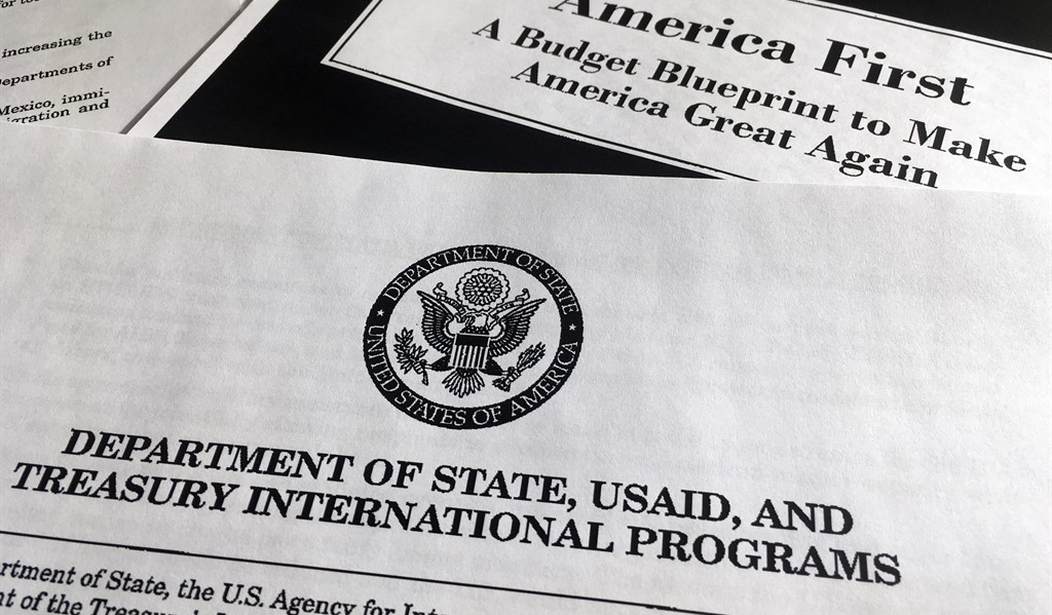
WASHINGTON -- President Donald Trump presented a radically different budget blueprint to Congress on Thursday. The new plan would increase defense spending by $54 billion and fund the increase with targeted cuts in other discretionary spending.
What makes the $1.1 trillion budget truly unique, Office of Management and Budget Director Mick Mulvaney told reporters before the rollout, is that "we wrote it using the president's own words. We went through his speeches, we went through articles that have been written about his policies, we talked to him, and we wanted to know what his policies were, and we turned those policies into numbers."
Mulvaney called the blueprint an "America First" spending plan, a "hard-power budget" that moves spending from soft-power programs like foreign aid and into building up the military itself. Trump's plan would cut the budgets for the Department of State and the U.S. Agency for International Development by 28 percent. While critics are alarmed, the blueprint has a saving grace, according to Mulvaney: "The president ran saying he would spend less money overseas and more money back home."
Critics are appalled. "By increasing military spending by $54 billion while cutting spending on civilian diplomacy and assistance, the Trump administration is militarizing foreign aid," charged Adam Isacson, senior associate for defense oversight at the Washington Office on Latin America.
As rumors of the pending foreign aid cuts spread last month, more than 120 retired generals and admirals sent a letter to Congress in which they quoted Trump's Defense Secretary James Mattis, who said when he was commander of the U.S. Central Command, "If you don't fully fund the State Department, then I need to buy more ammunition."
Trump also campaigned on a plan to have Mexico pay for a wall at the U.S. border. But Mulvaney said the proposed budget includes $1.5 billion for the border wall this year.
Over the years, conservatives have proposed cutting federal funding for a number of pursuits they consider left-leaning. Rather than talking about cutting these expenses gradually, Trump proposes to eliminate completely funding for the Corporation for Public Broadcasting, the Legal Services Corporation, the National Endowment for the Arts, the National Endowment for the Humanities and the United States Institute for Peace.
In answer to a press question, Mulvaney expounded, "the policy is that we're ending federal involvement with the Corporation for Public Broadcasting."
A reporter asked, "Over a period of years?"
"Well, this year," Mulvaney answered.
Mulvaney has clearly stated that this preliminary or "skinny budget" won't reduce the deficit -- but it won't increase deficit spending either. To make a dent in the national debt, Trump would have to cut entitlement spending.
"Unfortunately, the budget does not include any proposals on mandatory spending or revenue and does not include any proposals or projections beyond 2018," the Committee for a Responsible Federal Budget opined. "In this sense, this budget ignores the 70 percent of spending that is responsible for 90 percent of spending growth over the next decade and tells us nothing about how the Administration will address the nation's unsustainably rising national debt."
The blueprint next goes to Congress. While Republicans control both the House and the Senate, history shows that for all their fiscal conservative talk, Republicans often are loath to actually cut the cord of federal spending.
"While nearly every Republican claims to be a fiscal conservative, many of them defend subsidy programs important to their states or personal interests," observed Chris Edwards, editor of the Cato Institute's DownsizingGovernment.org, who tossed out rural business subsidies as an example. "As Trump's proposed cuts are considered on Capitol Hill, it will become more clear to Republican voters which members are real fiscal conservatives and which are defenders of big government subsidies."
Washington simply isn't used to administrations proposing huge cuts that seem likely to end in what one journalist described as the largest proposed reduction in the federal workforce since World War II. That same reporter asked Mulvaney if the White House had considered the "impact on property values." (The question showed that, in a sense, every Beltway homeowner has an interest in keeping the government big.) Clearly Mulvaney had heard the real estate question before. His answer was direct and provoked laughter in the briefing room. "I work for the president of the United States," Mulvaney answered. "The president of the United States, he represents the District of Columbia, Northern Virginia, and Southern Maryland, but he also represents the rest of the country. And I can assure you that we did not write this budget with an eye toward what it would do to the value of your condo."
COPYRIGHT 2017 CREATORS.COM

Join the Conversation
VIP members get the ability to comment on articles.