





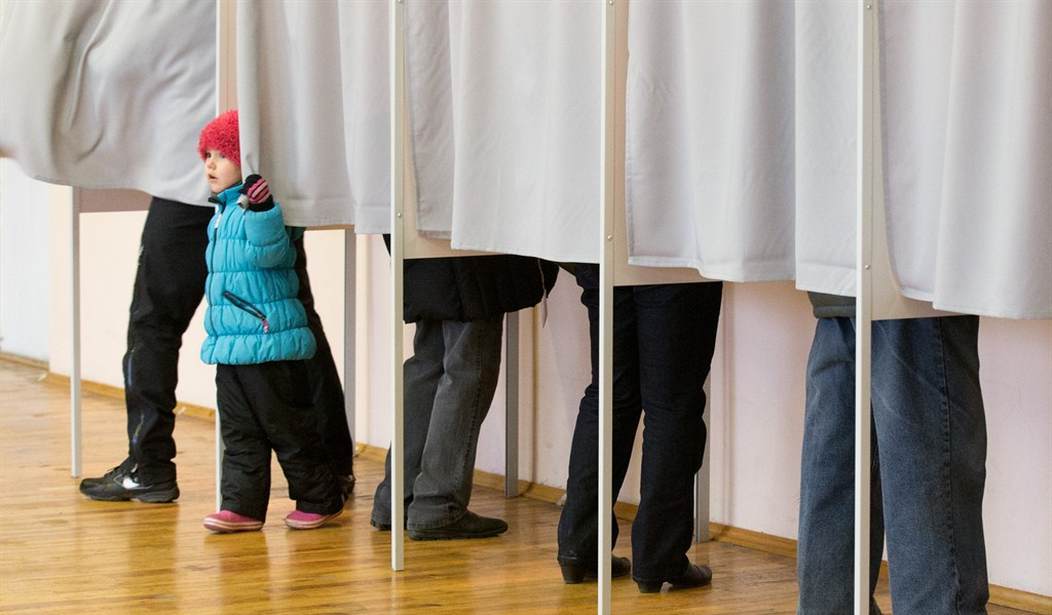
In March, President Barack Obama teased the notion of making voting mandatory. "It would be transformative if everybody voted," he said during a Cleveland event. "That would counteract money more than anything." Spokesman Josh Earnest walked back the idea the next day, after whetting the appetites of liberal activists. Too often, partisans talk about tinkering with our system to improve voter turnout without fixing why the electorate isn't showing up.
Voter turnout in 2014 was the lowest it has been since World War II. Not coincidentally, the midterm elections, with lower participation, shifted control of the Senate to the GOP. Thus, Democrats have looked at all manner of gimmicks to increase voter participation. Los Angeles is considering a lottery for voters. San Francisco supervisors are entertaining a measure to lower the voting age to 16 in some municipal elections.
I have my own suggestion for improving voter turnout: Knowledge is power. If American schools did a better job teaching about history and government, students most likely would grow up to be more engaged adults. Alas, the latest testing by the National Assessment of Educational Progress -- aka NAEP or The Nation's Report Card -- found that just 18 percent of eighth-graders scored "proficient" or better in history; 23 percent scored proficient or above in civics. In short, close to 4 in 5 middle schoolers don't know much about history, while 3 in 4 don't know much about their government.
The good news is that those scores didn't drop since NAEP tested those subjects in 2010. The bad news is that NAEP only tested eighth-graders this go-round. In 2010, NAEP also tested fourth-graders and high-school seniors; only 12 percent of seniors scored proficient or better in history. Roger Beckett, executive director of the Ashbrook Center at Ashland University in Ohio, sees the decision not to test all three grades as a bad sign. The new education fad is STEM -- science, technology, engineering and math -- which means, Beckett noted, "we don't talk about the crisis in history and civic amnesia."
In a country that Beckett argues teaches to the test, having fewer tests means getting less instruction. "If we don't have this educated citizenry that knows something about this country and how government works," quoth Beckett, "it's going to affect the decisions they make at the polls -- or (whether) they think it's important enough to show up."
Beckett is particularly concerned about the low number of students who scored as "advanced" -- 1 percent in history, 2 percent in civics. By comparison, 9 percent of eighth-graders scored as advanced in math in 2013.
Consider what students did not know. Asked how the three branches of government can limit the powers of the other two, 17 percent of students gave acceptable or complete answers. Some 13 percent didn't even try to answer. Asked which belief is shared by most Americans, more than half of eighth-graders answered that most Americans believe the government should guarantee everyone a job. Only 32 percent answered, "The government should be a democracy."
If young people don't understand that the White House doesn't operate by fiat or that the courts and Congress have a role in determining national policy -- including immigration policy -- they may feel let down by the system when it actually is working as designed. Kids today wouldn't buy a cellphone without knowing how it works, yet their schools graduate young people into the world without a grounded understanding of how their own democratic institutions operate best.
The very fact that Los Angeles is thinking of dangling a cash prize to entice citizens to vote says it all. Let's just toss out the tenet that citizens have responsibilities by throwing them treats. Democracy is an experiment in self-government. Self-government works best when people know as much about how to wield that power as they do about their cellphones.
Join the Conversation
VIP members get the ability to comment on articles.