





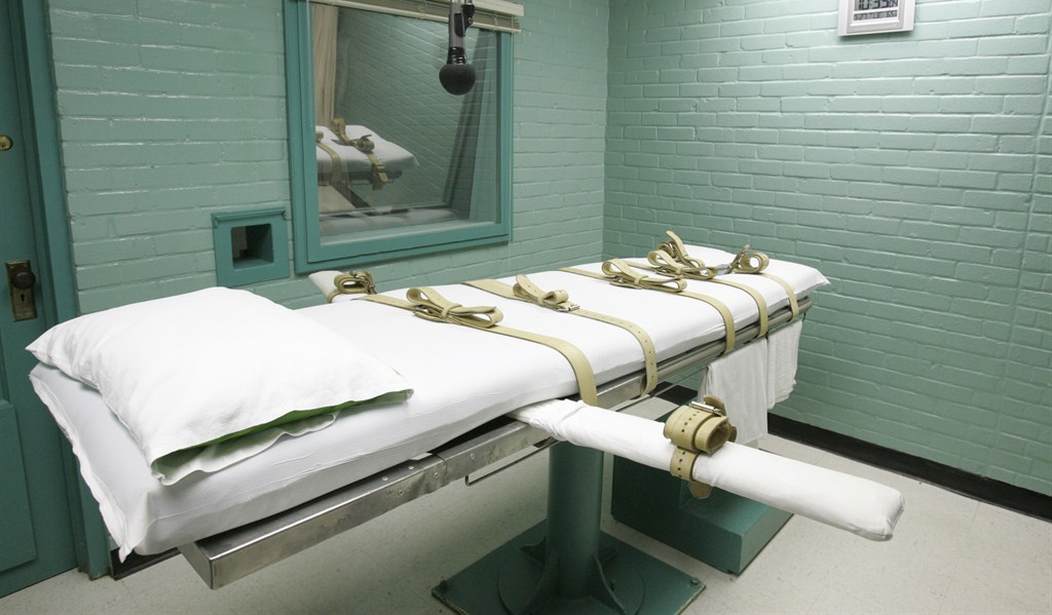
News reports this week were filled with lamentations from death penalty opponents about the messy and unnecessarily painful execution of Oklahoma's Clayton Lockett. As Andrew Cohen wrote in The Atlantic, Oklahoma corrections officials "were using an untested mix of lethal drugs, never previously used in that dosage combination, obtained through secret means, which precluded the possibility of oversight from attorneys or medical officials on the quality of the drugs. They were warned by medical experts, and asked by defense attorneys, to open up the process to review -- by the courts, by doctors, by some members of the public. Yet they refused."
Missing from that report -- and most others -- was the reason states are using new drug mixes obtained through unconventional means: Since the U.S. Supreme Court upheld Kentucky's three-drug lethal injection protocol as constitutional in 2008, death penalty opponents have used every trick in the book to make the drugs disappear.
Of course, before the big bench's 7-2 ruling, lawyers for death row inmates had argued that the three-drug protocol violated convicts' constitutional protection against "cruel and unusual punishment." The remote possibility -- a 0.001 percent chance -- that an inmate might suffer unduly prompted federal Judge Jeremy Fogel to halt California's three-drug executions in 2006; despite the Supreme Court ruling, there hasn't been one since.
After the big bench affirmed the three-drug protocol, activists went after suppliers. The European Union threatened to ban the export of sodium thiopental to the United States. European producers stopped making it. U.S. manufacturer Hospira also stopped making the drug.
That's when states started experimenting and scrounging for "untested" drugs.
When an investigation of Lockett's gruesome end is complete, it may find that the drug cocktail had little to do with Lockett's unintended pain. The problem could have been intravenous needles that were damaged or poorly inserted.
Kent Scheidegger of the pro-death-penalty Criminal Justice Legal Foundation blogged Wednesday that because lethal injection requires the involvement of medical professionals, it "was a mistake from the beginning. We should have kept the gas chamber and merely used a different gas. Carbon monoxide, for example, is painless." He's right.
I should note that Lockett had it easier than Stephanie Neiman, the innocent 19-year-old victim whom he and his friends beat and bound with duct tape in 1999. Lockett shot her twice before he ordered an accomplice to bury her alive in a shallow grave.
White House spokesman Jay Carney called the Oklahoma execution inhuman. He did not mention the Obama administration's role in pressuring states to surrender drugs found to be constitutional by the U.S. Supreme Court. In 2011, the Obama Department of Justice actually seized Georgia's supply of sodium thiopental because the drug, among other problems, did not have FDA approval. Really.
"If the White House is upset," Scheidegger wondered, "why don't they do something about the supply problem? Everyone knows that pentobarbital, the single-drug method, works just fine." Maybe President Obama should sign an executive order.



Join the Conversation
VIP members get the ability to comment on articles.