





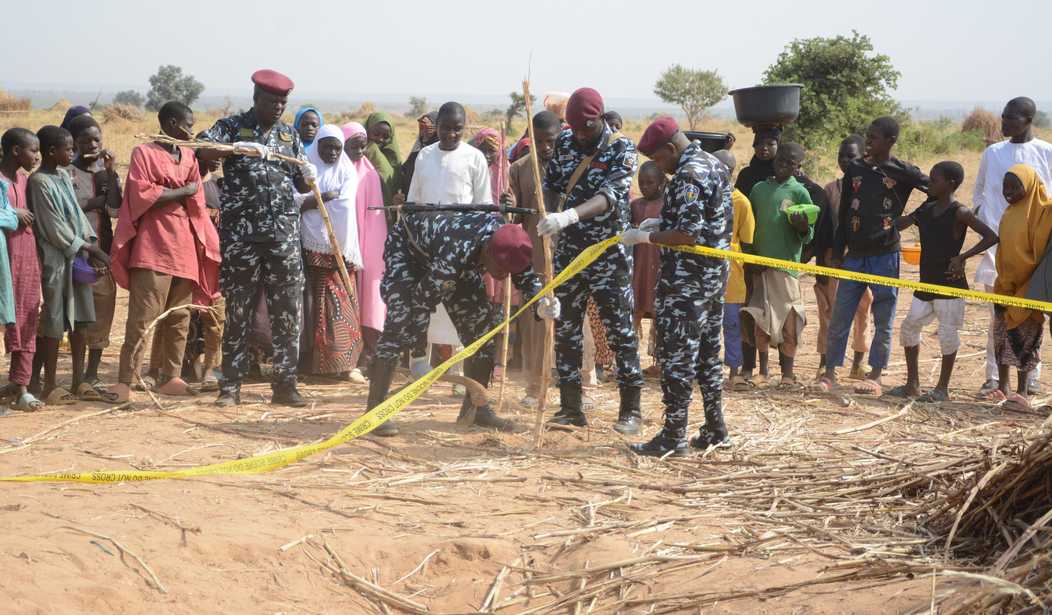
The conditions in Northern Nigeria have deteriorated significantly over the past six months. Attacks have increased dramatically—it feels as though massacres have become a daily occurrence. I recently spoke at a burial for eight people who were killed in a single night. The very next day, another 30 people were murdered in a separate attack. A few days later, 20 more lost their lives. It has become almost impossible to keep up with the scale and frequency of the violence.
Boko Haram and other terrorist groups have grown bolder in both their rhetoric and their actions. A few weeks ago, Boko Haram released a video declaring their intent to drive Christians out of the northern region by force. Another video warned that all Christians must “convert to Islam or be killed.” Attacks by radicalized Fulani groups have also escalated, leaving Christian communities paralyzed by fear.
147 Christians were slaughtered during Holy Week—34 on Easter Sunday alone—making it one of the deadliest Holy Weeks on record here in Northern Nigeria. This has precipitated the need for a new and important ministry for us at Across Nigeria as we are now serving over 547 widows whose husbands were killed in recent attacks—and the numbers and need are growing rapidly.
We have worked in Northern Nigeria for more than a decade, and I have never seen conditions this severe.
One thing that has become increasingly clear to me is that the situation is not improving. In fact, it has grown significantly worse. With now more than 70,000 killed since 2009, it’s time to put an end to the genocide of Christians in Northern Nigeria.
The genocide taking place here has been ignored for well over a decade. That is why, when President Trump spoke out about it, I was encouraged. He was the first president to speak out on the issue, which had been largely overlooked by both the Obama and Biden administrations. Not only did the president speak up about the issue, but he put his words into action.
On Christmas Day, President Trump ordered airstrikes in the northwest to target a new and rapidly growing terrorist group known as Lakurawa. Finally, there was a president willing to intervene. I was not the only one encouraged—much of the Christian community in Northern Nigeria felt the same way. For the first time, many believed their cries were being heard and that the United States was standing with them.
As encouraged as I was, concern weighed heavily in the back of my mind. I hoped this would not be another case of the U.S. launching airstrikes, then ultimately abandoning the situation. Unfortunately, there is a history of this pattern. We saw it in Libya in 2011 and again in Afghanistan in 2021, to name a few recent examples. My concern with the Christmas Day strikes was—and has always been—that the U.S. would strike and then withdraw, leaving an inevitable vacuum that would make the situation even worse.
Apart from a small company of U.S. troops working counter-terrorism and utilizing some drones, that is exactly what has happened.
Now, the consequences of these actions are becoming a grim reality. The initial action, followed by a lack of sustained engagement, has had a devastating effect. Instead of backing down, radicalized terrorist groups have been emboldened and have intensified their attacks.
We have also seen a shift in the posture of the Nigerian Army and security forces. With the United States appearing disengaged, there is a growing perception that Nigerian Army forces are choosing sides. Whether by order—implicit or explicit—or the need for survival, one speculates, but cannot clearly tell.
One consistent account I hear when visiting communities that have suffered attacks is that security forces almost always arrive only after the violence has already occurred. A Boko Haram informant recently told me that they drive back and forth in front of security forces and Army outposts without ever being stopped or hindered. He said the only time security forces respond to their presence is when they are directly engaged. Otherwise, in his words, “we have free rein.”
I’m not a warmonger. In fact, I have strong isolationist leanings. But after watching an increasing cycle of violence over the past decade, it’s clear that something has to be done.
The United States is the only country in the world with the capacity to carry out an effective intervention and help bring an end to this genocide. In fact, we are morally obligated to do so. But it will take more than airstrikes. It will take more than social posts. It will take fortitude, determination, and a solid plan.
What’s needed is a comprehensive strategy—one that combines targeted military action with efforts to stabilize conditions on the ground and provide sustained humanitarian support. It will also require leadership that is committed to seeing the mission through to the end. They can’t be distracted by the next flashy story. Past mistakes have shown us that short-term interventions rarely work—and often make conditions worse for those left behind.
Nigeria has sat in darkness for too long and Christians here are desperate for an end to their suffering. It is time for the government of the United States—and the media—to answer their cries. Otherwise, we are looking at another record year of Christians killed, with no end in sight. How can we justify our silence?
Editor’s Note: Do you enjoy Townhall’s conservative reporting that takes on the radical Left and woke media? Support our work so that we can continue to bring you the truth.
Join Townhall VIP and use promo code FIGHT to receive 60% off your membership.

Join the Conversation
VIP members get the ability to comment on articles.