





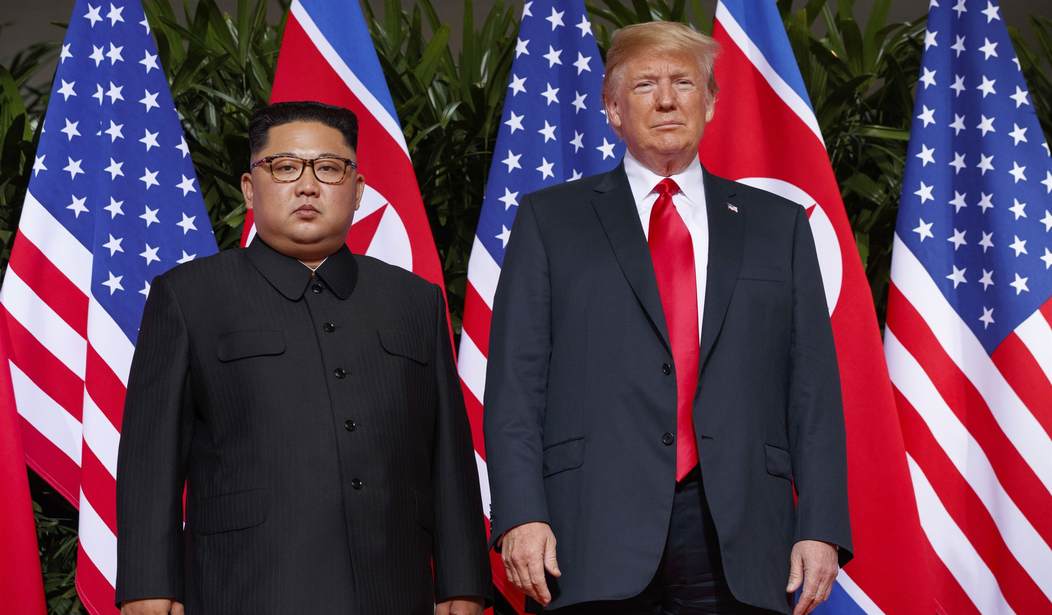
In 2018, a small but palpable change in Korean War diplomacy occurred, one that may yet produce something other than nuclear conflagration in east Asia: rotund North Korean dictator Kim Jong Un kept his word.
In April 2018, Kim made a promise just before he met with South Korean President Moon Jae-in. He said his regime would refrain from testing ICBMs and nuclear devices.
So far, his regime has kept that promise.
Given the Kim regime's depravity, vicious cruelty and documented lying, the halt in missile and nuclear weapons test is encouraging.
However, in less than a week (Feb. 27-28) Kim meets U.S. President Donald Trump in Hanoi, Vietnam. At the June 2018 Singapore summit, Kim told Trump that he would denuclearize his regime. That has not occurred.
Depending on your source, Pyongyang has done nothing -- or very little -- to denuclearize or has prepared to implement a couple of technically positive actions but slow rolled the process, hoping to exchange a cache of nuclear devices for relaxation in U.S. and U.N. economic sanctions.
No one is astonished that North Korea's criminal regime still has nuclear weapons. In many respects, nukes and ICBMs are Kim's only bargaining chips.
Many, however, are warily amazed that the diplomatic process continues.
On Feb. 19, Trump told Washington reporters he believes North Korea will ultimately denuclearize. However, his administration is not operating on a definitive timeline to achieve it.
That's a reasonable approach given North Korea's strangling economy and the immense military power Washington, Seoul and Tokyo wield. Thanks to cellphones, the North Korean people now know their South Korean kin eat well, own cars and take vacations to India and Hawaii. That's a reason for Kim to continue to negotiate.
Sanctions on North Korea remain in place and if anything over the last eight months enforcement has improved. The naval embargo has tightened and the number of ships carrying illicit cargoes identified and intercepted by the U.S. and its allies has increased.
Recall that Trump requires CVID: complete, verifiable, irreversible denuclearization. That requirement has not changed. Trump's intent is clear. Kim's intentions are more opaque.
In 2017 and 2018, I devoted several columns to the Trump administration's multidimensional coercive diplomatic effort in Korea. A chronicle of the operation appears in my latest book, "Cocktails from Hell" and draws on those columns. The book section concludes with this post-Singapore comment: "Elements of a serviceable CVID deal have emerged. North Korean domestic media have mentioned the possibility -- but the deal has yet to be made."
Verification of North Korean CVID is a huge issue. Will Pyongyang tolerate it? It seems South Korea and North Korea are indirectly addressing this issue. In December 2018, South Korean railroad experts inspected North Korea's railroads. For more than two weeks, a South Korean train crept over some 2,000 kilometers of northern track, gathering granular data on North Korean rail infrastructure and verifying its miserable condition.
This looks like coordinated planning for diplomatic success -- so kudos to Seoul and Washington.
The U.S. encourages inter-Korean "peace building" efforts like rail inspection and family visits. They are small steps but concrete and they set a positive diplomatic tone. Call that the inter-Korean diplomatic track.
The diplomatic effort may still breakdown, which is why the U.S. and its allies must prepare for failure as well. I've seen dozen or so open-source Korean diplomacy "failure scenarios" and I've sketched a couple of my own. Not a single scenario ignores the fact the U.S., Japan and South Korea possess overwhelming military superiority.
The Hanoi summit may produce nothing more than superficial goodwill. Two years ago, that would have been an achievement. But the time is approaching for North Korea to move from symbolic gestures to concrete, verified action.

Join the Conversation
VIP members get the ability to comment on articles.