





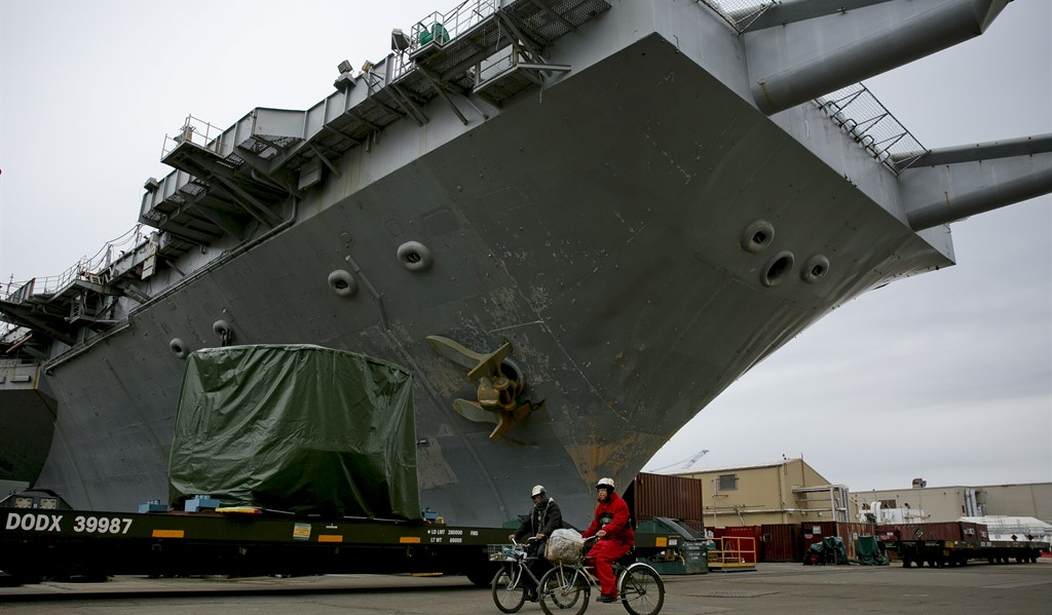
The U.S. Navy may be on the verge of a light aircraft carrier renaissance. New technology spurs the revival, both new smart weapons in the arsenals of potential military adversaries and new American weapons systems, the USMC F-35B strike fighter being the most pertinent example.
The issue is complex, so the back-story here is particularly relevant. In World War II, the U.S. Navy made extensive use of small aircraft carriers, ranging from very small carriers escorting convoys (CVEs) to light aircraft carriers (CVLs) that were essentially downsized models of the iconic big carriers (CVs).
CVLs could handle post-WWII jets. However, the Navy concluded super carriers made more sense strategically and economically. Nuclear-powered super carriers (CVNs) could carry a wing of multi-mission, high-performance combat aircraft and pack an array of defensive weapons. They could remain at sea for months.
Two CVN battle groups, operating as a pair, was a lethal Cold War-era combination. So that's where the U.S. Navy put its money.
Light carriers of a certain type never quite went away, or at least ships that looked like light carriers. Several classes of Navy amphibious assault ships sport aircraft carrier decks. Some of these assault ships are huge. However, they lack catapults for launching fixed-wing jets. They carry helicopters, U.S. Marine Harrier AV-8B jump jets, V-22 tilt-rotor aircraft and a usually a battalion task force of Marines. They also carry amphibious vehicles.
U.S. Marine Corps Harriers are Vertical/Short Take-Off and Landing (V/STOL) strike aircraft that don't require a catapult launch. They are light bombers whose primary mission is close air support for Marines ashore. USN amphibious assault ships rely on CVN-based air wings for fleet air defense
In the 1982 Falklands War, the British used their Royal Navy Sea Harriers to intercept Argentinian fighters attacking the British fleet. They did so because they had no choice. They didn't have a CV with supersonic jets.
It's now 2017. Enter the F-35B Lightning II. The controversial but versatile F-35B is the U.S. Marines variant of the Joint Strike Fighter. Like the Harrier, which it replaces, it is V/STOL.
Unlike the Harrier, the F-35B is supersonic and stealthy. A dozen F-35Bs give an assault ship a small but credible multi-mission aircraft squadron, capable of intercepting enemy aircraft and enemy cruise missiles and conducting strike missions.
Is this a 21st century CVL? Not quite. Assault ships are built to conduct and support amphibious attacks -- to assault a beach. They aren't built to support sustained aircraft carrier operations. Typically, assault ships carry only six Harriers. Permanently add more F-35Bs and you must reduce space for other equipment, like helicopters and V-22s. Assault ships also tend to be slower than other blue water surface warships.
Potential adversaries have spent decades developing new, long-range, smart weapons that are "carrier killers." China has been in the forefront of long-range anti-carrier missile development. China has deployed the DF-21D anti-ship ballistic missile (ASBM). The DF-21D is clearly designed to target and sink Navy CVNs. There are many ways to counter it. However, US Navy officers are already worried that relying on one or two CVNs to lead an operation approaching East Asia puts "too many eggs in one or two baskets."
This is one reason building a few 21st century CVLs make sense. It's a way of hedging against the loss of a CVN by putting some eggs in a few more baskets. There are others. The Navy is experimenting with new ways to "disperse" ships in a battle group, in order to make long-range targeting of individual ships more difficult. Two or three CVLs, each with two-dozen or so F-35Bs, dispersed through a CVN-led battle group would increase fleet survivability. Arming the CVLs with squadrons of armed drones would present an enemy with a lethal challenge.
Can the Navy build three or four CVLs for the price of one CVN? Maybe, maybe not. It's a question yet to be answered.



Join the Conversation
VIP members get the ability to comment on articles.