





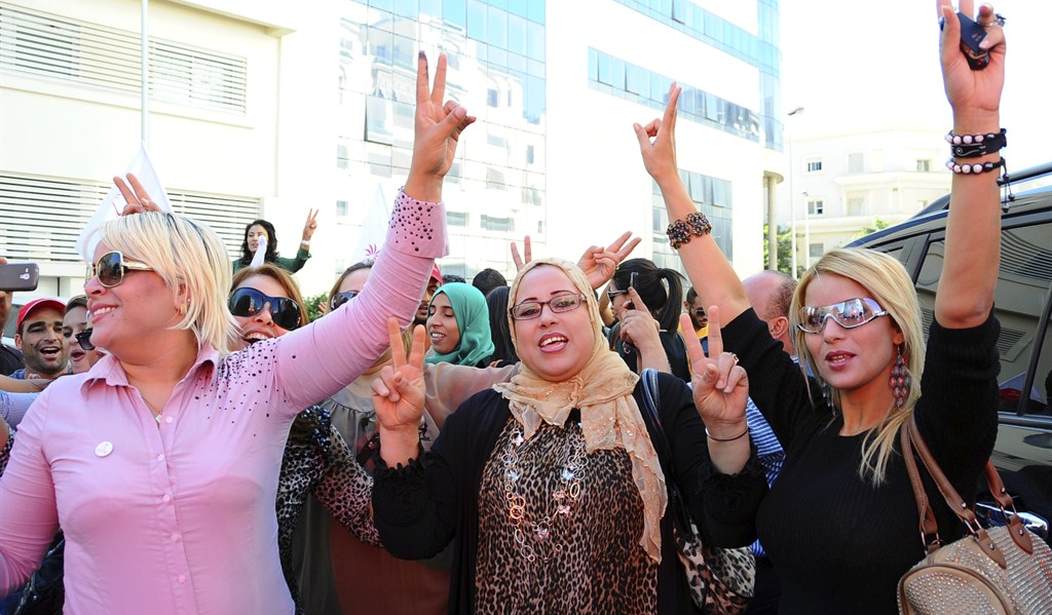
Tunisia continues to demonstrate that Arab Spring 2011's revolts can indeed seed democratic change.
On Oct. 26, Tunisia's secularist party, Tunisian Call (Nidaa Tounes), won a parliamentary plurality. By winning at least 35 percent of parliament's seats, Tunisian Call now has the opportunity to form a new coalition government. The Islamist Ennahda Party, which leads Tunisia's current coalition government, won 25 percent. That represents a marked decline from the last national election when Ennahda won around 40 percent.
Ennahda's political Islamist leaders have conceded defeat and promised to support the new Tunisian Call-led government. They then offered to participate in a "unity" government. Given Libya's anarchy, Syria's hell and Egypt's Bonopartist fragility, Ennahda's democratic concession is encouraging news.
Though the leaders of Tunisian Call insist that Ennahda will have no governing role in the new government, arithmetic argues otherwise. Tunisian Call's leaders know forging a coalition government with minor parties is a difficult proposition. Ennahda's awkward coalition with two small left-wing parties was an ineffective arrangement and contributed to a general perception of government ineptitude. Ennahda's coalition never provided a coherent program for addressing the problem that triggered Tunisia's revolt: its stagnant economy.
Tunisian Call has an economic program. The party calls itself "modernist" and favors trade and free enterprise-led economic growth (liberal economics in the classic sense). However, during the election Tunisian Call focused on security issues. Over the past two years terrorist cells, some of them tied to Islamist terrorist groups in Libya (e.g., Ansar al-Sharia), have conducted numerous attacks in Tunisia.
Tunisian Call accused Ennahda of being soft on Islamist terrorism, and tied that accusation to public distrust of long-term political Islamist reliability. The July 2013, assassination of Mohamed Brahmi galvanized Ennahda's political opponents, and in October 2013 prompted the Islamists to agree to new elections. Tunisian Call also noted reports that 3,000 Tunisian Islamist extremists may be fighting in Syria. Stay-at-home terrorists provided the electorate with something of an October Surprise headline underlining their threat. Two days before the election, police and special forces raided a terrorist hideout near the city of Tunis and killed six.
In the tit for tat of campaign accusations, Ennahda politicians suggested Tunisian Call is a front for former dictator Zine el-Abidine Ben Ali's detested regime. The Paris-educated Beji Caid el-Sebsi, Tunisian Call's leading figure, served as a government minister, but he also served as prime minister in the Arab Spring interim government, which ceded power to Ennahda after its historic 2011 election victory.
The 2011 interim government was a "unity" government, so Sebsi knows how to work with a coalition. Given his party's electoral victory, the 89-year-old Sebsi is now regarded as the front-runner in Tunisia's upcoming presidential election.
To forward his nation's promising experiment in democracy, Sebsi must tell his secularists and Ennahda's moderates that solving economic problems and protecting national security requires cooperation, not mere political "co-habitation."
Cynics claim that Ennahda's leaders watched the Egyptian Army topple Mohamed Morsi's Muslim Brotherhood regime and realized that if they attempted to create a hardline Islamist regime, they could suffer the same fate. Ennahda party members dispute this claim. They say that from the beginning, they have demonstrated a commitment to respecting the results of democratic elections. Tunisia is different from other Arab Spring countries, and, according to Ennahda, Tunisian Islamists are different.
How does it differ? Tunisia is an Arab state, they say, but one with a definitive "Mediterranean" orientation. Until the Romans beggared Carthage at the end of the First Punic War (Treaty of Lutatius, 241 BC), Carthage thrived and ruled a wealthy, trade-based empire. Today Carthage is an upscale suburb of Tunis. Tunisia economic modernizers are prepared to deal with Egyptian and Libyan political realities, but their economic models lie on the Mediterranean Sea's European littoral. Ennahda's leaders appear to have learned that lesson.


Join the Conversation
VIP members get the ability to comment on articles.