





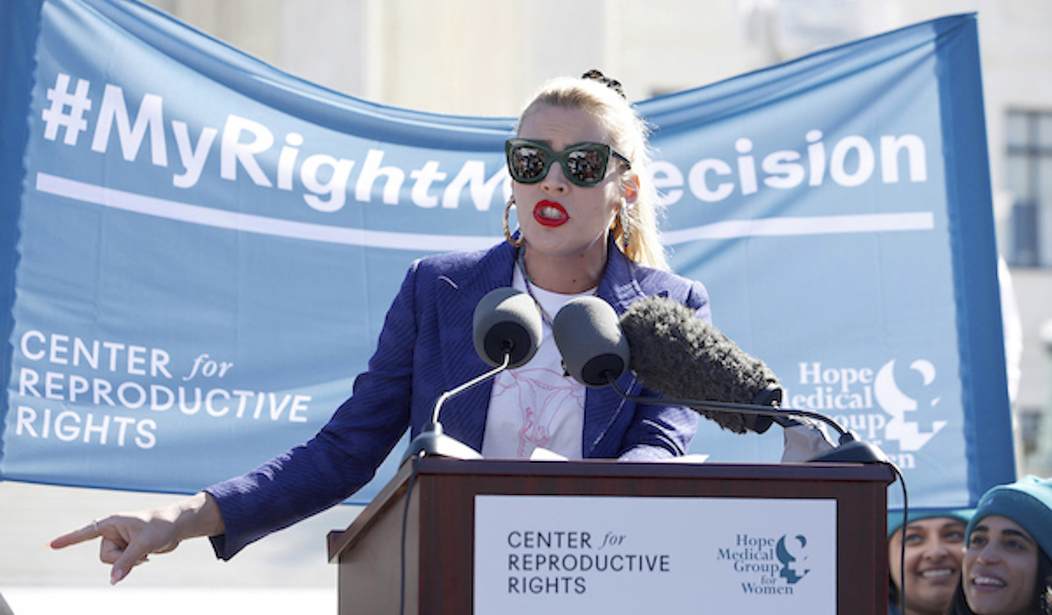
March is Women’s History Month. Last week, just in time for International Women’s Day on March 8th, I flipped on the news and was greeted by a very angry blonde shouting, “I will never stop talking about my abortion!”
My first thought—well, after “is that Anna Nicole Smith?” before I reminded myself she’s been dead for many years—was, “It doesn’t look like anyone’s stopping her, but okay.” Indeed, actress Busy Phillips, who has probably gained more fame in the last week for her abortion rant than any of her film roles, was greeted with cheers from the friendly crowd. As the demonstrators waved Planned Parenthood signs in support, Phillips proceeded to brag about how awesome her life is—all because of an abortion she had at age 15.
“Here I was sitting in Los Angeles in my beautiful office of my own late-night talk show. Soon, I would be driving my hybrid car to my beautiful f-----g home, to kiss my two beautiful and healthy children and my husband who had taken the year off to parent so I could focus on my career,” Phillips raved. "And I have all of this, all of it, because I was allowed bodily autonomy at 15!”
For all her boasting about her material goodies, Phillips doesn’t sound as if she loves her life. She sounded extremely angry and bitter—hateful, really. In any event, her comments struck me as tone-deaf and self-absorbed: as a dedicated pro-choice activist, she must know the statistics showing that a disproportionate number of women who terminate their pregnancies live in poverty, before and after the abortion. Many cite financial stress and domestic abuse as motivating factors for getting an abortion; they’re often more concerned about keeping the electricity on this month than making payments on a “hybrid car.” Regardless, Phillips vowed that she will "never stop talking about my abortion or my periods or my experiences in childbirth, my episiotomies, my yeast infections, or my ovulation that lines up with the moon!"
Uh, great? How exactly does an actress oversharing about her “yeast infections” advance women’s progress?
Is this what feminism has to offer in the way of role models in 2020?
I’m the mother of an 8-year-old girl. In order to celebrate Women’s History Month with my daughter, I had to look not to the present but to the past. Last weekend, as Black History Month gave way to Women’s History Month, I read her a biography of Harriet Tubman from a collection of children’s stories.
For me, the past is full of feminist heroines. I just published a novel about my feminist-minded, Irish immigrant great-great-grandmother, who was one of the first female saloon owners in the city of Cleveland. One of my favorite stories from women’s history is the trial of Hester Vaughan. Vaughan was a young immigrant woman who was abandoned by her bigamist husband upon reaching the States. She took a job as a domestic servant, where she became pregnant by her wealthy employer—who terminated her upon discovering the pregnancy. Vaughan was forced to give birth alone in an unheated room, where she was discovered with her dead newborn several days later. In a highly sensational trial, Vaughan was convicted of murder by an all-male jury. Despite Vaughan’s insistence that the child had died accidentally, the judge declared that "some women must be made an example of." She was sentenced to death by hanging.
But then the feminists got involved! The Revolution, a feminist newspaper launched by Elizabeth Cady Stanton and Susan B. Anthony, slammed the verdict, declaring Vaughan a victim of poverty and desperation, as well as her predatory employer.
“[Vaughan is a] poor, ignorant, friendless and forlorn girl,” an editorial in The Revolution said. "If that poor child of sorrow is hung, it will be deliberate, downright murder. Her death will be a far more horrible infanticide than was the killing of her child." The Working Women’s Association, a feminist advocacy group founded by the editors of The Revolution, took up Vaughan’s case and demanded a new trial. Elizabeth Cady Stanton maintained that as long as only men could serve on juries, trials for women like Hester Vaughan could never be fair. Susan B. Anthony said Vaughan was "condemned on insufficient evidence and with inadequate defense."
Due entirely to lobbying by these intrepid feminists, the governor of Pennsylvania commuted Vaughan’s sentence, allowing her to go free. But women like Elizabeth Cady Stanton and Susan B. Anthony didn’t take up Vaughan’s case only because they were feminists—although they were, and quite radical ones at that. But their feminism was informed by something missing from the modern feminist movement: a deep devotion to God. Elizabeth Cady Stanton was raised as a devout Christian, and although she later criticized religious institutions for their unequal treatment of women, she never abandoned faith in God. At the same time she was involved in the suffragist and abolitionist movement, Stanton gave birth to seven children. There’s no doubt Stanton’s religious underpinnings influenced her to fight for women like Vaughan—women no one else cared about, and whom a Philadelphia judge would gladly sacrifice to “make an example” for society.
Compare Stanton to Busy Phillips, boasting about her “hybrid car and beautiful f---ing home.” Does Busy Phillips think or talk about anyone besides Busy Phillips? If a case like Hester Vaughan’s appeared in modern America, would she even notice? Or is she too busy yakking about her “ovulation that lines up with the moon”?
Moreover, when mothers 100 years in a future search for feminist role models, will they pull up videos of a very angry Busy Phillips, shouting about how she’s rich and famous all because she had an abortion?
Join the Conversation
VIP members get the ability to comment on articles.