





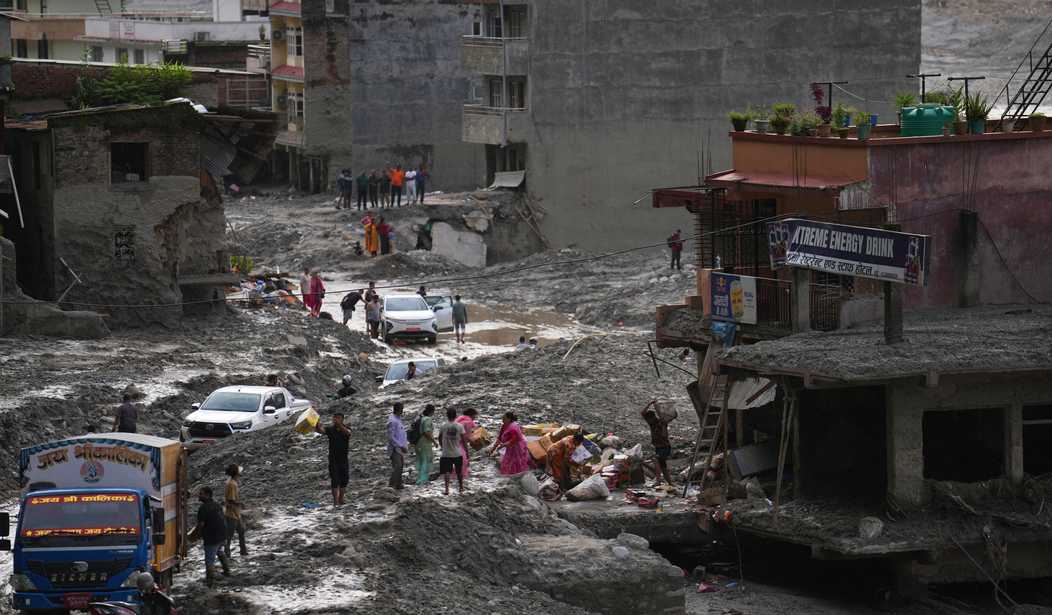
The horrific glacier collapse and flash flood in Nepal shocked the world. Millions of tons of rock, ice, mud, and water thundered down a Himalayan valley, wiping out roads, bridges, hydropower facilities, and entire communities. Hundreds are dead or missing. The destruction is almost beyond comprehension.
Before rescue operations were fully underway, however, major news organizations rushed to declare climate change the culprit.
The New York Times was among the first to blame climate change; others included the Associated Press and NPR. While acknowledging that scientists were still investigating the exact cause of the catastrophe, the Times nevertheless framed the event as another consequence of global warming, aka climate change. That conclusion is premature and false.
Good journalism follows the evidence. This time, the evidence had barely begun to arrive before the conclusions were determined.
Initial scientific investigations indicate that the disaster began when an enormous section of bedrock beneath a glacier collapsed, destabilizing the overlying ice and triggering a massive rock-ice avalanche. The resulting torrent of debris, water, and pulverized rock surged through the valley below. That description points first to geology.
The Himalayas are among the youngest and most tectonically active mountain ranges on Earth. Landslides, rockfalls, avalanches, and glacier collapses have occurred there throughout recorded history, long before industrialization and long before anyone worried about greenhouse gases.
The Times acknowledges that glacier failures have occurred dozens of times along the China-Nepal border since 1900.
But Times readers were presented with a climate narrative before investigators had even completed their work. Ironically, buried deep in the article is the statement that should have defined the entire story.
"I don't think we can simply say this is as a result of climate change," Newcastle University geomorphologist Stuart Dunning told the newspaper. He added that the disaster likely involved "a whole variety of factors."
That is exactly right. That sentence belongs in the headline, not halfway through the article.
The broader analysis by Roger Pielke Jr., Ph.D., points toward a much more practical explanation for why the disaster became so devastating. The natural event was only part of the tragedy.
Roads, bridges, hydropower projects, and settlements had been constructed directly within a valley vulnerable to debris flows and flash floods. When millions of tons of rock and ice came crashing down the mountain, that infrastructure magnified the human toll.
In other words, people dramatically increased their exposure to a well-known natural hazard. That is a lesson we can act upon.
Better geological monitoring, improved hazard mapping, more effective early warning systems, and avoiding construction in known debris-flow corridors would reduce future losses regardless of what happens to the climate. Those are practical solutions. Simply blaming climate change for the disaster as a knee-jerk reaction is not.
The Times also reports that scientists initially suspected a glacial lake outburst flood before satellite observations showed that no overflowing glacial lake was involved. That detail illustrates an important point.
Early explanations after disasters often prove incomplete or even wrong as more evidence becomes available. That is precisely why responsible scientists investigate first and draw conclusions later. Unfortunately, present-day climate journalism increasingly reverses that process. The conclusion comes first, followed by questions and a search for supporting evidence. Recently, we’ve seen this “publish first, ask questions later” pattern:
Every wildfire becomes evidence of climate change.
Every hurricane becomes evidence of climate change.
Every flood becomes evidence of climate change.
Now a mountain glacier collapse is rapidly folded into the same narrative, even while scientists openly acknowledge that they are still trying to determine what happened. That approach does a disservice to both science and the public.
Science advances by testing competing explanations against evidence. It does not begin with a preferred conclusion and work backward; journalism should operate the same way.
None of this is to deny that climate influences glaciers or that warming temperatures may affect mountain environments over long periods. Those are legitimate scientific questions worthy of careful investigation. But this specific disaster demands something more rigorous than speculation; it demands evidence.
The people of Nepal deserve answers rooted in geology, engineering, hydrology, and careful forensic investigation, not another round of climate messaging before the facts are known. Natural disasters have enough tragedy without journalists rushing to turn them into political symbols.
The New York Times and other major outlets had an opportunity to remind readers that science is a process, not an ideology. Instead, they chose to frame an unfolding geological disaster through the familiar lens of climate change while relegating scientific uncertainty to the fine print.
The rush to explain every catastrophe through climate change may produce compelling headlines, but it rarely produces better science or understanding of it. When the evidence is still emerging, the most honest answer is also the simplest: we do not yet know.
That is not a weakness; it is how science is supposed to work.
Anthony Watts (awatts@heartland.org) is a senior fellow for environment and climate at The Heartland Institute. He also operates the most viewed website in the world on climate, the award-winning website wattsupwiththat.com.
Editor’s Note: Do you enjoy Townhall’s conservative reporting that takes on the radical Left and woke media? Support our work so that we can continue to bring you the truth.
Join Townhall VIP and use promo code FIGHT to receive 60% off your membership.


Join the Conversation
VIP members get the ability to comment on articles.