





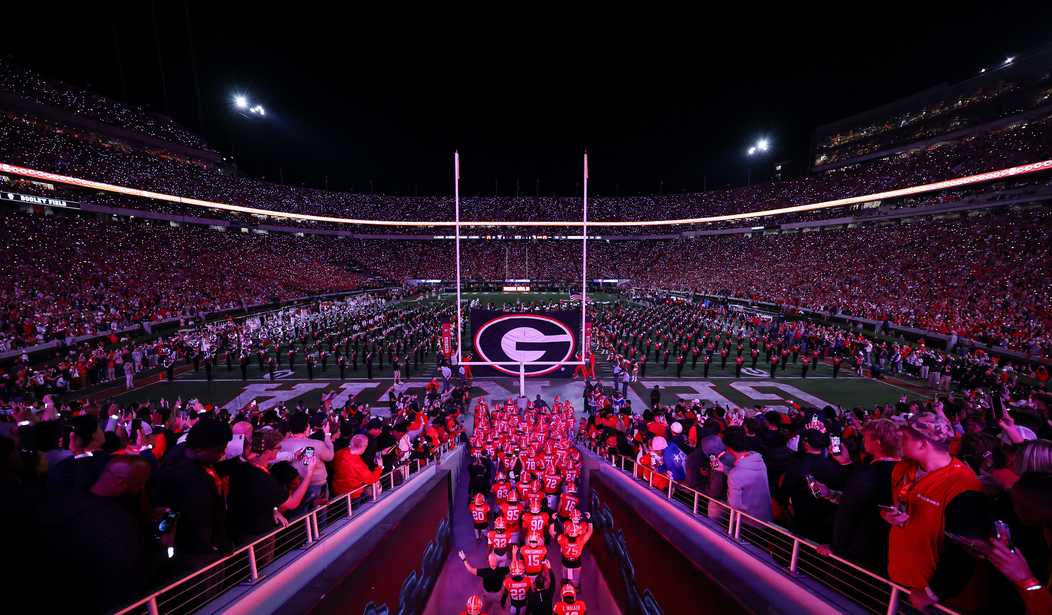
Imagine you’re selected to play for the Georgia Bulldogs football team at the University of Georgia.
You’re an incoming freshman with some serious talent. You’re from Mableton or some other suburb of Atlanta. Your parents are middle-class Black Americans, thrilled, as any parent would be, to see their son fulfill his college sports dream. You’ve put in countless hours: early mornings running drills, late evenings studying game strategy, and weekends sacrificed so you could earn a shot at making the team.
And then you make it.
You show up to your first game ready to prove your worth, ready to thwart the other team, and you walk onto that sacred field—only to look up in dismay and confusion, because where in any other year there would be thousands of deliriously excited fans, shouting encouragement, painted in red, black, and white, carrying energy from the stands to the field, you look up and see silence. Vacant seats. No band. No roar. Just a quiet breeze where game day should have been.
Who can you thank?
The National Association for the Advancement of Colored People (NAACP), which has called for a boycott of all Southern collegiate sports over recent changes in voting law. The organization claiming to fight for the rights of minorities just ruined your year—and with that, your prospects of advancing into the professional league.
This is not the first time activists have used sports as pawns in a political fight. In 2021, the radical Left declared Georgia's new voter ID law "Jim Crow 2.0" and pressured Major League Baseball (MLB) to yank the All-Star Game out of Atlanta. The next year, Georgia saw record voter turnout across every demographic, including Black Georgians. The voter suppression they warned about never materialized, because it was never real.
Now, some of the same voices are recycling the same false talking points about Louisiana v. Callais. Yet, nobody's voting rights or representation are being taken away, despite their claims. They are the boy who cried wolf.
The Supreme Court's recent decision in Louisiana v. Callais did more than settle a redistricting dispute. It forced a long-overdue reckoning with one of the most consequential constitutional questions of our time: Can race continue to serve as a lawful proxy for political identity? The Court said no, and it was right to do so. The ruling reaffirmed a foundational principle: every American must be treated equally under the law, and the government cannot divide its citizens by race.
Black Americans do not all think the same or vote the same. Skin color is not a political affiliation. The civil rights movement fought to affirm the individuality and dignity of every Black American, to guarantee that they would be judged and counted as full citizens, not sorted into categories of political convenience.
That is why the NAACP’s call to boycott is so misguided. When activists target athletic programs, the people hurt most are not politicians or judges. They are players, coaches, stadium workers, concession employees, security staff, small businesses, and local communities.
College athletes need playing time to get noticed, to build a case for the pros. A boycott that hollows out a season hurts the young men and women counting on that exposure. Does the NAACP want fewer Black athletes getting noticed by scouts? Does it want concession workers and stadium staff out of a job? Because that is precisely what a sustained boycott delivers: loss of livelihood, fewer opportunities, losses all around.
Sports shouldn't be a political battlefield. American athletes live in the greatest country on Earth, and every eligible citizen who wants to vote can do so. But weaponizing athletes’ hopes and dreams does not uplift the Black community. It exploits it.
The Court got Callais right. Treating race as a stand-in for political belief isn't protection. Black Americans deserve to be seen as individuals: voters with varied views, athletes with singular talents, and citizens with the full complexity that every human being possesses.
The NAACP’s effort to use young athletes’ futures as a bargaining chip for its political agenda must be called out and denied—full stop. That young Black quarterback or tight end who walks out onto the field for his first game deserves to hear the wild cheers of thousands of his fellow students and fans, applauding his dedication and skill, urging him to play the very best he can, for the love of the game and for the best prospects in his future.
He deserves nothing less.
Anna Pingel is the Policy Campaign Director and Senior Policy Analyst for Secure Elections at the America First Policy Institute, and a visiting fellow with the Center for Safety and Security at Independent Women.
Editor's Note: Do you enjoy Townhall's conservative reporting that takes on the radical Left and woke media? Support our work so that we can continue to bring you the truth.
Join Townhall VIP and use promo code FIGHT to receive 60% off your membership.


Join the Conversation
VIP members get the ability to comment on articles.