





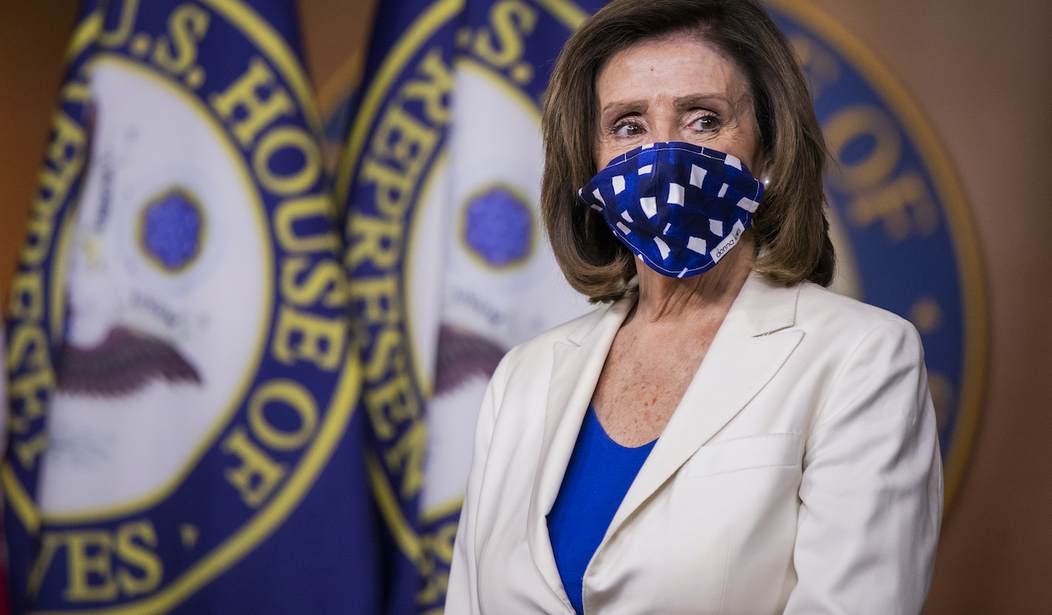
Congress is digging in for another battle over the proper government response to high unemployment and the shuttering of the economy in response to the coronavirus pandemic. Multiple bills have passed to provide more testing, protective gear and financial aid and the House of Representatives has started the next legislative phase, the HEROES Act, as a $3 trillion follow up to the CARES Act. Speaker of the House Nancy Pelosi (D-CA) has loaded up this bill with unrelated matter and partisan priorities.
President Donald J. Trump has signed into law several measures to respond to the crisis. The largest of those bills is the $2 trillion CARES Act, which included provisions that had zero to do with the coronavirus response effort. According to Rachel Bovard, of the Conservative Partnership Institute, the bill included $10 billion in aid to the U.S. Postal Service, $48 million in sex education funding, $25 million for salaries and expenses of Congress, and $25 million to the John F. Kennedy Center for the Performing Arts – a favorite of Members of Congress who frequent events there. That bill passed with unanimous support in the Senate and was voice voted in the House, because members feared opposing a bill that provided stimulus checks to Americans and attempted to aid small businesses shut down by government mandate. Now comes the sequel to that massive piece of legislation and this new version has proven to be a partisan legislative effort even more loaded with pet projects unrelated to the coronavirus’ economic impact on Americans.
The HEROES Act included a second $25 billion bailout of the U.S. Postal Service, in addition to provisions to forgive up to $10,000 of student loans for every borrower. The Heritage Foundation studied the bill and found that a provision to extend unemployment benefits to the end of the year will incentivize people not working. They also found that lifting the state and local tax deduction would be a Blue State tax cut that promotes higher state and local taxation and the $1 trillion promised to bailout states and localities will go to cover shortfalls that have nothing to do with state responses to the coronavirus. Those are big ticket items but expect more provisions to come to light when the American people have time to study the legislation.
There is likely to be an effort to revive a terrible idea that hikes cost on consumers called the “Durbin Amendment.” My group, the Center for Freedom and Prosperity, signed a coalition letter that states “we are concerned by the push by lobbyists for restaurants and other retailers to expand Dodd-Frank’s Durbin Amendment price controls to credit cards as well as debit cards.” This legislation is a priority that has nothing to do with the coronavirus economic response effort and will end up increasing costs on some businesses and consumers.
The Durbin Amendment hurts low income Americans and was an expensive provision buried in the so called ‘Dodd-Frank Wall Street Reform and Consumer Protection Act.’ That provision applied to debit cards and ended up hurting consumer and resulted in a spike in the fees associated with checking accounts. According to a Mercatus Center report from February of 2014, Dodd-Frank as a whole resulted in increased compliance costs, limited consumer access, and new burdens on small banks. While the law was marketed to help consumers, it may have hurt them more than it helped. Expanding the Durbin Amendment to credit cards would create even more hardship for Americans struggling to combat the economic impact of the coronavirus.
As the coalition argued, “consumers collect roughly $40 billion in annual rewards from credit cards ($167 per cardholder according to CFPB), and banks and credit unions’ ability to both provide free credit cards to consumers and consumer rewards could be imperiled” if this provision were to be added to the HEROES Act. Banks and credit unions would be forced to cut back on investments on cybersecurity and to hike fees on consumers, if this ‘consumer protection’ provision made it to the president’s desk.
Congress should resist efforts to load up the HEROES Act with matters unrelated to the coronavirus economic displacement and oppose any effort to bilk consumers when they are hurting the most. Now is not the time for partisans in the House of Representative to use the bill as a Christmas Tree for progressive priorities.

Join the Conversation
VIP members get the ability to comment on articles.