





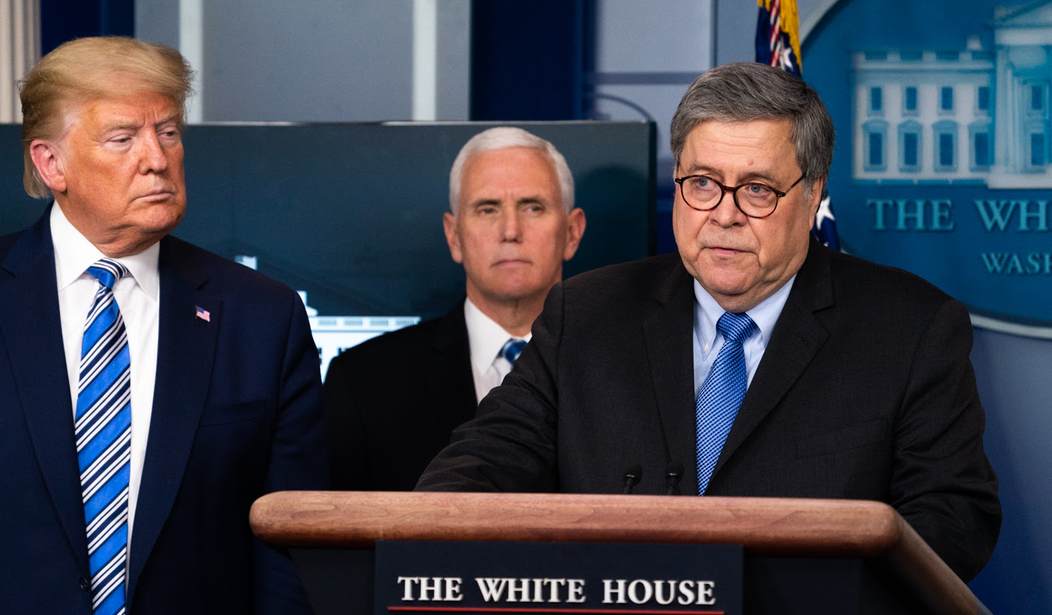
During an interview with conservative radio host Hugh Hewitt Tuesday morning, Attorney General Bill Barr addressed the issue of government overreach during the Wuhan coronavirus crisis.
"I do think that executive glance, whether it be in the federal system or the state system, you know, one of its capacities is to respond to immediate catastrophic dangers facing the people. And the reason that we give power to the executive is because frequently, that requires adapting to the circumstances. So initially, when you're faced with a potential catastrophe, the government can deploy measures and even put temporary and reasonable restrictions on rights if really necessary to meet the danger," Barr said.
"But it still has the obligation to adapt to the circumstances. Whatever powers the government has, whether it be the president or the state governor, still is bounded by Constitutional rights of the individual. Our federal Constitutional rights don't go away in an emergency. They constrain what the government can do. And in a circumstance like this, they put on the government the burden to make sure that whatever burdens it's putting on our Constitutional liberties are strictly necessary to deal with the problem," he continued. "They have to be targeted. They have to use less intrusive means if they are equally effective in dealing with the problem. And that's the situation we're in today. We're moving into a period where we have to do a better job of targeting the measures we're deploying to deal with this virus."
In Michigan, Democratic Governor Gretchen Whitmer has implemented extreme "social distancing" measures that include bans on travel to second homes, buying seeds, carpet, wood or other household items, in addition to banning fishing, riding in a motorboat and more. As a result, protests at the capitol in Lansing erupted last week as people demand the government ease restrictions so they can get back to work.
In recent weeks, Democratic governors have tried to close gun shops and according to New Jersey Governor Phil Murphy, civil liberties and the Bill of Rights haven't been factored into decisions.
"I wasn't thinking of the Bill of Rights when we did this," Murphy said during a recent interview with Fox News about his state's social distancing policies. "We looked at all the data and the science and it says people have to stay away from each other. That is the best thing we can do to break the back of the curve of this virus, that leads to lower hospitalization and ultimately fatalities."
During an Easter Sunday drive-in church service in Mississippi, a pastor was told by law enforcement his rights had been "suspended."
Video from Pastor Hamilton of King James Bible Baptist Church in Greenville, MS. Church tried the “drive-in” method of holding services & were targeted due to the Mayor issuing an order prohibiting such services. Watch as an officer tells the Pastor that his rights are suspended. pic.twitter.com/zLdT6Qd8ew
— Nick Short ???? (@PoliticalShort) April 11, 2020
Barr also discussed President Trump's handling of the crisis and deference to the states on a number of issues.
"I think it's important to recognize that the president, you know has not been using, you know, dictating things based on his inherent Constitutional authorities. He's been relying mainly on statutes that give him emergency authority, and also working within our federal system by leaving the governors to execute what they think is best at the local level. That can be a messy business, but at the end of the day, the better approach than trying to dictate everything from Washington," Barr continued.
Georgia, South Carolina and Tennessee announced they will reopen for business on May 1. States around the country are still assessing the risk and analyzing whether they meet three phases of reopening standards announced by the White House last week.
Editor's Note: Want to support Townhall so we can keep telling the truth about China and the virus they unleashed on the world? Join Townhall VIP and use the promo code WUHAN to get 25% off VIP membership!


Join the Conversation
VIP members get the ability to comment on articles.