


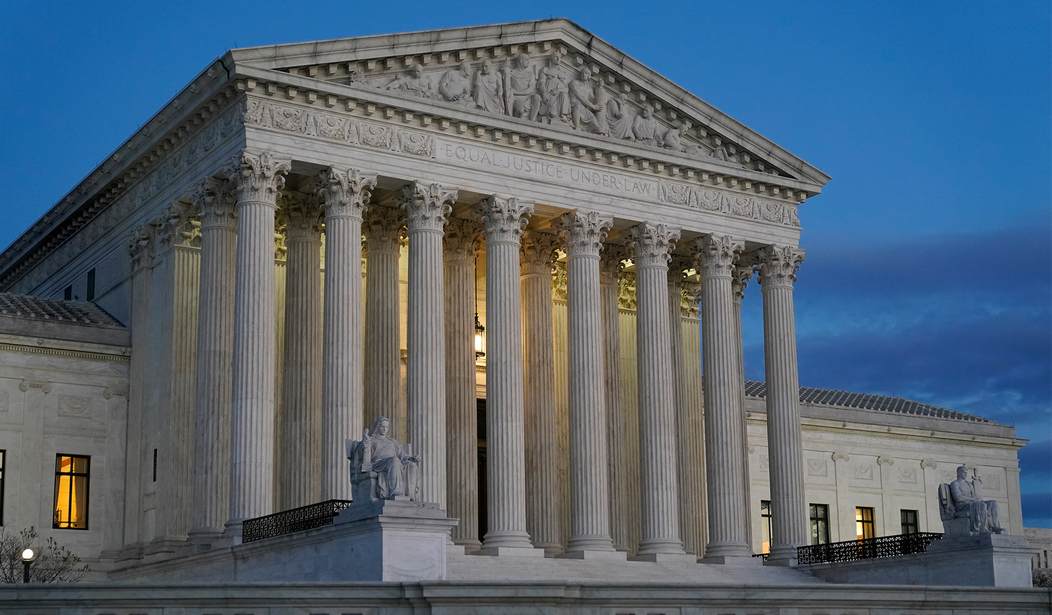
It's not just the radical left-wing groups that send activists to harass Supreme Court justices at their homes — a violation of federal law that has remained unpunished by the Biden Department of Justice — seeking to sway the outcome of cases before the highest court in the land with dubious funding networks.
No, there's a far more procedural and unaccountable way —that's been happening for even longer — in which the left is working to change the way justices vote on consequential cases dealing with issues vital to Americans: amicus briefs.
Filing such a brief with the Supreme Court is not problematic as a function of Americans' ability to make their voices heard in matters before the justices. But, as the influence of amicus briefs and the number of filings has increased, a significant bias has developed in the ideological slant of such filings, especially those generated through pro bono work at America's top law firms.
In a new study compiled by Derek T. Muller — a professor at Notre Dame Law School — and published in the Harvard Journal of Law & Public Policy, Muller explains that "[m]any of the largest law firms file amicus briefs before the United States Supreme Court" which "are often pro bono, which means the clients do not may for the firm to file the brief" but such work "can quickly total millions of dollars of legal briefing subsidized by the law firm" pursuing outcomes that supposedly reflect "the law firm's desire to work for its prior commitments to what it identifies as the 'public good.'"
Calling pro bono amicus briefs the "most discretionary aspects of legal practice," Muller notes that such efforts undertaken by major law firms "reflects the choices of attorneys to invest time and resources into a case" that "may have an ideological valence." Because "large law firms must approve attorneys' choices," Muller adds, the choice of which SCOTUS cases to file in "can reflect the firms' priorities, too."
Recommended

1/ I have a new piece in @HarvardJLPP Per Curiam: "Ideological Leanings in Likely Pro Bono Biglaw Amicus Briefs in the United States Supreme Court." https://t.co/DoGYGz2siq
— Derek T. Muller (@derektmuller) January 17, 2024
Because filing an amicus brief "can consume substantial resources at the law firm," doing so means those firms are "putting its significant financial backing behind the effort."
Surely, with such a financial investment in matters before the highest court in the land, there's a required reporting process for law firms to follow so the public and the Supreme Court is given the full picture of who is seeking to sway their legal decisions? Wrong. There's no formal requirement or process for tracking and reporting firms' pro bono work on amicus briefs designed to influence outcomes on consequential cases.
So what did Muller find in his study of pro bono amicus briefs filed with the Supreme Court? After developing a novel dataset covering "all Supreme Court merits cases from October Term 2018 to October Term 2021" (more on his methodology here in the report), Muller focused on "Biglaw" — defined as the "Am Law 100" list of the top 100 law firms in the U.S. by 2021 gross revenue — and segmented out the "likely pro bono" clients.
5/ The top line conclusion is that the briefs tilted roughly 2/3-1/3 liberal-conservative. pic.twitter.com/i4RUboDE3M
— Derek T. Muller (@derektmuller) January 17, 2024
Out of the 851 briefs selected in Muller's dataset, 545 — 64 percent — "aligned" with the liberal position while just 261 — 31 percent — aligned with the conservative position. The remaining briefs supported neither side.
As Muller noted, not all cases before the Supreme Court have the same impact — so he further segmented the cases into groups based on their "salience" determined by which cases had the most amicus briefs filed. In the "highest salience" cases, Muller's data found "Biglaw overwhelmingly favoring the liberal positions" with roughly 95 percent compared to about five percent that aligned with the conservative position.
From Muller's study:
And just five cases fit the “highest salience” profile: Dobbs v. Jackson Women’s Health Organization [28] (131 briefs); Bostock v. Clayton County and Harris Funeral Homes v. EECO [29] (93); New York State Rifle & Pistol Association Inc. v. Bruen [30] (81); Fulton v. City of Philadelphia [31] (80); June Medical Services v. Russo [32] (69). Two cases were about abortion, two about sexual orientation or gender identity (one of which included a religious liberty issue), and one about the Second Amendment. These “highest salience” cases touch on some of the most divisive areas of political controversy. Ninety-eight amicus briefs were filed in these five cases by fifty Biglaw firms. Ninety-three briefs (94.9%) aligned with the liberal position, and five (5.1%) with the conservative position. While there is a larger amount of ideological diversity among the less salient cases, in these five “highest salience” cases, the briefs skewed heavily in one direction.
Rather than what people typically think of when they hear the term "dark money" in the SCOTUS context — funds raised through obscured sources and spread through networks of not-for-profit organizations used to fund ideological activism or demonstrations aimed at wooing or intimidating justices — this is another kind of action.
The decisions regarding pro bono amicus briefs are even more removed from view, and the full cost of resources exerted to prepare such briefs remain unknown, though easily estimated to cost millions of dollars for the more than 800 briefs examined by Muller's dataset given the going hourly rates normally earned in "Biglaw." And the work carried out was significantly slanted toward benefitting the left's stance in cases being argued before the Supreme Court.
So, what's to be made of this unaccountable and rather shadowy use of pro bono briefing to support liberal causes at the highest court in the land? Muller has some thoughts on that, as well as notes on the limitations for further research on the subject caused by the lack of transparency.
Among his suggestions for future research to understand the ideological slant uncovered in this report is a comparison of "political contributions at law firms with the ideological preferences of likely pro bono amicus briefs" and "a look at individual Supreme Court litigators at these firms and their previous ideological or partisan affiliations." Also likely to be helpful, Muller says, is a "qualitative analysis of the non-profit organizations that file amicus briefs."
"There is little doubt that America’s largest law firms invest more resources in more liberal-leaning causes than conservative-leaning causes on behalf of likely pro bono clients in front of the United States Supreme Court," Muller noted in concluding his study. "But they invest substantial resources into conservative-leaning causes, too." But based on the dataset at issue here, covering "the biggest cases of this recent four-year period, however, the firms’ likely pro bono amicus work overwhelmingly leaned in the liberal direction."





Join the conversation as a VIP Member