


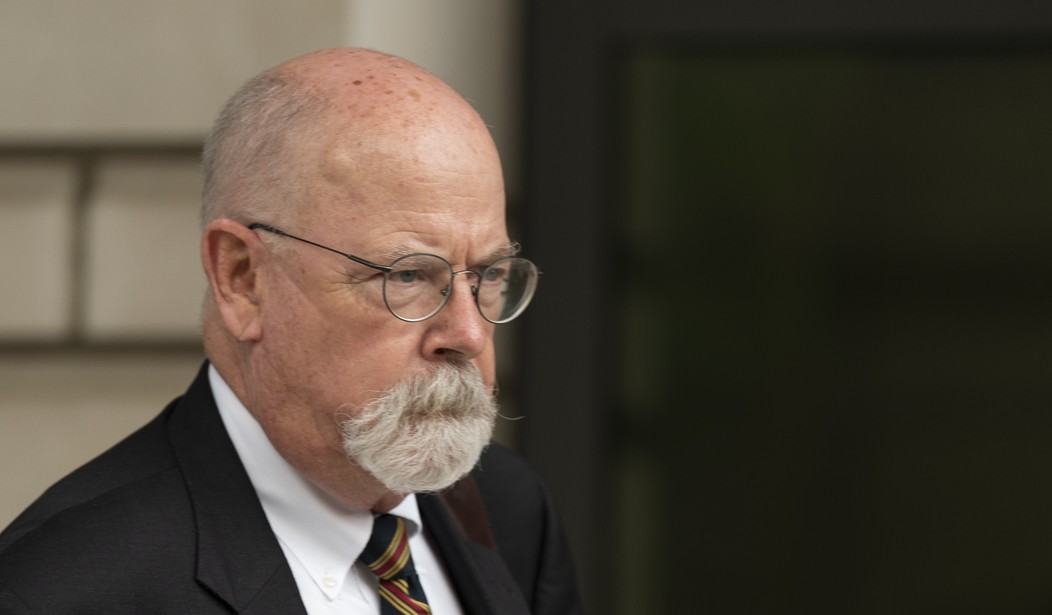
Special Counsel John Durham failed to secure a conviction from a Virginia jury against Igor Danchenko Tuesday afternoon in the United States District Court in the Eastern District of Virginia.
Danchenko, a key Russiagate player who supplied spy Christopher Steele with false, Russia sourced and salacious information about Donald Trump during the 2016 election, was acquitted on all counts of lying to the FBI. The jury spent Monday and Tuesday in deliberations before returning the verdict.
FLASH: Federal jury in Alexandria, Virginia finds Igor Danchenko NOT GUILTY of making false statements to FBI. He's the Russian analyst who worked w/ Christopher Steele, on a controversial dossier about former President Donald Trump and Russia
— Scott MacFarlane (@MacFarlaneNews) October 18, 2022
Igor Danchenko found not guilty on all counts.
— Techno Fog (@Techno_Fog) October 18, 2022
No shock - it's hard to win a false statements case when the FBI and Mueller were uninterested in pursuing the truth.
Here are the most important highlights from the trial - https://t.co/fs9nWgry9c
Danchenko and the FBI both lied in and about the Steele dossier.
— Richard Grenell (@RichardGrenell) October 18, 2022
They made outlandish claims that never materialized.
A jury saying that Danchenko didn’t lie doesn’t clear up how the lies were pushed by our government.
Despite the verdict, former federal prosecutor Andy McCarthy explains in the New York Post how Danchenko worked with Steele, the Clinton campaign and the FBI to frame President Donald Trump.
Recommended
Danchenko is charged with five counts of lying to the FBI about two of his sources for what became the infamous “Steele dossier” — a compilation of faux intelligence reports, mainly authored by former British spy Christopher Steele, that portrayed the GOP’s then-presidential candidate, Donald Trump, as a clandestine agent of Russia.
Danchenko was Steele’s principal source. In essence, Durham accuses him of (a) concealing from the FBI that he was getting some information about the Trump campaign from Clinton political ally Charles Dolan and (b) falsely claiming he received explosive information from Sergei Millian, a Belarusian American tangentially associated with Trump, alleging the GOP candidate was in a “conspiracy of cooperation” with the Kremlin.
It remains to be seen whether Durham can prove these charges: The allegation related to Dolan is not crystal clear (because Danchenko did make a vague reference to discussions with him), and Millian, who is overseas and beyond US subpoena power, has refused to testify.
What is not in doubt, though, is that the trial is highlighting the FBI’s shocking malfeasance in the Trump-Russia “collusion” probe, which it codenamed “Crossfire Hurricane.”
Ultimately, the bureau never had to pay the $1 million because neither Steele nor Danchenko could prove the dossier allegations. In fact, according to court filings, Durham’s investigation has concluded the so-called pee tape was a complete fabrication. Further, when the FBI finally got around to interviewing Danchenko, months after it first received Steele’s reporting, Danchenko debunked it as a screed of rumor and innuendo, much of it exaggerated and gussied up to look like professional intelligence analysis.
The rules of the Foreign Intelligence Surveillance Court and the Justice Department mandate the FBI must verify information before submitting it to the court in applying for surveillance warrants. Even though it could not prove the Steele allegations and had every reason to know they were exaggerated if not out-and-out false, the FBI relied on the Steele claims in sworn applications.
It gets worse. The FBI obtained FISC surveillance warrants to monitor former Trump campaign adviser Carter Page in October 2016 and mid-January 2017, representing to the court that Trump appeared to be in a corrupt conspiracy with the Kremlin. Finally, in late January, the FBI interviewed Danchenko, who debunked Steele’s reporting. Nevertheless, even after speaking with Danchenko, the bureau continued relying on Steele’s allegations when — again under oath — it persuaded the court to extend the surveillance in April and June 2017.
And while the FBI was working with knowingly false information to frame Trump, which eventually snowballed into the Mueller probe after he won the 2016 election, the Bureau buried the investigation against Hunter Biden and the criminal contents of his laptop.
Igor Danchenko: Acquitted after lying to FBI about Trump/Russia.
— Greg Price (@greg_price11) October 18, 2022
Michael Sussmann: Acquitted by jury of Clinton donors after lying to FBI about Trump/Alpha bank.
Kevin Clinesmith: Walking free and law license restored after pleading guilty to lying in warrants to spy on Trump





Join the conversation as a VIP Member