





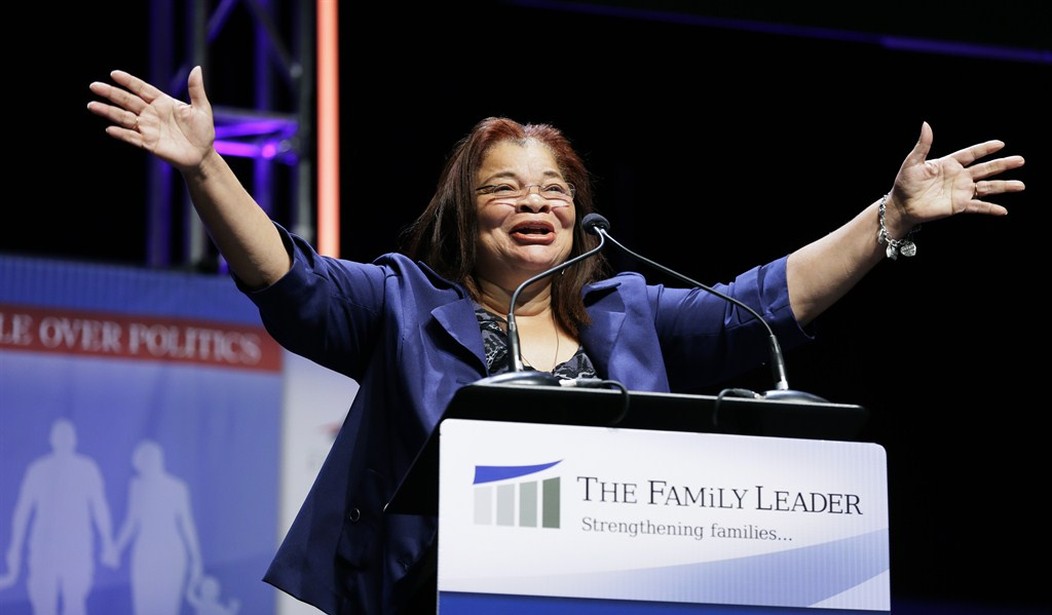
“Life is important…Life is sacred. Period.”
- Alveda King
Tuesday night, pro-life activist Alveda King gave her personal testimony in an hour-long talk and Q&A event in Georgetown University’s Copley Formal Lounge. The crowd was a mix of mostly students, pro-life and pro-choice alike. The event was co-hosted by three student clubs: Georgetown Right to Life, Georgetown Lecture Fund (who infamously brought Cecile Richards to speak last year), and Georgetown Women of Color.
Alveda King is the daughter of civil rights activist A.D. King, and niece Martin Luther King Jr. She grew up watching her father and uncle help lead our country down a better path during the civil rights era. Her long list of accomplishments include winning the Life Prize Award (2011), being a bestselling author, being both an actress and songwriter, and serving Georgia in the House of Representatives. King has since taken up the family legacy of advocating for all to have human dignity by speaking on behalf of the unborn’s civil rights.
King began her testimony by giving the audience a glimpse into the attitude around abortion during her parents’ time. She described how her parents grew up in a time that was much more conservative than our own – when it was courting not dating, when outings were supervised, and condoms were called “raincaps”. It was during this era that Naomi Barber King was in college – before she herself became a King – and she became pregnant with Alveda.
King recounted how a pre-Planned Parenthood birth control advocacy and resource group advertised to people like her parents. Both were young and in college, with bright plans for marriage and a future. This group worked to promote “The Negro Project”, which King described as the sterilization of young African Americans thinly veiled as uplifting that community. Though, King did mention that this group did offer information about anatomy and the reproductive system. However, they did so while telling women to come see them for a
King even refuted the idea that her uncle was a pro-choice advocate. In 1966, Planned Parenthood offered Martin Luther King Jr. a “Margaret Sanger Award”. While there was a written acceptance speech and acknowledgement, MLK did not attend to accept the award. Alveda told the audience that the writing did not match her uncle’s style, and that her aunt, Coretta Scott King, accepted it despite having a differing (pro-choice leaning) opinion from MLK, himself. Alveda maintained that the reason her uncle was offered the award was to attract the African American community to Planned Parenthood.
King continued along the timeline to 1973 – the year of her first abortion. At a three month check-up, King asked her doctor if she was pregnant. Instead of checking the state of her pregnancy, her doctor decided to abort it – without anesthesia.
King had another abortion later in life, but by the mid-70s she began to question the reality pro-choice doctors and advocates were painting for her. Her grandfather convinced her not to abort for a third time, and it was during that pregnancy that she realized she could never lose another child to abortion. At the time, she still considered herself pro-choice (she wouldn’t have but how could she tell other women what to do), but over time became more and more focused and aware of the rights of the unborn that were never heard.
There were several questions posed to King that she answered thoroughly and gracefully. One of which raised the issue of division within the pro-life movement. According to King, the most divisive aspect of the movement is when the different branches (social advocates, legal advocates, medical advocates, protesters, etc.) do not work in harmony. She believes that each aspect of this issue is important – and that they must go together in order to “inform, educate, and advocate” in a compassionate way for all involved.
The final question asked for King’s opinion on the competition between a woman’s voice and the voice of the unborn. She replied, “They should sing together...” Alveda King ended by explaining how a woman and her unborn child are “interwoven in the fabric” of humanity.


Join the Conversation
VIP members get the ability to comment on articles.