





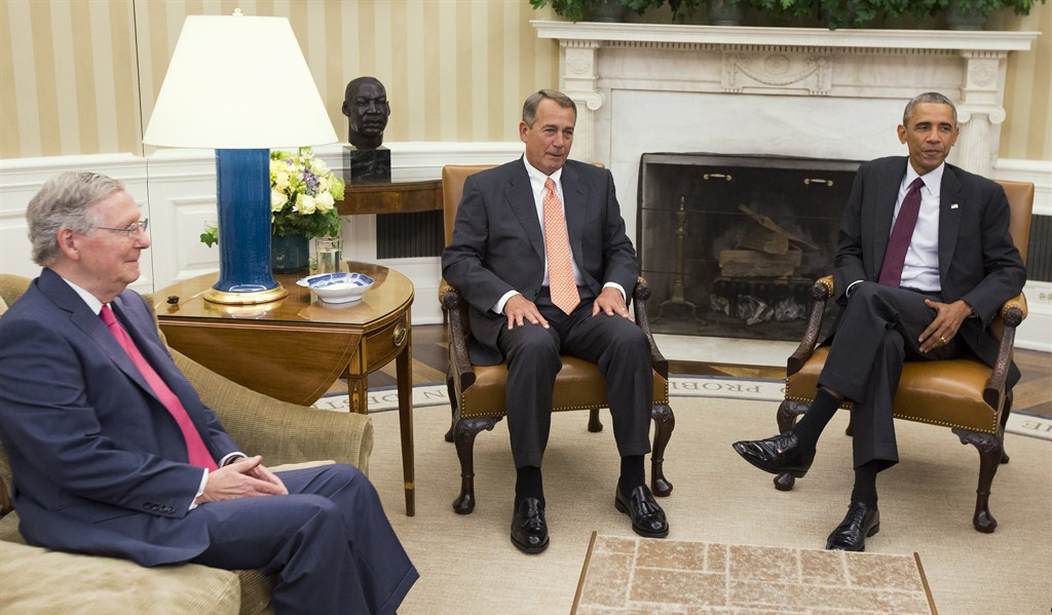
The term "Christian" has many meanings. Nevertheless, a whopping 491 members of Congress consider themselves Christ-followers -- if, perhaps, only in a nominal sense:
When the new, 114th Congress is sworn in on Jan. 6, 2015, Republicans will control both chambers of the legislative body for the first time since the 109th Congress (2005-2006). Yet, despite the sea change in party control, there is relatively little change in the overall religious makeup of Congress, according to a new study by the Pew Research Center. More than nine-in-ten members of the House and Senate (92%) are Christian, and about 57% are Protestant, roughly the same as in the 113th Congress (90% and 56%, respectively). [A]bout three-in-ten members (31%) are Catholic, the same as in the previous Congress.
Interestingly, though, there is only one GOP lawmaker in the new federal Congress who bucks this growing trend. Rep-elect Lee Zeldin (R-NY) practices Judaism. On the other hand, while most Democratic members are also self-described Christians -- unlike congressional Republicans, they have a plurality of members who are not:
Democrats in the new Congress are somewhat more religiously diverse than Republicans, though not as diverse as the population as a whole. Of the 234 Democrats in the 114th Congress, 104 (44%) are Protestant, 83 (35%) are Catholic, 27 (12%) are Jewish, two (1%) are Mormon, two are Buddhist, two are Muslim, one is Hindu and one does not identify with a particular religion.
Somewhat amazingly, the poll also suggests that there is a higher percentage of Christians in Congress than in the general population!

But how, realistically, can that be true? As it happens, CNN reached out to the Pew Research Center and the firm provided a rather plausible and obvious explanation:
"One of the things we have seen in our surveys is that the American public says one thing they like to see in candidates for office is strong religious beliefs," said [Alan] Cooperman, who noted that when Pew asked voters what qualities impact their vote, the most negative attribute was someone who doesn't believe in God."On the whole, American adults tend to say that they do want strong religious beliefs in candidates and they tend to say that they would be less likely to vote for someone who says they do not believe in God," he added. "Candidates are reflecting the views of the public when they do tend to affiliate with a religious group."
Surprise. Perhaps this is why so many lawmakers tend to identify with the Christian faith. They know, deep down in their heart of hearts, it's what their constituents want to hear.
Join the Conversation
VIP members get the ability to comment on articles.