





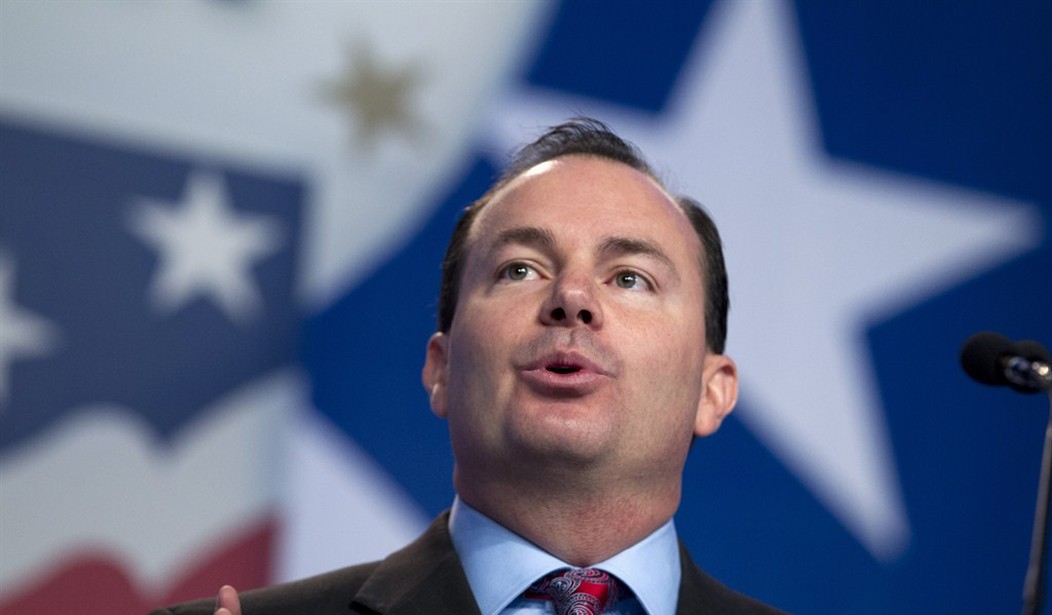
Former-President Bush speechwriter Michael Gerson has a fine op-ed in today's Washington Post, heaping praise on Sen. Mike Lee (R-UT). Gerson writes:
For those who expect and fear an irrepressible conflict between the tea party and the Republican establishment, Sen. Mike Lee of Utah is a hopeful anomaly. Should this anomaly become a trend, the GOP’s future would be considerably brighter.
Few have done more to burn ideological bridges within the GOP. Yet no one from the tea party side is now doing more to construct them....
Lee has been proselytizing for a “comprehensive anti-poverty, upward-mobility agenda” — making him one of the few Republican politicians talking in any sustained way about stalled economic mobility, stagnant middle-class wages and economic inequality. To this, Lee has added a dollop of populist “anti- cronyism,” proposing to simplify the tax code and rein in the big banks. Setting aside the policy details, Lee makes strikingly sane observations about the Republican future....
The subtext here is not a challenge to establishment Republicanism, which would offer no ideological objection to the role of government that Lee described. The real contrast is with libertarianism, particularly of the Rand Paul variety. And Lee has come close to making his criticism explicit. “Freedom means ‘we’re all in this together,’?” he said. “The conservative vision for America is not an Ayn Rand novel. It’s a Norman Rockwell painting, or a Frank Capra movie: a nation of ‘plain, ordinary kindness, and a little looking out for the other fellow, too.’?”
This is a good, general prescription for Republican recovery: More Frank Capra. Less Ayn Rand.
Gerson hits a few good notes here, but his ultimate conclusion is wrong.
Lee, as Gerson says, is trying to build policy bridges between the populist Tea Party and the Republican establishment. And Lee's communitarian rhetoric is, in many ways, the polar opposite of what establishment Republicans like Mitt Romney have run on. In particular, Lee's tax plan is a direct repudiation of Romney's individualist 47 percent line.
But Gerson goes, on to claim, "Lee's specific agenda ... is well within the broad tradition of ... compassionate conservatism."
This is just plain false. Bush's compassionate conservatism oversaw the largest expansion of the entitlement state since President Johnson and before President Obama. Bush greatly expanded the scope and power of the Department of Education and he signed the pork-filled 2005 transportation bill.
Lee's policies take the federal government in the opposite direction. Lee's transportation bill cuts the gas tax and returns most transportation spending to the states. His education bill empowers state governments to foster higher education competition by bypassing federally empowered accrediting organizations.
Recommended

And most importantly, Lee's populist policies are the exact opposite of the corporatist deal Bush struck with drug companies when he expanded Medicare Part D.
There simply is no major difference between Lee's limited government vision, and the one espoused by most libertarians, including Rand Paul. Lee's vision, however, is antithetical to how K Street Establishment Republicans have governed Washington in the very recent past.
But by getting establishment Republicans like Gerson to move in his direction, Lee is slowly changing the soul of the party.






Join the conversation as a VIP Member