





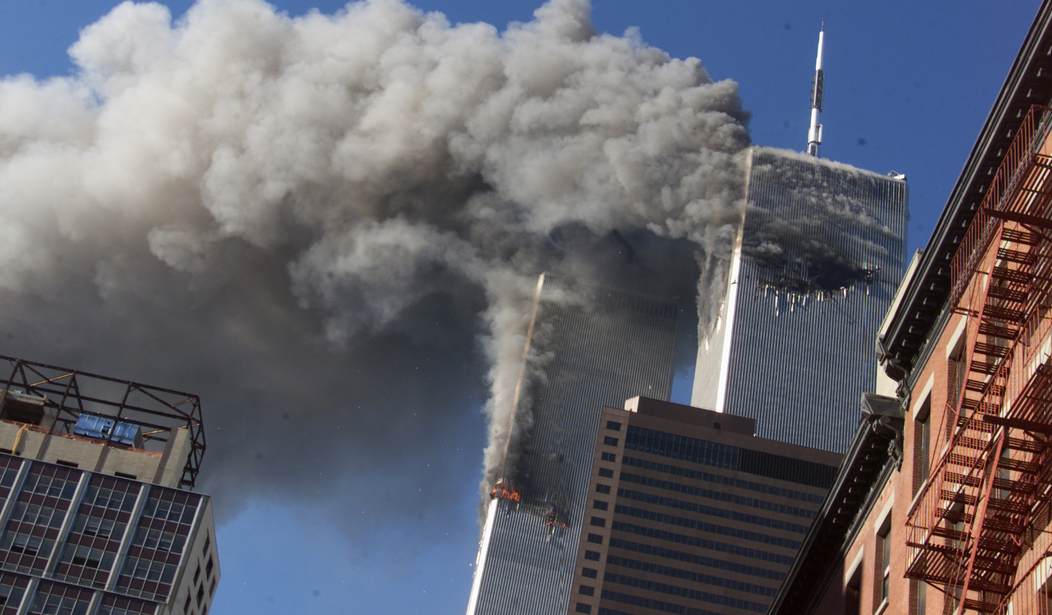
Three days after the terrorist attacks on Sept. 11, 2001, the worst and most murderous attack on the United States in history, President George W. Bush declared "a National Day of Prayer and Remembrance."
He went to the National Cathedral and spoke to the nation, casting the horrible event in theological light, saying that the United States must "answer these attacks and rid the world of evil."
Bush said we live in a world "of moral design" and he appealed to "Almighty God to watch over our nation."
Three months later, he addressed Congress in his State of the Union message and defined nations supporting terror as an "axis of evil."
Others also cast the attack in theological light but were denounced rather than supported by Bush.
Evangelists Jerry Falwell Sr. and Pat Robertson discussed what happened on Robertson's television show and cast the event as divine retribution for what they defined as evil occurring inside our country.
As reported by The New York Times, "The Rev. Jerry Falwell and Pat Robertson set off a minor explosion of their own when they asserted ... that an angry God had allowed the terrorists to succeed in their deadly mission because the United States had become a nation of abortion, homosexuality, secular schools and courts, and the American Civil Liberties Union."
Per Bush's spokesman, the president "does not share those views and believes that those remarks are inappropriate."
What is certainly clear is the activities that Falwell and Robertson talked about and condemned are defined in the Bible as sin, and therefore evil.
Recommended
As a born-again Christian, we do indeed live in a world, as Bush said, "of moral design," and the idea of good and evil has meaning only if there are consequences.
Certainly, it is true, as other evangelicals pointed out then, that we cannot claim to explain specific acts of God. But we certainly know that evil has inescapable consequences. If not, it has no meaning.
What we might ask now is, if the horror of Sept. 11, 2001, had anything to do with good and evil, where do we stand today compared to then?
The data shows that today the country is decidedly less religious than it was Sept. 11, 2001. Despite the trauma of 9/11, it did not cause Americans as a whole to do soul searching to take inventory of our own moral behavior.
Per Gallup, in 1950, the percentage of Americans who said they have no religion was close to 0. In 2001, it was 8%. Today, that figure has increased to 21%.
In 1996, 27% supported the idea of legalized same-sex marriage. Today, that figure stands at 71%
In 2000, 8%, per Gallup, said abortion should be legal in the third trimester of pregnancy. Today that percentage has almost tripled to 22%.
The transgender issue was not even part of the national discussion in 2001. Today, it receives major attention.
Per a new study released by my organization, CURE, "The Trans Youth Phenomenon: Critiques and Hard Questions," the incidence of youth identifying as transgender "has substantially increased."
As traditional morals decline, we adopt a new religion of government. In 2001, federal government spending as percent of GDP was 17.6%. In 2022, it was up to 24.6%.
Bloated government slows our growth. GDP grew from 2000 to today, on average, 2% per year. From 1950 to 1999, the average was 3.6%.
Regarding national security, all the spending makes us less secure because it puts pressure on the defense budget.
I think Falwell and Robertson did the nation a favor in 2001 to say we must look inside as well as outside. If we did, and we made corrections where, according to biblical standards, we were headed in the wrong direction, we would be a stronger nation today.






Join the conversation as a VIP Member