





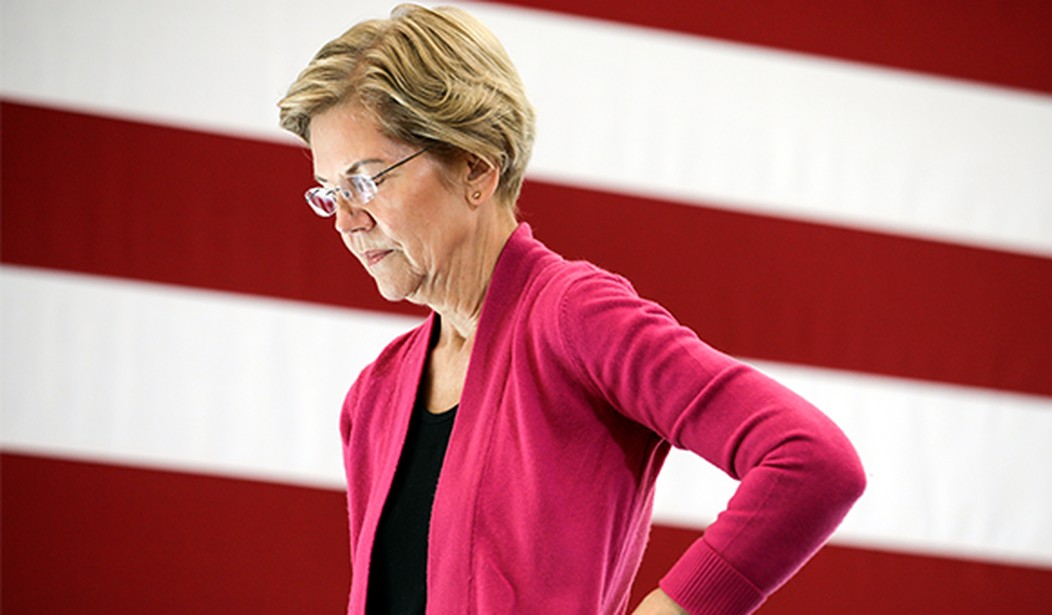
Whether on April 15 or any other day of the year, “tax” is a 4-letter word. Senator (and presidential hopeful) Elizabeth Warren (D-Mass.) seems to realize this, which is why she continues to insist that, “we don't need to raise taxes on the middle class by one penny to finance Medicare for All.” As Reason editor Peter Suderman points out, Warren has avoided talking about raising taxes when discussing her healthcare plan, preferring an “employer contribution” that would supposedly lower costs compared to current employer medical contributions. Getting wrapped up in the tax discussion, however, obscures the very-real consequences that government-run healthcare would entail. Warren can call taxes whatever she wants, but she must explain who will pay for the inevitable failures of socialized medicine.
To listen to Sen. Warren, the current U.S. healthcare system is little more than a Rube Goldberg machine. Warren thinks that if Washington can “streamline” the system and cut out pesky middleman profits, consumers and taxpayers will actually save money. But the surging presidential candidate ascribes a fairytale ending to a likely dystopia. To get a sense of what government-run healthcare would look like, we needn’t turn to European countries and debate the applicability to the American system.
Quadrants of the U.S. system are already socialized, but the resulting failures have largely escaped the attention of the media. Run directly by the Department of Health and Human Service (HHS), the Indian Health Service (IHS) administers healthcare in 330 Indian territories across the country. Similar to the “Medicare for All” approach, the service funds doctors and hospitals and dictates quality of care. This expansive promise to Native Americans is the understandable result of centuries of mistreatment at the hands of the federal government. But unfortunately, this guaranteed care does not amount to much.
Victoria Kitcheyan of the Winnebago Tribe of Nebraska writes that, across the country, Native Americans have had to make do with, “emergency room nurses who do not know how to administer such basic drugs as dopamine; employees who did not know how to call a Code Blue; an emergency room where defibrillators could not be found or utilized when a human life was at stake…” And the results are horrifying. Mark Walker, a contributor for The New York Times, recently wrote about the plight of 6-month-old James Ladeaux, whose upper respiratory infection was misdiagnosed by IHS doctors as only a cold. He was correctly diagnosed and saved from a tragic demise, but only because he was quickly transferred to a private hospital. This is sadly the norm at facilities such as Sioux San (where Ladeaux was initially treated). At that location, five government investigations found patients frequently misdiagnosed and “treated by staff members who have not been screened for hepatitis and tuberculosis.”
Recommended
Fortunately, tribes are starting to take matters into their own hands and assume control of facilities such as Sioux San. Fed up by the sorry state of affairs there, the Great Plains Tribal Chairmen’s Health Board took charge and began recruiting skilled personnel and upgrading facilities. These changes are welcome but demonstrate the large capital outlays required to make up for decades of neglect. And if government-run healthcare becomes the norm, patients can expect deficiencies in quality of care and eventually spending (and tax) hikes to address these problems.
Even if Sen. Warren’s math currently checks out (it doesn’t), her plan leaves no fiscal room for the inevitable failures that have gripped IHS, Medicaid, and the Department of Veterans Affairs, and will impact Medicare for All as well. To millions of Americans, that will mean dealing with the “t” word year-round and working longer hours just to appease Uncle Sam.
It’s time to move past these misguided proposals, and work to lower costs instead of raising taxes on future generations.
Ross Marchand is the director of policy for the Taxpayers Protection Alliance.







Join the conversation as a VIP Member