





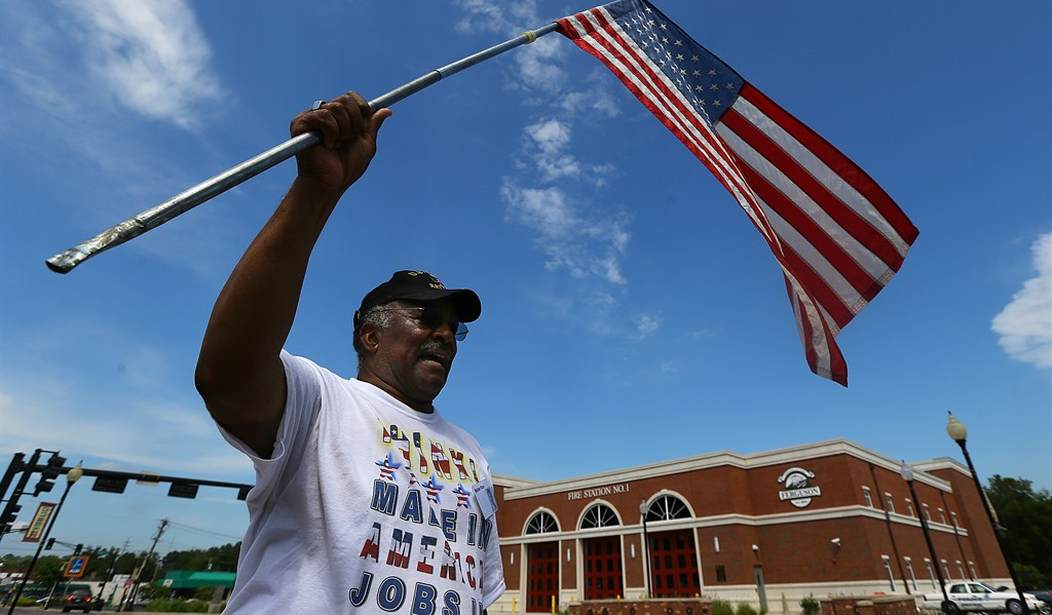
On this Labor Day weekend, like most Americans, I come to praise labor, not indulge in it. Has there ever been a people that speechified more about the joys and satisfactions of work and the work ethic, yet was so enamored of labor-saving devices?
American efficiency, American organization, and therefore American prosperity has been something of an example around the world -- at least since Henry Ford, that half-genius, half-crank and all-American revolutionary, put the world on wheels. And was savvy enough to raise his workers' pay to unheard-of levels so they could buy the Model Ts they were cranking out on the assembly line, another American innovation.
A few kinks have developed in the American image since -- like the Great Depression. And occasional lapses in that once vaunted made-in-USA craftsmanship. Still, no other system seems to have responded so flexibly to the challenge, mystery and psychological thriller known as the "science" of economics. (To quote Hayek, "The curious task of economics is to demonstrate to men how little they really know about what they imagine they can design.")
Much like economics itself, the American attitude toward labor can be a curious paradox: simultaneous admiration and distaste for work. Surely no other civilization -- if that's the right word for this American experiment, general hurly-burly, and great adventure -- has labored so hard to make labor obsolete.
Americans long have sought to avoid the kind of labor that demeans: dull, rote, repetitive, unthinking work. The kind of brutish labor that will follow orders right out the window. But we never seem to tire of the kind of labor that elevates and expands the human consciousness, that approaches a craft or even art. Whether it was the Shakers in their neat little colonies full of music and workmanship ('Tis the gift to be simple, 'tis the gift to be free...) or Jefferson at Monticello, Americans have been fascinated with labor-saving devices. Inventing and perfecting them remains our favorite form of labor.
Recommended
Naturally, a day of rest has been set aside to honor labor. If we really loved work, we'd be working -- not picnicking and taking that last dip in the lake. "Work consists of whatever a body is obliged to do," Mark Twain explained in "The Adventures of Tom Sawyer." "Play consists of whatever a body is not obliged to do." Whitewashing a fence can be either, depending on the psychology involved, as Tom well knew. He and the Finn boy were American to Mark Twain's good old Missouri core. The hard and necessary kind of labor that requires muscle and bone may command our respect, but it is the inventive, imaginative kind that attracts our admiration, from Silicon Valley to the Research Triangle.
The assembly line and the efficiency expert are American inventions, too, but they represent the dark side of our relationship with labor, the reduction of man to machine. For Americans, labor tends to be an activity rather than an identity, what we do rather than what we are. We have balked at efforts to reduce us to just economic units: capital or labor. Instead we look on both as just different aspects of ourselves at different times in our working lives. We may go broke from time to time, or hit it rich, but we refuse to be considered part of any permanent class -- upper, lower or in-between.
Unlike Europeans, here we tend to view labor as a means to an end, perhaps a phase that one passes through on the way to becoming just another anonymous millionaire, certainly not "our station in life." This is entirely too fluid a society for anybody to be assigned a permanent station in it.
Everybody's got something else going: The little investment on the side, the private start-up after business hours, the extra shift at the plant, the new invention or rock band that we're putting together out in the garage.
Every man an entrepreneur! The phrase "working class" rings foreign in our ears despite all the efforts of those who would like to pigeonhole us. We never did pick up European phrases like the masses, the proletariat, the underclass. ... We're much too varied, too individualistic, even quirky to let ourselves be labeled. Much as our intelligentsia (another un-American concept) would like to put us all in little boxes. But we keep getting out, wanting to make our own decisions, even our own mistakes. Indeed, one of the most powerful arguments that can be made in this country against even the most entrenched institutions -- whether the welfare system or farm subsidies -- is that they'll result in the creation of a permanent, dependent class.
In American society, community is a good word, but dependence a bad one. We're all for Social Security, having contributed to it, but resist having to go on relief. We are happy to help others stand on their own, but resent freeloaders. We associate labor with freedom, not servitude. Which is another reason slavery, the curse and bane of our history, could not last.
The idea and reality called class exists in this country much as it does in any other, but we don't like to acknowledge it, which may explain our remarkable social mobility. For myths shape reality much more than the other way around. Our myth is called the American dream, with its hope/illusion/goal of equal opportunity for all. If we believe in that dream, it needn't remain just a dream. If we don't, it'll never become a reality. Maybe that's why, though ours is not a classless society, it also is not a class-bound one. Happy Labor Day.





Join the conversation as a VIP Member