





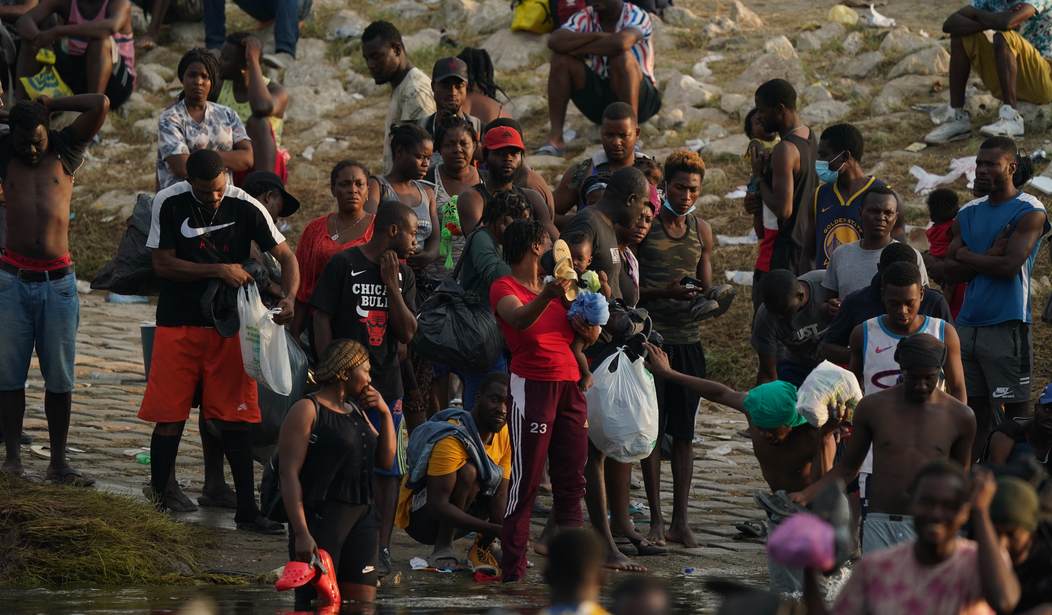
Fourteen thousand migrants from Haiti recently crossed the Texas border illegally, with only a minority of them deported back to Haiti. Other Haitians are crossing the trackless “Darien gap” in Central America. They too will soon be in our country, most of them to stay. There are already more than 700,000 Haitian immigrants in the United States, legal and illegal, and 30,000 more were apprehended in recent months at the U.S. border with Mexico according to the Migration Policy Institute.
The Haitians show that immigration is out of control because the border is open. Migrants from anywhere can cross illegally with impunity. America already contains more than 45 million people who were born elsewhere, the most of any country, and about a quarter of them are illegal. Pew notes that the number crossing the border in July 2021 soared to nearly 200,000, the most in 20 years.
The danger to the nation is that assimilation is overwhelmed. The United States was founded mostly by Europeans. It derived from Europe a strongly individualist culture. America offers matchless opportunities to ordinary people, but freedom isn’t free. Americans expect that immigrants will live an individualist life—competing to get ahead and avoiding personal problems. Before 1965, immigrants assimilated relatively easily because most of them already came from Europe and thus knew what to expect. But since 1965 immigrants have come mostly from Latin America and Asia, where cultures emphasize adjustment to adversity rather than change and achievement. For many of them, freedom is a shock.
This has made assimilation much more difficult. Waves of ill-prepared Hispanic migrants have overwhelmed the public schools in major cities. Most have suffered far more problems with school failure, crime, and single parenthood than the norm. To adjust, they need more intensive schools and other services. But society cannot meet these demands with immigration at its current rate. To reduce the flow, the border must be controlled.
Recommended
The immediate reason for the crisis is that the Biden administration promised to be more “humane” about immigration than Trump was. But two other factors are involved.
First, legal limits to immigration have broken down. The rules are so complicated that those who can get into America, even illegally, can make some legal claim to stay. Many advocate groups stand ready to help them. So lacking “papers” no longer deters migrants. Millions are coming here expecting to enter illegally and then regularize their status later. Many Democrats now favor legalizing all or most of them.
The asylum system, especially, has become an open door. Anyone coming to America illegally can stay provided they claim persecution where they came from. While most such claims are later rejected, they get the claimants into the country, where they can usually remain illegally until legalized. To limit entries, asylum claimants, like refugees, should have to prove adversities before entry, and all illegals must simply be deported.
Second, the morals of immigration are completely one-sided. The argument to admit the Haitians is simply that they are miserable. No claim against them is heard. Certainly they come from one of the world’s poorest countries, which has suffered natural disasters and political violence throughout its history. Currently gangs rule much of the country. Who could be more deserving?
But why does being miserable give them a claim to come to America? As the Haitians show, most migrants can imagine no solution to their predicament but to escape to America. Why do Americans so readily accept responsibility for people who accept none for themselves?
The immediate solution to the border crisis is to toughen up the legal rules for entry so nobody entering illegally has any claims to stay. But we must also question whether helping the desperate to escape their countries is the only way to help them. The United States, like other Western countries, has a serious commitment to help the unfortunate, but that norm never imagined absorbing the huge numbers who today clamor at our gates. By one estimate, 700 million people in poor countries would move to America and other Western countries if they could. To accept such numbers would destroy the society we have.
Rather, miserable lives abroad must be helped without immigration. The United States and the United Nations have several times sent troops to Haiti. They should do so again. The regime there must face long-term oversight from outside so that disorder and corruption are reduced and the population no longer needs to escape.
Lawrence M. Mead is Professor of Politics at New York University and the author of Burdens of Freedom: Cultural Difference and American Power. He’s also host of the “Poverty and Culture” podcast.








Join the conversation as a VIP Member