


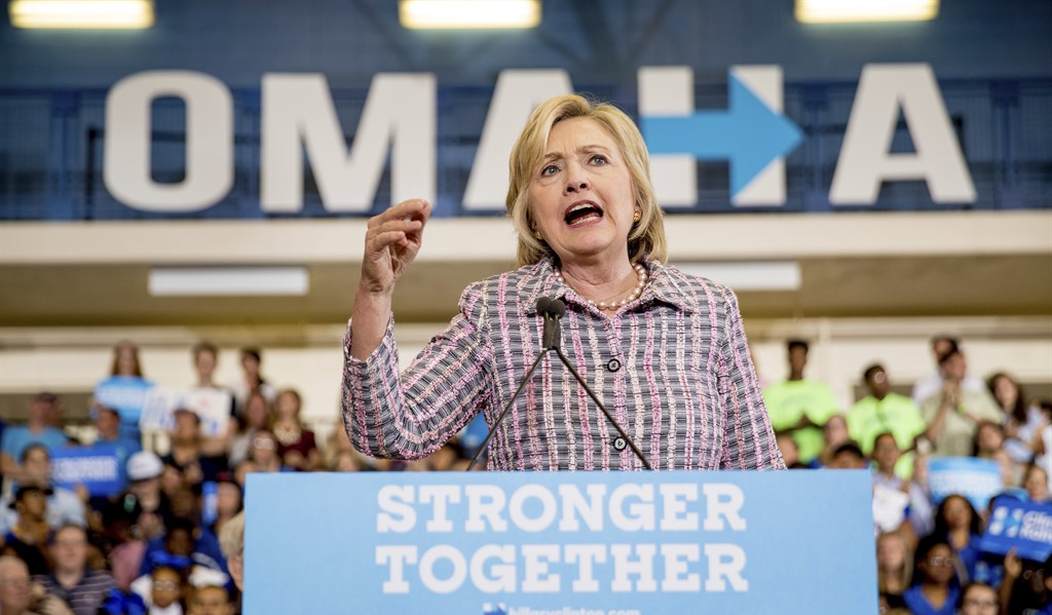
Among the innumerable flip-flops, course corrections and reinventions that have come to define Hillary Clinton's three decades in public life, perhaps the most interesting one is her decision in 2016 to go all in as the woman-candidate.
In 2008, Clinton downplayed her gender. Mark Penn, her chief strategist in that campaign, had a "FWP" (First Woman President) plan that emphasized toughness, not nurturing. Voters, he argued, did "not want someone who would be the first mama, especially in this kind of world."
Ann Lewis, a 2008 senior adviser, told the New York Times last year that the decision not to double down on gender was the "biggest missed opportunity" of Clinton's presidential bid. "It was not a major theme of the campaign," Lewis added.
She's right about the latter, I'm not sure about the former. Perhaps one reason Clinton didn't bang the feminist gong more forcefully was that she feared it might remind voters she was a household name because of her husband's accomplishments, not her own. Clinton successfully sponsored only three pieces of legislation while in the Senate: the renaming of a road, the renaming of a post office and the naming of a house as a historic landmark. She had other accomplishments, but little that would have distinguished a senator named Jones or Smith.
Another possible factor: Clinton was running against Barack Obama, the man who would become the first black president -- and in the game of identity politics, race trumps sex.
This is a hotly controversial point on college campuses, but the heat cools rapidly the farther away you get from the women's studies departments. Yes, of course, America has a sexist history. But so does every other society in the world. America hasn't always been ahead of the pack on women's rights, but it has rarely been far behind. New Zealand was the first to grant women the vote in 1893. America followed suit with most of Europe right after WWI in 1920. Women's suffrage didn't hit France until 1944. Switzerland waited until 1971. The first ballots cast by women in Saudi Arabia? 2015.
You could say that racism in America was horizontal, while sexism was vertical. Women are born into every class and demographic. Affluent white women may not have been allowed to vote until 1920, but they were hardly treated the same way as black women or, for that matter, Native American women.
Moreover, women's political, religious and ideological orientations are difficult to stereotype. You'd be hard-pressed to find an African-American who dissented from the battle for civil rights. It has always been easy to find women -- lots of women -- who dissent from feminist orthodoxy. For instance, gender is a very poor predictor of attitudes on abortion.
To make the case that women are coequals in the Coalition of the Oppressed, feminists often rely on hyperbole. In "The Feminine Mystique," Betty Friedan argued that housewives were "in as much danger as the millions who walked to their own death in the concentration camps."
Uhhh: no.
I am not one to feed the stunning self-regard of millennials, but it is to their credit that they don't much care about Clinton's gender. Bernie Sanders beat Clinton among young women (by a factor of 6-1 in the Iowa caucuses).
The coverage of the Democratic convention last week was instructive. By far, the delegates -- and pundits -- most excited by the relentless mantra about the First Woman President were aging white liberal baby boomers.
And that's fine, I suppose. But it's worth considering that Clinton's decision to emphasize the historic nature of her candidacy is probably as calculated as her decision to de-emphasize it in 2008. The person standing between her and the Oval Office this time isn't the first black president, but a thrice-married, crude billionaire who polls slightly better than the Zika virus with women. Baiting the ever-baitable Donald Trump to rant about the "woman's card" is a shrewd way to pad her lead.
No doubt Clinton, a lifelong feminist, believes her rhetoric about shattering the final glass ceiling, but one thing is clear from her decades in the political arena: If she thought it wasn't to her advantage to say it, she probably wouldn't.







Join the conversation as a VIP Member