


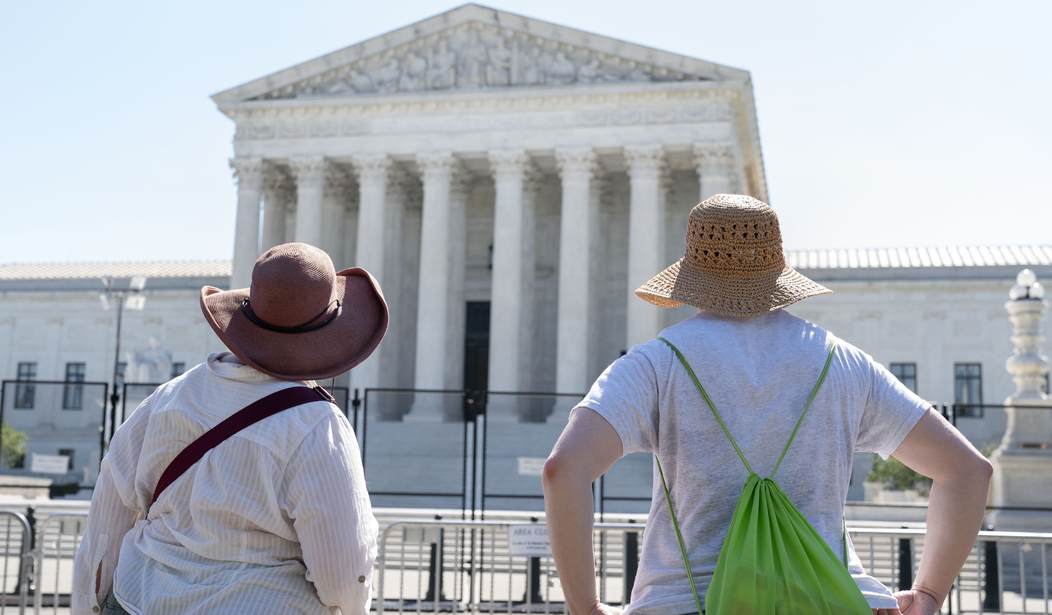
The Supreme Court term that ended last week will go down in history as one in which the Court took major steps to reaffirming the constitutional framework laid out by our Founding Fathers, where power is separated and major policy decisions are properly made by elected officials who can be held accountable to their constituents by means of regular elections. The Court’s ruling in West Virginia v. EPA, issued on the final day of its term, is an excellent example.
At issue was whether or not the Environmental Protection Agency had overstepped its authority when, in 2015, it created what it called its “Clean Power Plan,” a regulatory regime to address climate change. The EPA said it had legal authority to do so courtesy of the Clean Air Act; its opponents – in this case, the states of West Virginia and North Dakota, and two coal-mining companies – argued otherwise.
By a vote of 6-3, the Court agreed with the EPA’s opponents. Referring to the locus of decision-making authority in this case, Chief Justice John Roberts wrote for the majority, “A decision of such magnitude and consequence rests with Congress itself, or an agency acting pursuant to a clear delegation from that representative body.”
In invoking what he called “the major questions doctrine” – that is, the idea that in “extraordinary” cases, involving topics of pronounced “economic and political significance,” federal agencies must be able to show specific Congressional authorization for their activities – Roberts pushed the EPA, and all executive branch agencies, back into their proper lane.
This is as it should be. Our constitutional framework demands no less. Our Founders knew that the power to legislate is a dangerous power – it is, after all, the power to deprive someone of life, liberty, or property – and, as such, it had to be guarded. As a bulwark against tyranny, that power is split between the legislative branch (where it is split further, between two houses of Congress) and the executive. Both ends of Pennsylvania Avenue must agree before a law takes effect, and everyone who has a hand in making law – members of Congress and the president – are held accountable by being required to stand for election at regular intervals.
Recommended

For the past four decades – ever since the 1984 Supreme Court ruling in Chevron v. Natural Resources Defense Council – the courts and the Congress have prioritized the view of the so-called “experts” in the agencies making the rules. Congress could write a broad directive, and simply rely on the “experts” to fill in the “details” – the kind of “details” that could create job-crushing regulations, or seize properties, or otherwise erode liberties.
This is wrong. When Congress defers to unelected bureaucrats, there is no accountability. When there is no accountability, tyranny rears its ugly head.
In West Virginia v. EPA, the Supreme Court says ceding power to unelected bureaucrats, no matter how “expert” they may be, is wrong, and puts a stop to it. And for that, I say three cheers for the Supreme Court.
I cannot leave a discussion of the Supreme Court’s ruling in the case of West Virginia v. EPA without a comment on Justice Elena Kagan’s dissent. It is a perfect example of one of the things that’s so wrong about liberal jurisprudence.
Wrote Kagan, “The stakes are high. Yet the Court today prevents congressionally authorized agency action to curb power plants’ carbon dioxide emissions. The Court appoints itself – instead of Congress or the expert agency – the decision-maker on climate policy. I cannot think of many things more frightening.”
First, she’s just wrong. The majority ruling does not “appoint” the Court as the decision-maker; it prohibits a group of unelected bureaucrats from being the decision-maker, absent a specific authorization from our elected representatives to make that decision, and says Congress should be the decision-maker.
Second, and perhaps more important, as Kagan’s words make clear, to her, the policy outcome is the important thing, and the process used to arrive at that outcome is irrelevant. She’s got it exactly backward. As her fellow Justice Brett Kavanaugh said during his confirmation hearing, “Judges do not make decisions to reach a preferred result. Judges make decisions because the law and the Constitution as we see them compel the results.”
Stripping power from unelected bureaucrats and returning power, and decision-making authority, to the people’s elected representatives is the right prescription for what ails us. At least then we’ll be able to hold the decision-makers accountable.
Jenny Beth Martin is Honorary Chairman of Tea Party Patriots Action.






Join the conversation as a VIP Member