





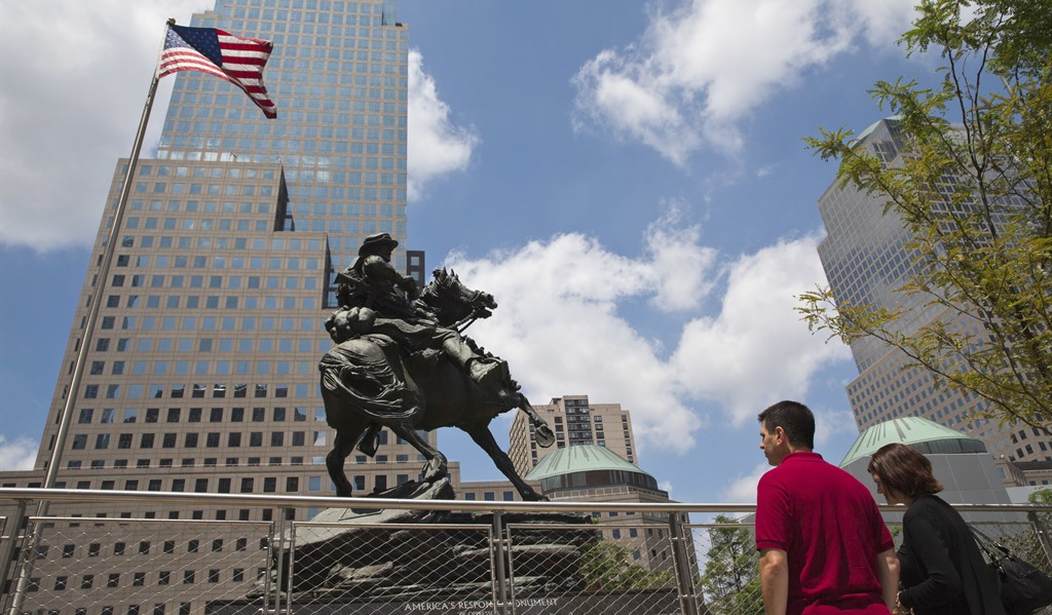
We declared our independence from Great Britain 240 years ago this week. It was a declaration long in coming, brought about by the overreaching rule of King George III and Britain's insistence on taxation without representation. It was sparked, in part, by the quartering of troops in our own homes. We were required to give -- both in taxes and hospitality, without any say -- without a vote or a voice.
Patrick Henry's call to action in 1775 at the Virginia Convention, "Give me liberty or give me death," was the first strong public statement that laid out our choice in stark terms: if we were to be free, if we were to have liberty, then we would have to fight Britain. Until then, the commonly held belief was that we could negotiate with Britain. We could go along and get along.
But Henry understood that we could no longer wait and see. Instead, if we were to be free, we had to fight for our freedom.
He lay down the gauntlet and clearly presented his view of what we were facing.
Our choice was liberty or death.
Our founders chose to take the challenge and declared our Independence from Britain on July 4, 1776.
Our Declaration of Independence is a three-part document: the first a declaration of freedom, including our understanding of the natural order of authority and power; the second a long list of grievances, reinforcing the belief that there was no choice but to declare our independence as a free country; the third an acknowledgment of risk and the oath of the signers to one another.
Recommended
The first section is the one that is most often quoted: "We hold these truths to be self-evident, that all men are created equal, that they are endowed by their Creator with certain unalienable Rights, that among these are Life, Liberty and the pursuit of Happiness. --That to secure these rights, Governments are instituted among Men, deriving their just powers from the consent of the governed, --That whenever any Form of Government becomes destructive of these ends, it is the Right of the People to alter or to abolish it, and to institute new Government, laying its foundation on such principles and organizing its powers in such form, as to them shall seem most likely to effect their Safety and Happiness."
The second part, less often referenced, lays out the reasoning for why we were seeking independence, noting that government should not be changed lightly. Instead only when "a long train of abuses and usurpations, pursuing invariably the same Object evinces a design to reduce them under absolute Despotism." At that point it was no longer a choice to change but "it is their right, it is their duty, to throw off such Government, and to provide new Guards for their future security."
Our founders concluded the document with the pledge to each other and an invocation of God. Knowing that their declaration would be seen as an act of treason by the king, the signers also knew that, if they were not successful, they would risk losing their lives.
It is important that we understand that we are a unique nation. We declared ourselves free and acknowledged that our rights came from God to the people to be loaned to the government.
Theodore Roosevelt, the 26th president of the United States, once stated, "We want to make our children feel that the mere fact of being Americans makes them better off... This is not to blind us at all to our own shortcomings; we ought steadily to try to correct them; but we have absolutely no grounds to work on if we don't have a firm and ardent Americanism at the bottom of everything."
It is important for Americans to understand why our country is different, to acknowledge where we can do better, and it is our duty to provide for our future security.
Happy Fourth of July!






Join the conversation as a VIP Member