





My Cato Institute colleague, Chris Edwards, put together a remarkable (and depressing) chart showing that federal bureaucrats get almost twice the level of compensation as workers in the productive sector of the economy.
Defenders of the bureaucracy (including a federal pay panel dominated by bureaucrats) claim that government employees actually are underpaid because…well…just because.
My modest contribution to the debate was to put together a chart based on the Labor Department’s JOLTS data, which shows that bureaucrats are far less likely to voluntarily leave their jobs than folks in the private sector, which is very strong evidence that they are being over-compensated.
But all this debate about pay is looking at only one part of the equation. What about the stereotype that bureaucrats don’t work very hard? Well, as anyone who’s ever visited a motor vehicles department or a post office already knows, that’s also true.
And the hard data confirm our personal observations. Here are the main findings of new research by Andrew Biggs of the American Enterprise Institute and Jason Richwine of the Heritage Foundation, which was published in the Wall Street Journal.
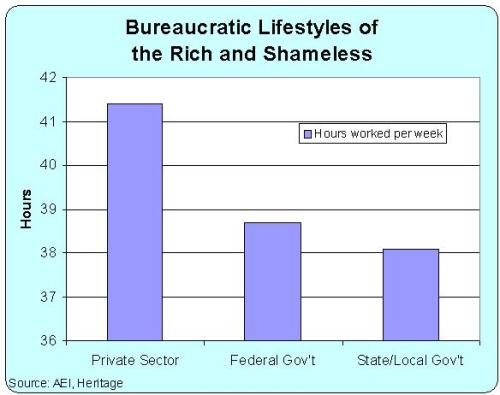
…overstaffing is a serious problem in government, and the best evidence is a simple empirical fact: Government employees don’t work as much as private employees. …new evidence from a comprehensive and objective data set confirms that the “underworked” government employee is more than a stereotype. …The time-use survey’s data on work time…allow us to analyze both the number of hours individuals work during a typical workweek and the total number of hours they work during the year. …What we found was that during a typical workweek, private-sector employees work about 41.4 hours. Federal workers, by contrast, put in 38.7 hours, and state and local government employees work 38.1 hours. …Put another way, private employees spend around an extra month working each year compared with public employees.
Here’s the chart Excel generated when I entered the data in a spreadsheet. It must be nice to get paid a lot to work a little.
Actually, maybe it’s not a bad thing that bureaucrats are lazy. Do we really want more diligent IRS agents? More hard-charging OSHA inspectors? Do we want Fannie and Freddie regulators burning the midnight oil concocting more affordable leading rules?
I think you understand my concern.
So this brings us back to the fact that they are paid too much. This video has the gory details.
The real issue, as I state at the end of the video, is that most government jobs shouldn’t exist at all.
By the way, Biggs and Richwine include a very important point in their op-ed about the connection between the current budget negotiations and the existence of an over-paid and under-worked bureaucracy.
This fact may hold different lessons for different people, but our own take is simple: Before we ask private-sector employees to work more to support government, government itself should work as much as the private sector.
As noted above, I want government to do less, not for bureaucrats to do more, but their point is still appropriate.
P.S. Here’s a good joke about government bureaucracy. Here’s a similar joke in picture form. And we find the same humor in this joke, but with a bit more build up.









Join the conversation as a VIP Member