



The Democrats now find themselves in a thoroughly uncomfortable dilemma over Iraq.
Back in the early days of the American invasion, when things were going relatively badly, Democratic Senate majority leader Harry Reid announced that the war was "lost" and that America's only recourse was to pull out. (This, of course, would have been an absolute poitical disaster for the Bush administration, as Reid no doubt knew and hoped it would be.) In the subsequent months and years, when things there have gone substantially better, Reid has never retracted his highly premature conclusion, but it is safe to say that it is now "inoperative."
According to such sources as The New York Times, which can hardly be described as having been a cheerleader for the attack, the Al Qaeda forces in Iraq are now thoroughly on the defensive, and the Al Maliki government is strengthening its grip on the country. It seems likely that Bush will achieve his goal of stepping down as president with the Iraq problem well on its way to a solution.
That leaves the Democrats in a bit of a pickle. What, exactly, is their current policy in regard to Iraq? It would be out of the question to insist, in the teeth of the good news from Iraq, that the United States should adopt the former Democratic policy and simply bug out. And, in purely political terms, it would be equally difficult for the Democrats to admit they were wrong, reverse their position and endorse the administration policy.
Is there some middle road they could safely take? It's hard to envision what it might be. Either the United States must insist on prevailing, as it is currently doing, or substantially abandon the region altogether. And it's hard to imagine any more disastrous policy than the latter. The Middle East has for decades been both one of the most critical areas on Earth, thanks to its indispensable reserves of oil, and also one of the most volatile, by virtue of its ethnic and religious quarrels. To abandon it would verge on economic suicide.
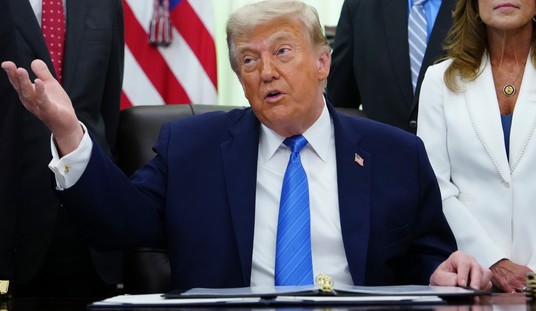
It is not surprising, then, that at the moment there is no settled Democratic policy on Iraq. If the Democrats win in November, the cooler heads in the party will presumably prevail and endorse a policy not all that different from Bush's -- i.e., sustaining the current regimes in Iraq and elsewhere in the region that support U.S. policy. But between now and Election Day the Democrats need a Middle East policy different from Bush's yet not obviously suicidal -- and they just don't have one.
For the moment, the Democratic answer is silence. And it's hard not to feel that it is probably their best bet. After all, Election Day is just four and a half months away, and there are plenty of other issues the Democrats can seize on to emphasize their sharp differences with the Republicans.
But the American people are hardly unaware of the importance of the Middle East, and of America's stake in that area. And they will credit President Bush with the wisdom to recognize these and devise policies that take them into account. Painful as American losses -- any losses -- in the Middle East may be, they pale in comparison to those our country would suffer if it lost the capacity to influence events there.
We must never forget that there are individual despots, and whole nations, in the Middle East who despise the United States and would gladly drive it out of the region, and deprive us of its oil reserves, if only they could. Keeping that from happening must be a cardinal aim of U.S. foreign policy and ought to be a matter of bipartisan agreement. That is why, despite the understandable distaste partisan Democrats would feel at having to endorse a Republican policy, the happiest result for the United States, and the soundest long-run course for the Democratic Party, would be a Democratic decision to endorse President Bush's policy in Iraq.







Join the conversation as a VIP Member