
There's something very wrong about how many HOAs operate. The idea that my neighbors get a say in what I do with the property I purchased is insane. Sure, some try to keep it to a minimum, such as just keep your grass cut and don't junk up the neighborhood, but others try to tell you what shade of white your house's trim must be or whether you can get a trampoline for your kids.
And now, they're really crossing the line when they start trying to push gun control in the neighborhood.
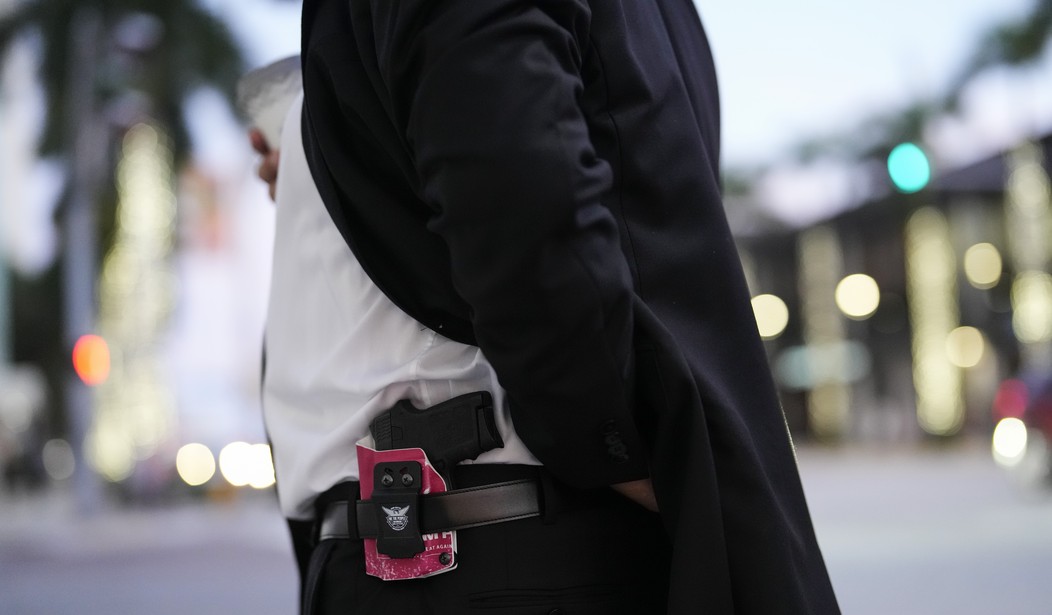
In Port St. Lucie, Florida, a neighborhood HOA has decided to create a rule where you cannot carry a firearm in any of the common areas of the community. You can carry one in your yard, but not to the clubhouse that your HOA dues maintain.
Florida AG Jame Uthemier sent a letter to the HOA demanding they not enforce this law due to the state's preemption statute, where all gun control laws must come from the state legislature in Tallahassee. The police chief in Port St. Lucie said that's not a law and his department wouldn't enforce it, which is good, but as the NRA's Institute of Legislative Affairs notes, this is still an issue.
As firearm rights have expanded in the state, it is perhaps inevitable gun control activists would find new outlets to exercise their anti-gun obsessions. However, larger questions loom as to whether HOAs and condominium boards are to be considered private property managers with their own lane of authority or whether they possess and exercise enough quasi-governmental control that constitutional protections should constrain them. While Florida has been the site of recent headlines pertaining to this issue, similar conflicts with aggressive association governance have emerged in various other states.
Several states have seen disputes involving legal questions at the intersection of constitutional rights, property interests, contract law, insurance obligations, and state firearm preemption statutes. While HOAs are typically private entities, they have in many cases accumulated significant authority over their residents, such as the ability to make monetary assessments, impose unilateral rulemaking, levy fines, and exercise architectural control over a wide array of spaces, to cite just a few examples. Add in the presumption of intruding upon the exercise of a fundamental constitutional right, and the typical dichotomy between private and public action becomes increasingly blurred.
Precisely. Many HOAs have become quasi-governmental in their reach, essentially determining ordinances that apply to a given neighborhood or subdivision, and have the force of law if someone doesn't conform to the standards. Since these are also the homes of a lot of petty tyrants, this creates a big issue.
It's easy to say that if you don't like HOAs, then you should move somewhere that doesn't have one. The truth is that no one should be forced to sell their home in order to exercise basic constitutionally protected rights.
And, frankly, I think the law is on the side of those who are taking issue with this sort of thing.
Legal cases in Illinois have recently challenged firearm bans in public housing where federal courts have held that housing authorities cannot broadly prohibit otherwise lawful firearm possession inside residents’ homes. While different from HOAs and their gathering spaces, the cases have parallel issues of whether quasi-governmental housing entities may impose firearm restrictions through lease agreements or internal policies despite infringing directly on constitutionally protected conduct.
Hawaii is also at the center of Wolford v. Lopez, a Supreme Court case which examines whether states can broadly prohibit firearms on private property open to the public unless express consent is given. Although not directly an HOA case, the pending decision could have broader implications for how courts analyze cases in which public authority and private property are intertwined. Even as courts continue to refine the Bruen legal framework to define the scope of “sensitive places,” new issues are arising on how self-defense rights exist in modern residential environments.
Hawaii's case involves the so-called vampire rule, which means you're prohibited from carrying a gun unless specifically invited in. This overrides the property rights of the business owners because it means they must make a public statement on guns if they wish to allow customers to exercise their Second Amendment rights, which in a state like Hawaii, might cause difficulties for the business.
The truth is that an HOA is, if anything, an organization made up of the residents of a community. That means that, for all practical purposes, those common areas belong to all of the residents. Saying that they can't carry a firearm lawfully in those areas, which they pay for, is a violation of their own property rights.
I'm not sure if the courts would actually see it that way, but the truth is that I just thought I had a problem with HOAs before this. Now there's even less chance of me living anywhere with one.