





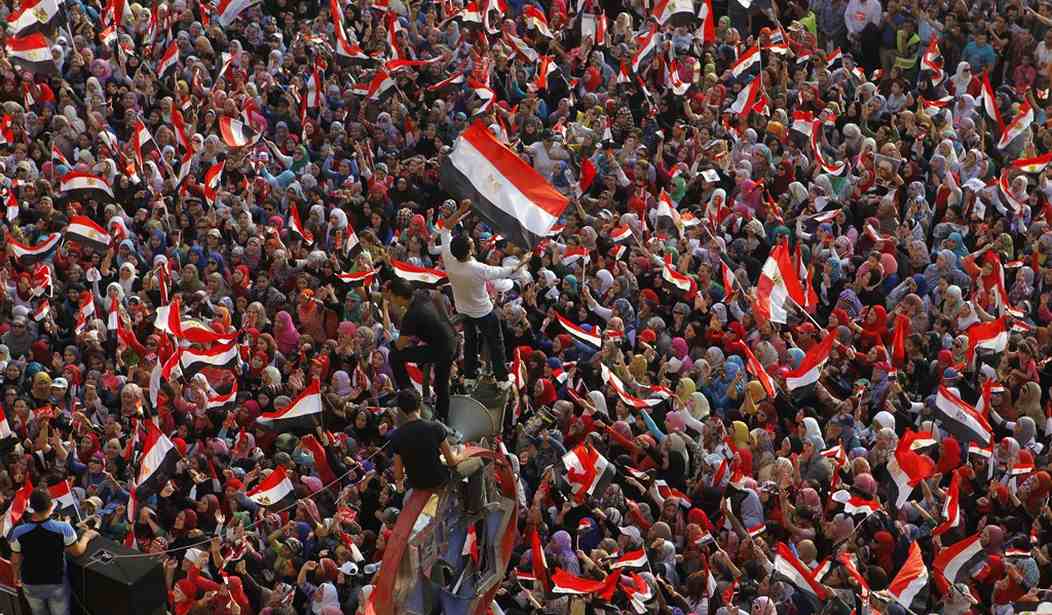
Egyptian President Mohamed Morsi is in quite the bind. As if hundreds of thousands of protestors gathering in Cairo's Tahrir Square to call for his resignation wasn't enough, now Egypt's military has issued a stark ultimatum to Morsi: resolve the conflict or the military will intervene.
The commander of Egypt’s armed forces, Abdel Fatah al-Sissi, told the government and opposition groups in a televised statement that the military would step in within 48 hours if they could not resolve the standoff that has paralyzed the country and led to a number of deaths in recent days.
The statement did not make clear whether commanders want Morsi to step down or share power, and it did not specify the kind of role the armed forces would assume if the stalemate continued. Instead, Sissi pledged to impose a “road map” toward a solution if the conflict persists, leaving considerable room for interpretation.
“If the demands of the people are not met within the given period of time, [the military] will be compelled by its national and historic responsibilities, and in respect for the demands of Egypt’s great people, to announce a road map for the future, and procedures that it will supervise involving the participation of all the factions and groups,” Sissi said, calling the coming two days a “last chance.”
...
Morsi’s office issued a vaguely worded statement just after 1 a.m., saying that the president would continue to walk the “path that was outlined,” regardless of “any statements that could deepen the divisions between the sons of the nation, and could threaten social peace.”
Morsi, the Muslim Brotherhood member who emerged victorious from 2012 elections following former President Hosni Mubarak's ouster, has drawn the ire of secular and Christian Egyptians with his aggressive Islamist agenda.
Now, with the esteemed military poised to step in, there are several possible outcomes to the conflict.
1. Morsi could give in to the protestors' demands and cede the presidency. This would likely mean interim (a loose term in Egypt) rule by a military council, similar to the council in power for a year after Mubarak's resignation. Such a council would probably schedule elections for the near future. But the result of those elections is anyone's guess, and Islamists could very well come out on top once again.
2. Morsi could try to remain in power but agree to a compromise process mediated by the military. Such a process would probably involve either a power-sharing agreement or a promise to stand for fair reelection promptly.
3.Morsi might just ignore the ultimatum. He's in power for a reason -- the Islamist agenda still has plenty of support in Egypt, even if others aren't too thrilled. This outcome could get ugly, since the protestors/military seem unlikely to back down and Islamists won't voluntarily give up the power they've gained post-Mubarak.
4. The military might be bluffing. If the 48-hour deadline passes and nothing happens, things could revert to the Morsi status quo. But this would badly discredit the military, and the protestors probably wouldn't accept such an outcome.
It seems a bit far-fetched that Morsi would step down voluntarily, with a large segment of the population still very much on board with his Islamist vision, and Egypt's military isn't in the habit of making toothless promises -- so that rules out outcomes one and four.
We're now left with two likely possibilities -- either Morsi agrees to a mediation process or all hell breaks loose. So far, President Obama is treading lightly (anyone suprised?), with the White House putting out this statement:
President Obama called President Morsy on Monday, July 1, to convey his concerns about recent developments in Egypt. The President told President Morsy that the United States is committed to the democratic process in Egypt and does not support any single party or group. He stressed that democracy is about more than elections; it is also about ensuring that the voices of all Egyptians are heard and represented by their government, including the many Egyptians demonstrating throughout the country. President Obama encouraged President Morsy to take steps to show that he is responsive to their concerns, and underscored that the current crisis can only be resolved through a political process. As he has said since the revolution, President Obama reiterated that only Egyptians can make the decisions that will determine their future.
Just as President Obama failed to stand for or against Mubarak two years ago, he doesn't dare take a strong position on Morsi now. Some might call this good diplomacy (hedging our bets), but it seems more like foolishness. Mohamed Morsi is no friend to the United States, and he's proven to be nothing but an impediment to our interests in the Middle East, especially when it comes to Israel. The last two years have demonstrated that the United States cannot successfully work with Islamist regimes, politically or morally. They are inherently hostile to nearly all of our foreign policy goals, and their treatment of dissenters and religious minorities is unacceptable.
So why are we afraid to stand with the protestors and call for an end to Islamist rule in Egypt? When Obama says "the United States...does not support any single party or group," he might as well be siding with Morsi in the eyes of the protestors. We should call loudly for a leader who favors real freedom, not just the freedom for one group to force its beliefs on others. The "democratic process" is what gave us Morsi in the first place.


Join the Conversation
VIP members get the ability to comment on articles.