


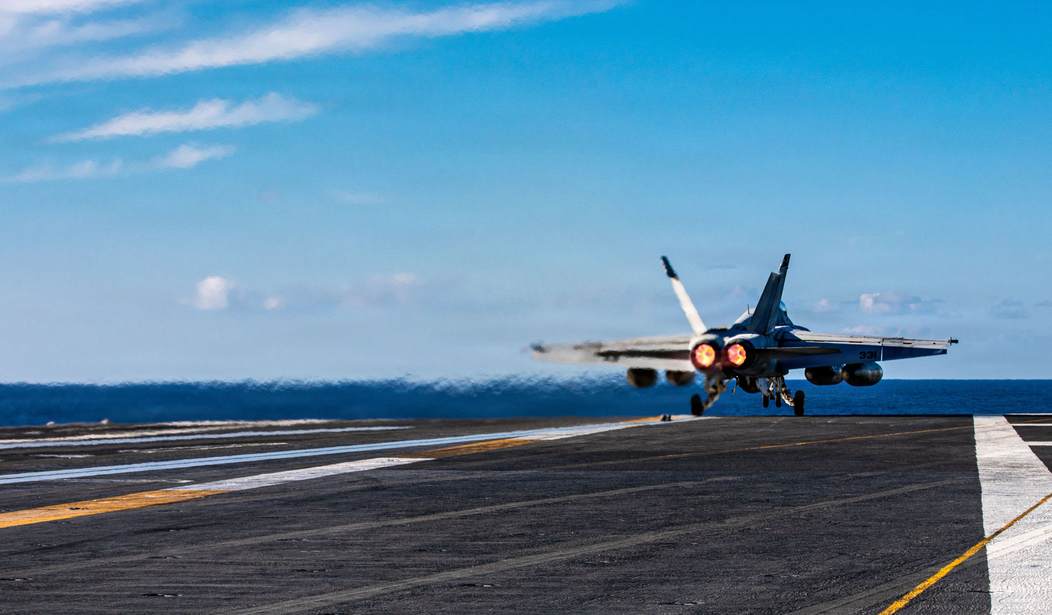
Since last week, many political commentators seem to have turned into libertarians, or perhaps even Tucker Carlson, on foreign policy. They blame the Iran war for Republicans’ devastating midterm losses and argue that, had President Trump simply kept his promise of “no new wars,” we would not be in this position. But the exit polling does not support that conclusion, and many of those same critics seemed to have no objection when Trump decimated ISIS during his first term, ordered strikes on terrorist leaders in the Middle East, or seized Nicolás Maduro in Venezuela.
What we can be frank about, however, is that the war itself was not fought properly.
Victor Davis Hanson, a military historian and senior fellow at the Hoover Institution, explained how exactly it went wrong.
Victor Davis Hanson: We Made a Mistake in Iran The U.S. should have hit Iranian dual targets and infrastructure, kept the Strait open, kept the crippling sanctions, armed the Kurds, and gone home. Instead, the U.S. wanted to negotiate. “You cannot talk to a theocratic, apocalyptic regime that has just killed 40,000 of their own people. They're not rational.” ▶️ Watch the FULL episode with @VDHanson here: https://t.co/LvKHW62AU6
— Daily Signal (@DailySignal) November 9, 2026
"People supported the war when it first happened because they had seen what Trump had done with the first term, Soleimani, Baghdadi. He bombed the proverbial – I don't like the word he used, S-H-I, blank, blank, out of ISIS, but it was just a few weeks and they gave up half of Iraq," Hanson said. "And then he went out and they just decimated within a day the Wagner Group. Soleimani, Baghdadi, ISIS, Wagner Group. And then the second term, bam, go down to Panama, straighten it out, no violence, bam, get brilliant kidnapping or extraction of Maduro. So then they, in June of last year, they bombed the – 25 hours, they took out a lot of the nuclear facilities. So everybody was all fine with that."
The goal of the war, Hanson argued, was not the mistake. Iran needed to be prevented from obtaining nuclear weapons, and those who lost their lives in that effort died for a worthy cause, not in a disaster like the Kabul airport attack during Biden’s withdrawal from Afghanistan. The problems began, he said, when military action gave way to negotiations.
"But you cannot, let me say this very carefully, you cannot talk to a theocratic, apocalyptic regime that has just killed 40,000 of their own people," he said. "They're not rational. They're not even like North Korea that has a patron like China that tells them what to do. Nobody tells them what to do, not China, not Russia. And so we did. And then we heard, well, the war's going to be over in two weeks."
But we heard that promise over and over, with no end to the war in sight. That is where the failure lies, not in the reason for going to war, but in how it was fought. Hanson went on to explain what a successful campaign could have looked like.
"Hit the nuclear industrial military, hit some dual targets, stop all the land bridge traffic into the former Soviet Union, hit the rail lines, hit the airports, and then keep the straight open, keep the sanctions that Bessent finally evolved into being crippling, keep them on, let them stew in their own juice, forget what Turkey says, arm the Kurds, and go home," he said. "And the oil price – I mean, right now, the oil price is going to crash because there's more oil going out of the Gulf now in various manner of Red Sea, Oman pipeline, et cetera, than before the war. So let's just dispense with that. There was a mistake, and all of us said that, that you don't stop."
The central failure of American warfare over the past two decades has not simply been the decision to go to war. Nor has it been only the attempt to build democracies in countries whose people did not want them, although that was a major mistake. It has been politicians’ belief that they can fight on two fronts at once: the battlefield and public opinion. Short of a conflict on the scale of World War II, they cannot expect to maintain broad public support throughout a war.
War is fought to achieve an objective. Had we fought this one decisively, achieved our objectives, and left, it would have been hailed as another success for President Trump’s “peace through strength” approach, rather than hanging over Republicans’ midterm defeat. Conservatives should not abandon “peace through strength” at the first sign of failure. They should ask who bears responsibility for prolonging the war, and who convinced the president that negotiations would achieve what military force had not.
We were promised a two-week war. It should have been fought as one.
Editor's Note: Do you enjoy Townhall's conservative reporting that takes on the radical Left and woke media? Support our work so that we can continue to bring you the truth.
Join Townhall VIP and use promo code FIGHT to receive 60% off your membership.
Join the Conversation
VIP members get the ability to comment on articles.