





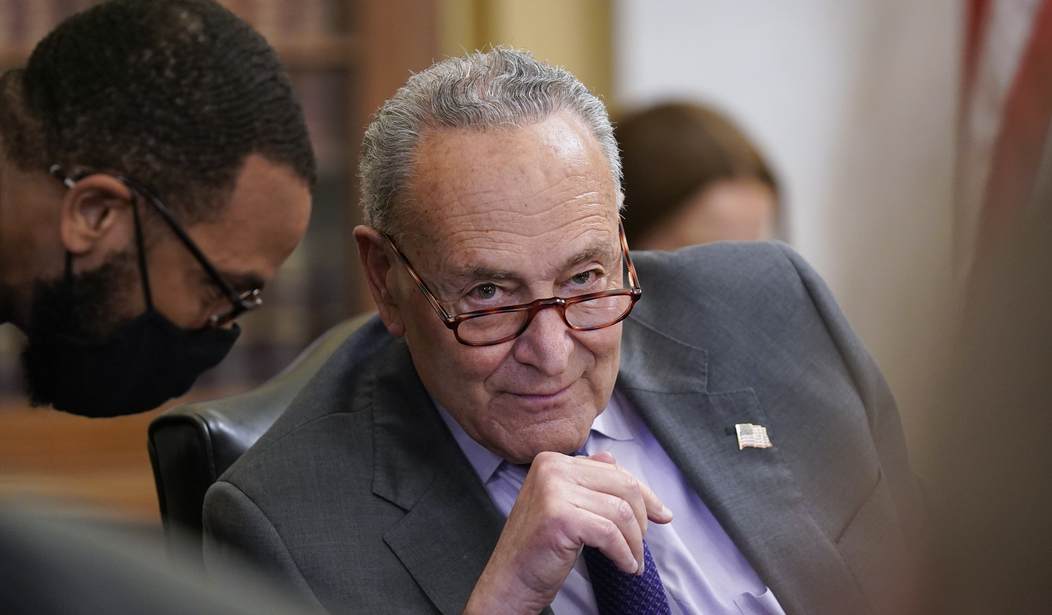
Senate Majority Leader Chuck Schumer (D-NY) is set to bring S.1 to the floor for a test vote Tuesday evening despite little chance of it passing the upper chamber. And while the legislation is called the For the People Act, the American people are not for the act, polling shows.
According to a survey conducted this spring by Echelon Insights, "public campaign financing is deeply unpopular" with more than two-thirds of voters opposing the idea.
The concept of public campaign financing?? is deeply unpopular to voters. 67% of voters strongly/somewhat oppose the idea in general, and 69% strongly/somewhat oppose it in regards to campaigns that have already raised millions of dollars. pic.twitter.com/d8MkZLOY3F
— Echelon Insights (@EchelonInsights) March 24, 2021
A poll commissioned by the Honest Elections Project found that more than 75 percent of voters support requiring a photo ID to cast a ballot, a practice that states would be barred from employing under the provisions of the For the People Act.
The same HEP poll also found that just 11 percent of voters want to allow the practice of ballot harvesting—something all states would have to allow under S.1— while more than 60 percent think such unsupervised collection and casting of ballots should be illegal.
The opposition to the key pieces of the For the People Act means that fewer than three-in-ten Americans support the passage of S.1, HEP's poll also showed.
With opposition among Republicans and even some Democrats—including Joe Manchin (D-WV), a scenario in which Schumer can secure the 60 votes needed to end debate and subsequently pass the For the People Act is essentially unimaginable. "Senate Dems on track to suffer stinging defeat on election reform," declared a CNN chyron Tuesday morning.
Republicans portray the For the People Act as just one piece of Democrat plans to radically change the way America's government functions by centralizing more power, adding liberal states to the Union, packing the Supreme Court, and limiting debate over future legislation by gutting the Senate's filibuster.
Senator John Kennedy (R-LA) called S.1 "ruthless, even by Washington standards" during a Tuesday morning interview, adding the bill would be more aptly named the "Screw the People Act."
.@SenJohnKennedy breaks down the "Screw The People Act"
— Townhall.com (@townhallcom) June 22, 2021
"We'll never have another election day. We'll have election months." pic.twitter.com/LX6EpUXdcd
In Monday's White House briefing, Press Secretary Jen Psaki floated the possibility that a failure to pass S.1 "may change the conversation on the hill" and yield more support for ending the filibuster, a message picked up and repeated by several Democrats in Congress overnight.
Jen Psaki says that a failed vote on the 'For the People Act' "may change the conversation" surrounding the filibuster. pic.twitter.com/LSvMOAhnKF
— Townhall.com (@townhallcom) June 21, 2021
Senate Republican Leader Mitch McConnell (KY) said last week that S.1 is "a solution in search of a problem," adding there's "no rational basis" for the federal government to take control over elections away from states.
The For the People Act previously passed the House of Representatives by a vote of 220 to 210.

Join the Conversation
VIP members get the ability to comment on articles.