







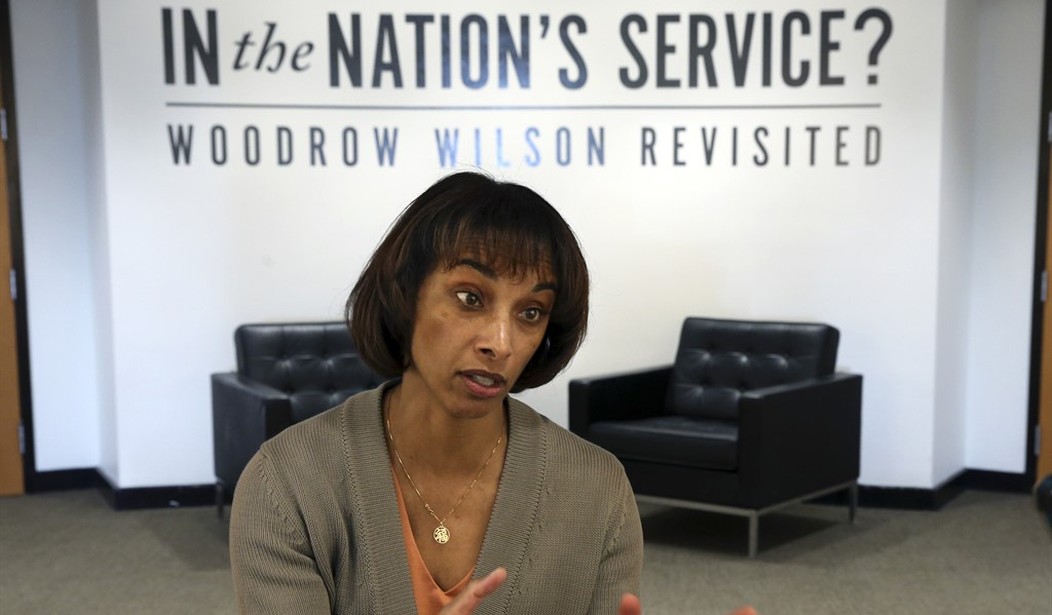
During his appearance on "Fox News Sunday" earlier this week, Jared Bernstein, a White House economic adviser, played coy on the definition of a recession, trying to argue we're not really in one. This narrative, it turns out, is a pattern. A Thursday report from Neil Irwin at Axios had a piece, "White House: Even if GDP contracted, it's not a recession," which noted that the White House is trying to get ahead of the Commerce Department releasing its initial estimate of growth for the second quarter.
White House Council of Economic Advisers chair Cecilia Rouse and Bernstein, who is a member, are going with the National Bureau of Economic Research's (NBER) definition of a recession, rather than what Irwin refers to the "colloquial" definition of two consecutive quarters of negative growth.
The NBER definition is more vaguely defined as "a significant decline in economic activity that is spread across the economy and lasts more than a few months."
Irwin references a blog post from Rouse and Bernstein published by the White House on Thursday, explaining that they're going with NBER. Towards the end they claim that "Recession probabilities are never zero, but trends in the data through the first half of this year used to determine a recession are not indicating a downturn."
Also written in Irwin's piece though is that "Analysts expect the GDP report to show a soft 0.9% growth rate. More worrying, a 'nowcast' that models GDP growth from the Atlanta Fed suggests the Q2 number will print -1.6%," with the Atlanta Fed having raised concerns for some time now about the United States being close to a recession. When the Wall Street Journal surveyed economists last month, they also found that we are increasingly likely to headed towards a recession.
Irwin references comments from a Goldman Sachs economist that while he agrees we may not be in a recession right now, it's possible for next year:
The context: Private-sector economists generally agree with the Biden team's take, but they see elevated recession odds ahead.
- "We are doubtful that the economy is already in recession," said Goldman Sachs economist Ronnie Walker in a research note, but added that forward-looking indicators have softened in recent weeks and that the firm puts 30% odds on a recession in the next year.
What's next: Expect to hear many administration officials emphasize these ideas in the run-up to next week's GDP release as they seek to get ahead of some potentially nasty headlines, should the number come in soft.
A statement from Rouse is also included:
What they're saying: "The American people are digesting a lot of information about the economy, and we're trying to inform the ongoing discussion about the state of the business cycle with concrete information about how important calls, like a recession, are made," Rouse tells Axios.
- "That's especially critical right now as some of the key factors in play, such as consumer spending and job growth, have maintained real strength through the first half of this year."
It's worth noting that while Rouse mentions the "American people," they've given President Joe Biden particularly low marks on the economy. A CNBC poll from last week has him at a 30 percent approval rating for his handling of the economy, lower than the lows experienced by Presidents Barack Obama or Donald Trump. Further, just 11 percent said the economy was "excellent (1 percent)" or "good (10 percent)."
During Bernstein's "Fox News Sunday" appearance, host Shannon Bream read some highlights of a recent Fox News poll, with one takeaway being "Voters say the economy is bad, and they expect it will get worse."
RealClearPolitics (RCP) currently has Biden's approval on the economy at 32.4 percent, while 63.6 percent disapprove.


Join the Conversation
VIP members get the ability to comment on articles.