







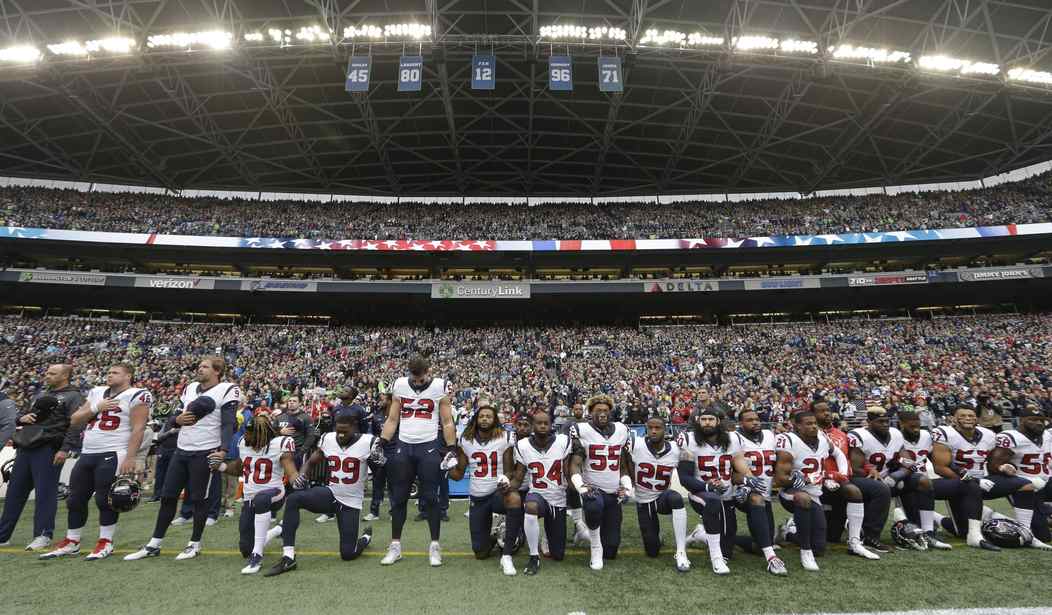
First they kneeled for “The Star-Spangled Banner.” Then they toppled a statue of Francis Scott Key. Now they want to purge the anthem entirely.
A recent Yahoo! News article outlined the ballad's “problematic background” and suggests it be replaced by a song with a “less troubling history and a more inclusive message.”
Historian and scholar Daniel E. Walker said the calls for revision are about America living up to its creed.
“I do side with the people who say that we should rethink this as the national anthem, because this is about the deep-seated legacy of slavery and white supremacy in America, where we do things over and over and over again that are a slap in the face of people of color and women,” Walker said in the article. “We do it first because we knew what we were doing and we wanted to be sexist and racist. And now we do it under the guise of ‘legacy.’”
The problem with the anthem, writes reporter Lyndsey Parker, goes back to Key’s “bigoted background.” Key was born to an aristocratic family on a Maryland plantation. He owned several slaves and, as a lawyer, prosecuted both black and white abolitionists. The article also cites Key’s friendship with President Andrew Jackson and brother-in-law Roger Taney, the fifth chief justice of the Supreme Court and author of the majority opinion in the Dred Scott decision, as evidence of racism.
But others argue that Key publicly spoke out against slavery.
“Key was an early and ardent opponent of slave trafficking,” writes historian Marc Leepson. “By all accounts, Key treated his own slaves humanely, and freed several during his lifetime. What’s more, he had a deserved reputation for providing free legal advice to impoverished free blacks and slaves in Washington.”
There is evidence that Key's contemporaries agreed. When a respected leader in the free African-American community passed away, a long trail of men on horseback followed his casket to the cemetery, all of them African-American except for Key. Even an abolitionist newspaper admitted that Key’s decision to ride with the mourners as a lone white man “evinces an elevation of soul above the meanness of popular prejudice, highly honorable to Mr. Key’s profession as a friend of men of color.” Likewise, the Rev. John T. Brooke, a friend of Key’s, described him as a “true friend to the African race.”
Nonetheless, the woke mob has "cancelled" both Key and the anthem he penned.
It’s not the first time groups have urged the song to be ditched. In 2017, the California chapter of the NAACP urged Congress to remove “The Star-Spangled Banner,” calling it “anti-black” and “wrong.” A year earlier, the New York Times ran a piece with the headline, “Is the National Anthem Racist?” and pointed to lyrics in the anthem’s rarely-sung third stanza which includes the lines, “No refuge could save the hireling and slave/From the terror of flight or the gloom of the grave.” Key’s words referred to those the British had enslaved aboard their ships and during the war of 1812, both black and white—including freed slaves.
As for a replacement, suggestions include "Lift Every Voice and Sing,” which some consider the “Black national anthem,” and John Lennon’s “Imagine.” One soccer club in Tulsa, Oklahoma announced they will play Woody Guthrie’s “This Land Is Your Land” before games instead of the national anthem.
As the movement gains momentum, it remains to be seen whether Key’s words will yet be sung in the land of the free and the home of the brave.



Join the Conversation
VIP members get the ability to comment on articles.