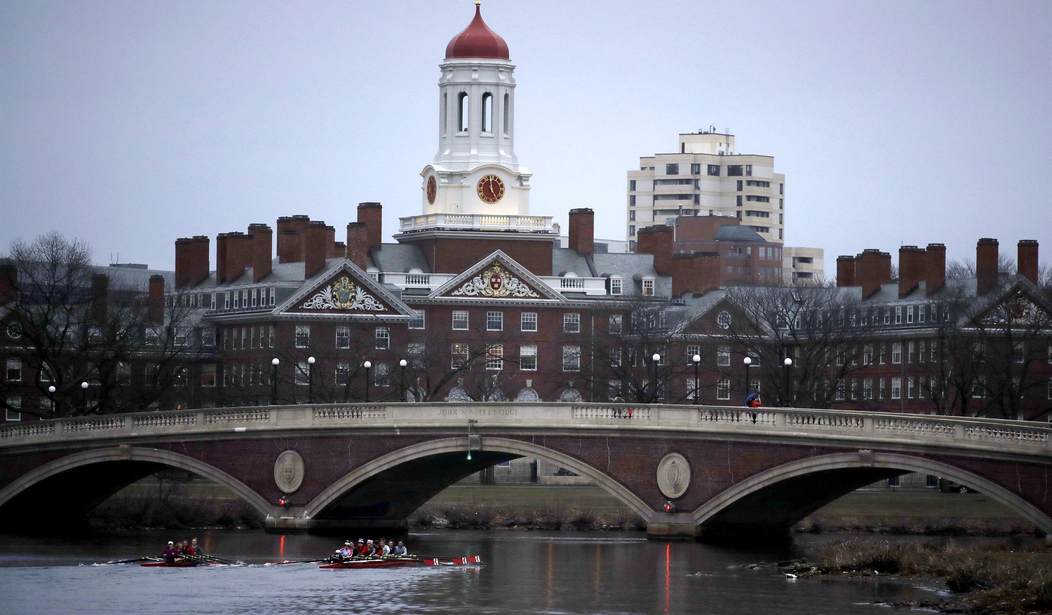

Last week, the United States Supreme Court ruled that race-conscious admissions policies, known as "affirmative action," at Harvard University and the University of North Carolina are unconstitutional.
As Spencer reported, the majority opinion written by Chief Justice John Roberts and joined by Justices Thomas, Alito, Gorsuch, Kavanaugh, and Barrett stated that "Harvard and UNC admissions programs cannot be reconciled with the guarantees of the Equal Protection Clause. Both programs lack sufficiently focused and measurable objectives warranting the use of race, unavoidably employ race in a negative manner, involve racial stereotyping, and lack meaningful end points. We have never permitted admissions programs to work in that way, and we will not do so today."
NEW — "Harvard and UNC's admissions programs...violate the equal protection clause of the 14th Amendment..." pic.twitter.com/gGkJnvZUOL
— Townhall.com (@townhallcom) June 29, 2023
On Monday, three civil rights groups filed a lawsuit against Harvard over its "discriminatory" "legacy admissions" policy, which they claim benefits white students.
The three groups, the Chica Project, the African Community Economic Development of New England (ACEDONE), and the Greater Boston Latino Network (GBLN) said in a press release that the policies give the upper hand to applicants "with familial ties to wealthy donors and alumni."
The groups allege that the "legacy admissions" policies violate Title VI and the Civil Rights Act of 1964 (via Lawyers for Civil Rights Boston):
As the complaint outlines, nearly 70% of Harvard’s donor-related and legacy applicants are white, and they receive a substantial boost based on their status. Donor-related applicants are nearly 7 times more likely to be admitted than non-donor-related applicants, and legacies are nearly 6 times more likely to be admitted.
For the Class of 2019, about 28% of the class were legacies with a parent or other relative who went to Harvard. Qualified and highly deserving applicants of color are harmed as a result, as admissions slots are given instead to the overwhelmingly white applicants who benefit from Harvard’s legacy and donor preferences.
Even worse, this preferential treatment has nothing to do with an applicant’s merit. Instead, it is an unfair and unearned benefit that is conferred solely based on the family that the applicant is born into. This custom, pattern, and practice is exclusionary and discriminatory. It severely disadvantages and harms applicants of color.
The complaint notes that in recent years numerous colleges and universities have recognized the unfairness of such preferences and have abandoned them, including all higher education institutions in Colorado; the University of California; Johns Hopkins University; and Amherst College.
"There's no birthright to Harvard," Ivan Espinoza-Madrigal, the executive director of LCR said in a statement.
"As the Supreme Court recently noted, 'eliminating racial discrimination means eliminating all of it.' There should be no way to identify who your parents are in the college application process. Why are we rewarding children for privileges and advantages accrued by prior generations? Your family's last name and the size of your bank account are not a measure of merit, and should have no bearing on the college admissions process," Espinoza-Madrigal added.
In the aftermath of the Supreme Court's decision on affirmative action, several Democrats, including President Joe Biden, have called on schools to end legacy admissions, according to Reuters.