





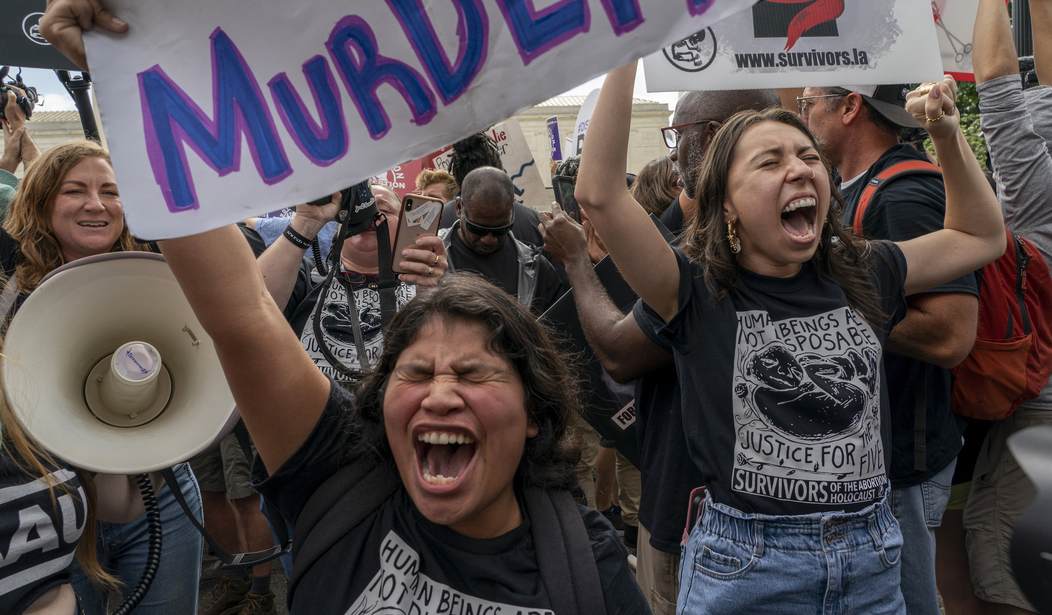
A poll published this week shows that Democrats are more likely to vote in the midterm elections this year after the Supreme Court’s ruling overturning Roe v. Wade, which legalized abortion in all 50 states in 1973.
The NPR/PBS NewsHour/Marist poll found that 10 percent of Democrats support the Supreme Court’s decision to overturn Roe. A majority, 88 percent, do not support the decision. Seventy-seven percent of Republicans support the Court overturning Roe, while 20 percent opposed it.
NPR’s write-up explained that a higher percentage of Democrats said they are more likely to vote in the midterms since the ruling.
This issue presents volatility into the 2022 midterms, because 78% of Democrats say the court's decision makes them more likely to vote this fall, 24 points higher than Republicans.
A bare majority of 51% say they would definitely vote for a candidate who would support a federal law to restore the right to an abortion, while 36% would definitely vote against such a candidate.
That could be a shot in the arm for Democrats if they mobilize around this issue, though Republicans are still favored at this point to take back the House this fall because of high inflation and gas prices.
Overall, the poll claims that 40 percent of Americans support the Court’s decision to overturn Roe while 56 percent oppose it. The survey of 941 respondents, conducted Friday through Saturday after the Court’s ruling, has a margin of error of +/-4.9 percentage points.
Broken down by gender, 38 percent of women surveyed said they support the Court’s ruling while 59 percent opposed it. Forty-three percent of men support the Court’s ruling while 54 percent oppose it.
“The issue is personal to most Americans. Two-thirds of people responding to the poll say they or someone they know has had an abortion. That was true of three-quarters of independents, 7-in-10 Democrats and 55% of Republicans,” the write-up added.
The case, Dobbs v. Jackson Women’s Health Organization, involved a 15-week abortion ban in Mississippi. The court upheld the ban and overturned Roe and Planned Parenthood v. Casey.
In the opinion, the Justices wrote that the U.S. Constitution does not protect the right to abortion and determined that Roe and Casey were wrongly decided.
“The Constitution does not confer a right to abortion; Roe and Casey are overruled; and the authority to regulate abortion is returned to the people and their elected representatives,” the opinion stated.
“Like the infamous decision in Plessy v. Ferguson, Roe was also egregiously wrong and on a collision course with the Constitution from the day it was decided. Casey perpetuated its errors, calling both sides of the national controversy to resolve their debate, but in doing so, Casey necessarily declared a winning side. Those on the losing side—those who sought to advance the State’s interest in fetal life—could no longer seek to persuade their elected representatives to adopt policies consistent with their views. The Court short-circuited the democratic process by closing it to the large number of Americans who disagreed with Roe.”

Join the Conversation
VIP members get the ability to comment on articles.