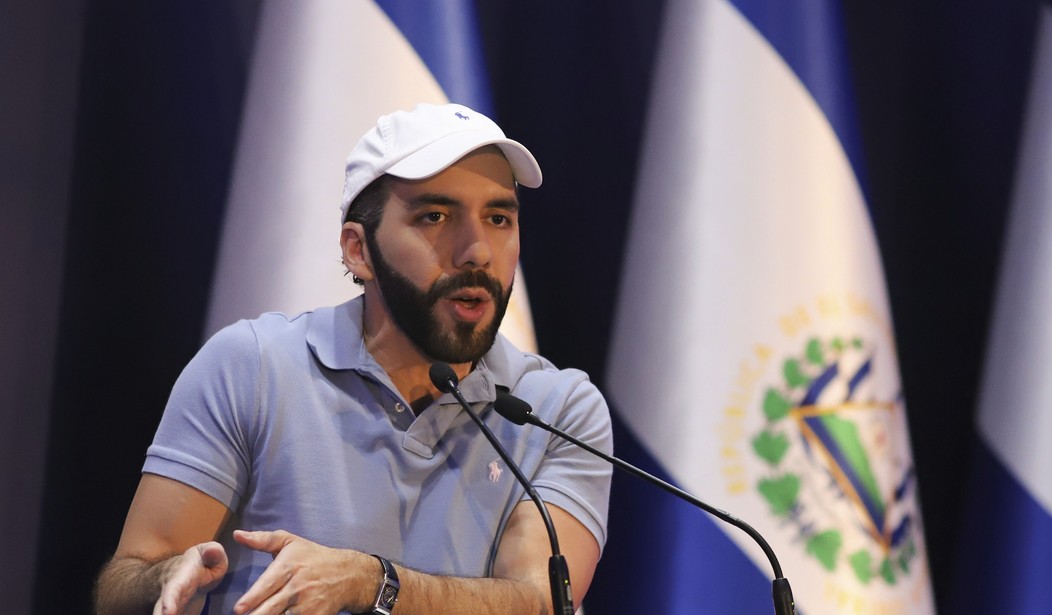

El Salvador has transformed from the murder capital of the world to the safest country in the Western hemisphere. And President Nayib Bukele accomplished that in about three years. How?
In a wide-ranging interview with Tucker Carlson, the leader explained that they built up the police force and doubled the army, using it to combat crime. That’s the “official” answer, he said, but the “real answer” is that El Salvador’s transformation is a "miracle.”
“It was an impossible task,” Bukele explained to Carlson, since gang members were so embedded within the civilian population. “They were everywhere and they were killing randomly. So how do you stop it?”
He recalled sitting in a meeting at the early stages of the war against gang members, trying to figure out how they can go after them without dragging the civilian population into it, since gang members will attack anyone to create terror.
“So we really we try to figure out what to do and I, they basically said, well we're looking at an impossible mission here. So, we pray. And we—”
“You prayed in the meeting?” Carlson interjected.
“Yes, yes, of course. Several times,” Bukele responded, for “wisdom to win the war.”
“I thought at the time that we would have civilian casualties,” the president continued. “So we said, we [prayed] that the casualties will be as low as possible. And we didn't have any civilian casualties.”
A surprised Carlson wondered if everyone in the meeting was OK with stopping to pray for guidance.
“Yes, yes, all my security cabinet [members] are believers,” Bukele told him. “They all believe in God. We're a secular country, of course, but we all believe in God.”
That’s not the only time Bukele explained he prayed to God for guidance.
After the security situation was more or less under control, Bukele focused on improving the economy.
Carlson said he listened to a translation of his inaugural speech where Bukele discussed a three-point plan to grow the economy.
“And I'm thinking, I wonder what that is. I don't know, start a Federal Reserve Bank. And you said the first, the first point of my plan is seek God's wisdom.”
Taken aback, Carlson wondered why that would be the first part of his plan, but Bukele questioned why it wouldn’t be the first part.
“I just, I've never heard any leader of any country say that,” Carlson told him.
“It’s a commonsense thing to seek God’s wisdom,” Bukele replied.
Carlson said Bukele has proven that with very limited resources and no help from outside, a country can drastically change for the better. What does that say about larger, wealthier countries like the U.S. though? It “must be a voluntary decision,” Carlson argued.
Bukele told him one could draw that conclusion.
"I guess that's why I came here, to be totally honest, is what your success says about the country that I live in, or other countries in the hemisphere or in Europe where people are killed by the thousands every year," Carlson said.
Bukele explained that the hostility that's been directed toward El Salvador because of their success may be because other countries and leaders are "afraid of the example [El Salvador has set] because a lot of people might say, hey, we want that too."
When Carlson pressed him to explain why a country that "has the means to end violent crime" wouldn't do it, Bukele said he was unsure.
"I can make up theories, but I really don't [know]," he said.
President Nayib Bukele saved El Salvador. He may have the blueprint for saving the world. pic.twitter.com/92etFh7sSI
— Tucker Carlson (@TuckerCarlson) June 6, 2024