





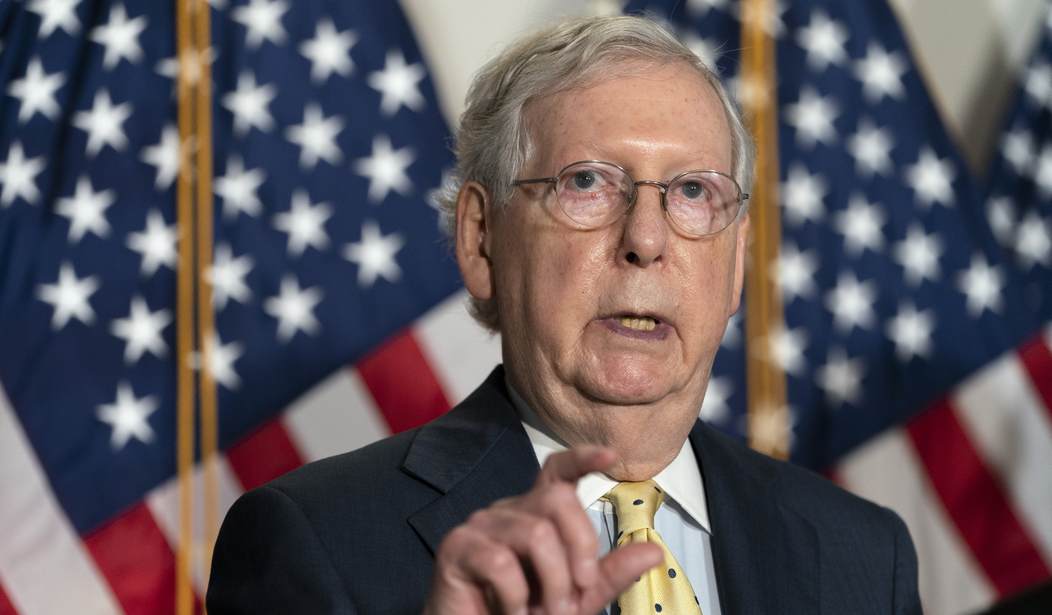
Senate Minority Leader Mitch McConnell is sounding the alarm about how the GOP will retaliate should Democrats nuke the filibuster or reduce its strength.
"A post-nuclear Senate would not be more efficient or more productive. I personally guarantee it," McConnell said Tuesday. "Do my colleagues understand how many times per day the Senate needs and gets unanimous consent for basic housekeeping? Do they understand how many things could require roll call votes? How often the minority could demand lengthy debate?"
On Monday, McConnell also threatened to force votes on GOP-sponsored legislation.
If Democrats made the change, Mr. McConnell’s office said he would propose more than a dozen bills, including measures that would prevent the implementation of a private-sector vaccine mandate, prohibit so-called sanctuary cities from receiving federal grants or stop the Biden administration from implementing any fracking ban.
Other GOP bills on Mr. McConnell’s list, which he thinks can garner 50 votes or more, would prevent the Internal Revenue Service from implementing the Biden administration’s proposal to require banks to send to more information about customers’ accounts to the IRS and prohibit elementary and high schools from using as much as $164 billion in unspent Covid-19-relief funds if they aren’t open for in-person learning.
Using a Senate procedure known as Rule 14 to circumvent Democratic-controlled committees, Mr. McConnell plans by Monday night to start adding more than a dozen Republican bills to the legislative calendar.
In the Senate, the typical practice is for the majority leader to make motions to proceed. Technically anyone can, although such a move is rare. (WSJ)

Senate Majority Leader Chuck Schumer said McConnell's move "didn't quite work."
"Last night, you may have seen Senator McConnell try to Rule-14 18 gotcha amendments,” Schumer said Tuesday during a press conference. “He was trying to say, ‘See, Democrats, you're not going to like 50 votes. I challenged him and asked unanimous consent that we have 50 votes on those 18 plus the voting rights Act, the Freedom to Vote Act, and the John Lewis Act. And of course, he objected. So, we're not afraid of 50 votes. We want 50 votes. And McConnell's gotcha activity didn't quite work."
McConnell, in turn, argued Democrats are trying to “break the Senate.”
"Our colleagues who are itching for a procedural nuclear winter have not even begun to contemplate how it would look," McConnell said. "Our colleagues who are itching to drain every drop of collegiality from this body have not even begun to consider how that would work."
President Biden, in calling for changing the Senate rules, has claimed that without the passage of Democrats’ voting rights bills, democracy is under attack.
“It gives me no satisfaction in saying that, as an institutionalist, as a man who was honored to serve in the Senate, but as an institutionalist I believe the threat to our democracy is so grave that we must find a way to pass these voting rights bills,” he said in Georgia on Tuesday. “Debate them, vote, let the majority prevail and if that bare minimum is blocked, we have no option but to change the Senate rules including getting rid of the filibuster for this.”











Join the conversation as a VIP Member