





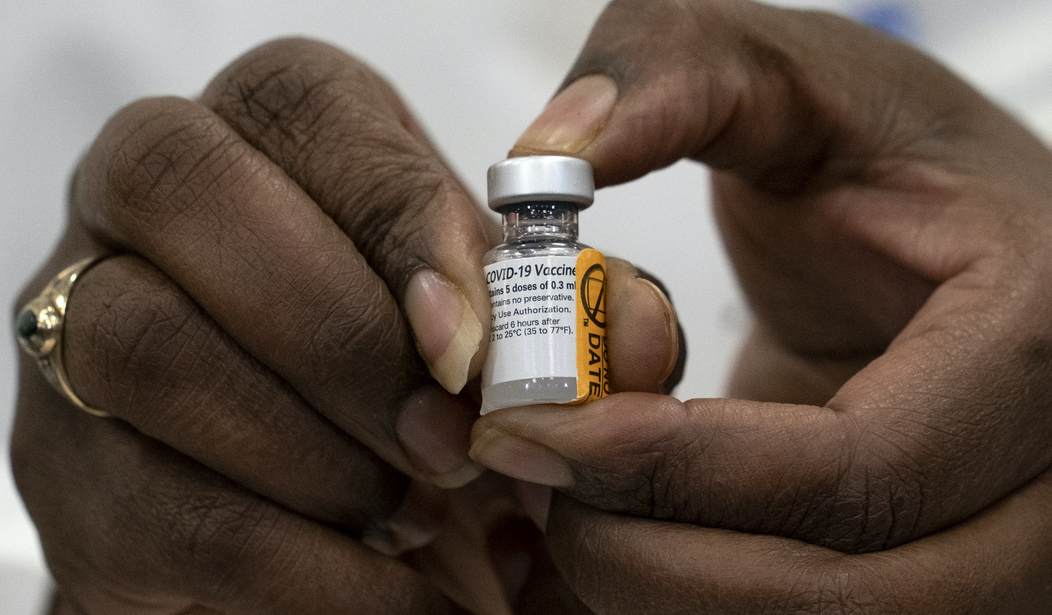
A hospital employee in Wisconsin who "intentionally" ruined hundreds of doses of the Moderna COVID-19 vaccine has been fired, Advocate Aurora Health said Wednesday.
Earlier this week the medical center learned that 57 vials had been removed from a pharmacy refrigerator and left out overnight. Each vial contains 10 doses. “While some of the vaccine was administered to team members on Dec. 26 within the approved 12-hour post-refrigeration window, unfortunately most of it had to be discarded due to the temperature storage requirements,” Advocate Aurora Health said Monday.
After an internal review, officials initially believed the cause was “inadvertent human error,” but they updated their statement after speaking with the individual responsible, who “acknowledged that they intentionally removed the vaccine from refrigeration.”
The Grafton Police Department, the FBI, and the Food and Drug Administration were among those notified, according to The Epoch Times.
“We continue to believe that vaccination is our way out of the pandemic,” the health care center said in a statement. “We are more than disappointed that this individual’s actions will result in a delay of more than 500 people receiving their vaccine.”
BREAKING: Advocate Aurora now says an employee at its Grafton hospital intentionally removed the Moderna COVID-19 vaccine from a refrigerator resulting in nearly 500 doses having to be thrown away pic.twitter.com/yjhCOM64Ge
— Matt Smith (@mattsmith_news) December 31, 2020
Monday’s statement the company released pic.twitter.com/9CPe6wgHag
— Matt Smith (@mattsmith_news) December 31, 2020
According to the Centers for Disease Control and Prevention, more than 12.4 million doses of the Moderna and Pfizer BioNTech COVID-19 vaccines have been distributed, with over 2.7 million people receiving the first dose so far, though data is not updated in real time.
U.S. officials have acknowledged that the COVID-19 vaccination effort has been slower than expected.
“We agree that that number is lower than what we hoped for,” Moncef Slaoui, scientific adviser of Operation Warp Speed, told The New York Times. “We know that it should be better, and we’re working hard to make it better.”
The 2.1 million administered doses reported by the C.D.C. is an underestimate of the true number because of lags in reporting. And a C.D.C. official said in a separate news conference on Wednesday that 2.6 million people had received their first dose. Whatever the number, it falls far short of the goal that federal officials put forward as recently as this month to have 20 million people vaccinated by the end of this year. (The New York Times)
President-elect Joe Biden criticized the pace this week, arguing that at that rate, “it’s going to take years, not months,” to get the country protected.
President Trump said Tuesday that it's up to individual states "to distribute the vaccine once brought to the designated areas by the Federal Government."
He added: "We have not only developed the vaccines, including putting up money to move the process along quickly, but gotten them to the states."
It is up to the States to distribute the vaccines once brought to the designated areas by the Federal Government. We have not only developed the vaccines, including putting up money to move the process along quickly, but gotten them to the states. Biden failed with Swine Flu!
— Donald J. Trump (@realDonaldTrump) December 29, 2020
States have argued they lack funding to distribute and administer the vaccines, but the relief package Trump sign on Sunday allocates more than $8 billion to those efforts, the NYT reports.
Dr. Anthony Fauci expressed hope that vaccination numbers were trend upwards come January.
“We certainly are not at the numbers that we wanted to be at the end of December,” the National Institute of Allergy and Infectious Diseases director told CNN on Tuesday. “I believe that as we get into January, we are going to see an increase in the momentum.”


Join the Conversation
VIP members get the ability to comment on articles.