







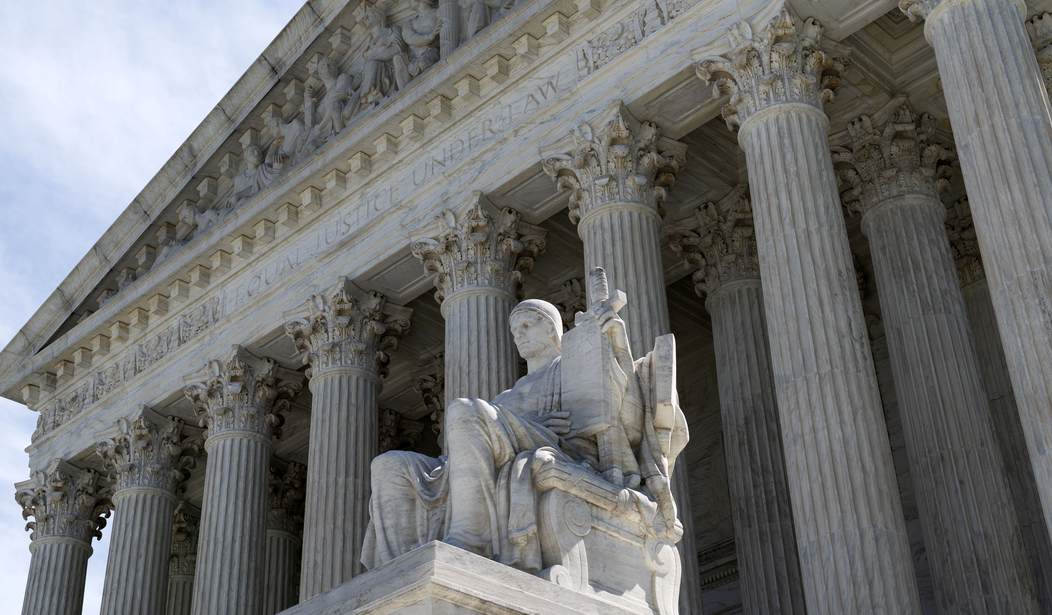
When the news broke yesterday of Justice Breyer's intention to retire from the Supreme Court after this term – a decision that was apparently leaked prematurely – my phone started blowing up. Friends and colleagues texted and emailed about the prospect of an imminent, epic political war breaking out over filling the upcoming vacancy. Given recent history, and the left's pattern of vicious histrionics, this reaction was an understandable initial instinct – but upon further scrutiny, I believe it will prove misplaced in this case. I could be wrong. A major curveball or bombshell could scramble the dynamics. But barring that sort of thing, or a truly radical pick by the president, I suspect the Breyer replacement process will be a relatively low octane affair that may well move forward fairly smoothly and somewhat predictably. Why?
(1) All SCOTUS vacancies are high-profile political events, but some are laden with much higher stakes. In the scheme of things, this is a low-stakes vacancy. The likely outcome is a progressive justice replacing a progressive justice, with the ideological balance of the Court unchanged. Going to the mats to try to derail this nomination doesn't make strategic sense. I'd bet Mitch McConnell lets his very conservative members fight the good fight and rile up the righty base in an election year (it's always useful to remind conservative voters about the importance of the courts and the balance of power in the Senate) while allowing members with other considerations take whatever votes they need to on this one.
(2) Moderate senators on both sides of the aisle are incentivized to support the forthcoming nominee. Some Republican moderates will likely seek to burnish their cross-partisan credentials by voting in favor of a qualified nominee with whom they have ideological differences, especially given the aforementioned low stakes. Susan Collins, I'll note, has never voted against a Democratic president's SCOTUS nominee. She touted that point in announcing her courageous pro-Kavanaugh vote in 2018. She'll want to emphasize that point again here, I'd guess. Even some conservative members may argue that for the most part, presidents should be allowed to select their people and that elections have consequences (while underscoring how they refuse to treat Democratic nominees as shabbily as the Democrats so often do when the roles are reversed). Importantly, Democratic moderates Joe Manchin and Kyrsten Sinema have every reason to vote with their party this time. Both have supported Biden's judicial nominees as a matter of course, and this is an easy way to tamp down some of the base's anger that's been directed at them so virulently for months on end. It's a layup: A chance to say, see, we're part of the team – in a high profile, but low stakes setting. No-brainer.
(3) The president campaigned on the promise of nominating a black woman if a Supreme Court vacancy arose during his term. This was an unseemly, reductive, identity-obsessed pledge – but it was a base play. The base is fixated on such things. And with that base furious with the party lately (on BBB, "voting rights" and the filibuster, etc.), this is about as clean a win as Biden is likely to get this year. So he's going to serve up the sort of nominee he promised, the left will get to feel good about how "progressive" they are, and the nominee will get confirmed. The White House has every reason to play this relatively safe (picking someone who checks the boxes, has a good pedigree, and has low risk of giving Manchin/Collins any second thoughts) and notch the W. He needs one badly, even if it won't save his party in the midterms.
Add that all up, and I put the over/under on "yes" votes on this yet-unnamed nominee at 52. And I might take the over, depending on how the hearings go. That may rankle some conservatives, but it's my analysis of what's going to happen. Events will vindicate or blow up my predictions. We shall see. A few more stray thoughts: It's not going to be Kamala Harris, for several reasons. If I had to bet on the identity of the nominee, I might put my money on this woman – who was a Breyer clerk, and who was recently installed on the DC Circuit Court in a bipartisan vote. Shades of the Kavanaugh and ACB paths, combined. Finally, this made me chuckle:
https://t.co/1zaEkHaZSl pic.twitter.com/Rv992Xl8yp
— Tim Carney (@TPCarney) January 26, 2022
Conservative (or even centrist) black women need not apply for this slot, obviously. If progressives had to choose between someone who thinks like Lt. Gov. Sears and a younger version of Justice Breyer (cis white male), we all know who they'd choose 100 times out of 100. Much of the time, identity politics is a means to an end: Power. I'll leave you with my real-time formation of the above analysis as the news broke on Fox yesterday, and a smart piece by Charles Cooke:
.@guypbenson: "I start to wonder if, in fact, this could end up being a relatively low octane Supreme Court fight... [Senator] Susan Collins, for example, has voted for every Democrat nominated justice in her tenure..." pic.twitter.com/eGI2mBBsEl
— Townhall.com (@townhallcom) January 26, 2022
The obvious aside, Breyer’s retirement is not all bad news for conservatives. https://t.co/NC47ztfFWk
— Charles C. W. Cooke (@charlescwcooke) January 26, 2022



Join the Conversation
VIP members get the ability to comment on articles.