





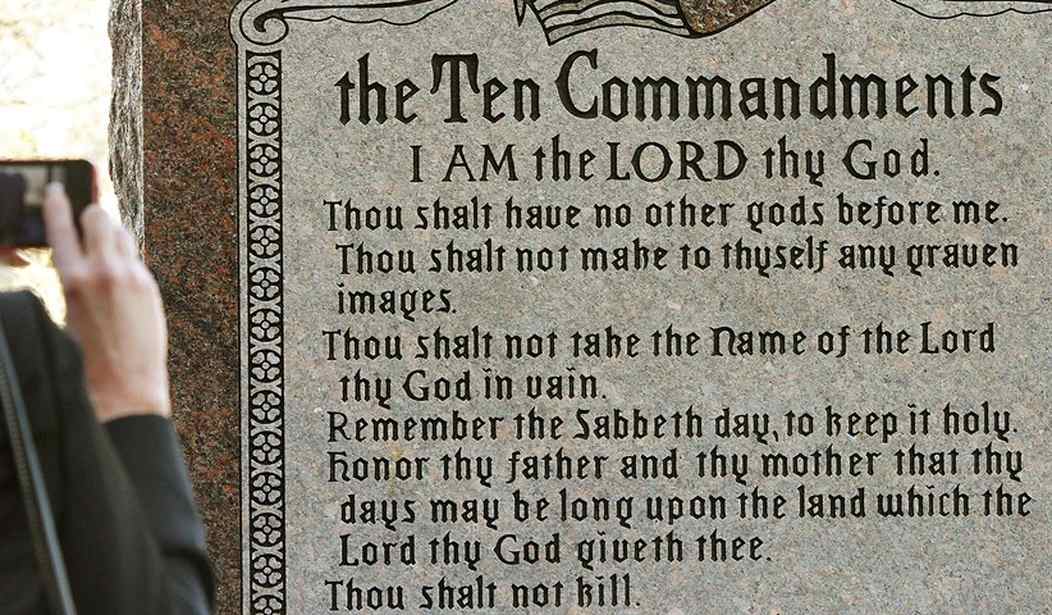
In a recently issued opinion that could have widespread implications, the highest court in Oklahoma determined that the state’s Ten Commandments statue, located near the capitol, cannot stay where it is. The AP reports:
A Ten Commandments monument on the Oklahoma Capitol grounds is a religious symbol and must be removed because it violates the state's constitutional ban on using public property to benefit a religion, the Oklahoma Supreme Court ruled on Tuesday.Oklahoma's highest court said the Ten Commandments chiseled into the 6-foot-tall granite monument, which was privately funded by a Republican legislator, are "obviously religious in nature and are an integral part of the Jewish and Christian faiths." The 7-2 ruling overturns a decision by a district court judge who determined the monument could stay.
Interestingly, the statue did not actually violate federal law, the judges ruled. And yet, it is not constitutional, either:
Attorney General Scott Pruitt had argued that the monument was historical in nature and nearly identical to a Texas monument that was found constitutional by the U.S. Supreme Court. The Oklahoma justices said the local monument violated the state's constitution, not the U.S. Constitution.
But how, exactly, did the statue violate Oklahoma’s governing document?
“[The] court said the placement of the monument violated a section in the state's constitution, which says no public money or property can be used either directly or indirectly for the ‘benefit, or support of any sect, church, denomination, or system of religion,’" Reuters reported.

So because the Ten Commandments statue clearly espouses Christian and Judaic teachings on public lands, the justices concluded, its placement is therefore unlawful. Meanwhile, this might also help explain why the justices were so eager to throw out the attorney general’s central argument:
Lawmakers have argued that the monument was not serving a religious purpose but was meant to mark a historical event.That opened the door for other groups, including Satanists and the Church of the Flying Spaghetti Monster, to apply for permission to erect their own monuments on Capitol grounds to mark what they say are historical events.
Nevertheless, Attorney General Scott Pruitt has asked the justices to reexamine the case.
“In response [to the ruling], my office will file a petition with the court for a rehearing in light of the broader implications of this ruling on other areas of state law,” he said in a statement. “In the interim, enforcement of the court’s order cannot occur. Finally, if Article 2, Section 5, is going to be construed in such a manner by the court, it will be necessary to repeal it.”





Join the conversation as a VIP Member