


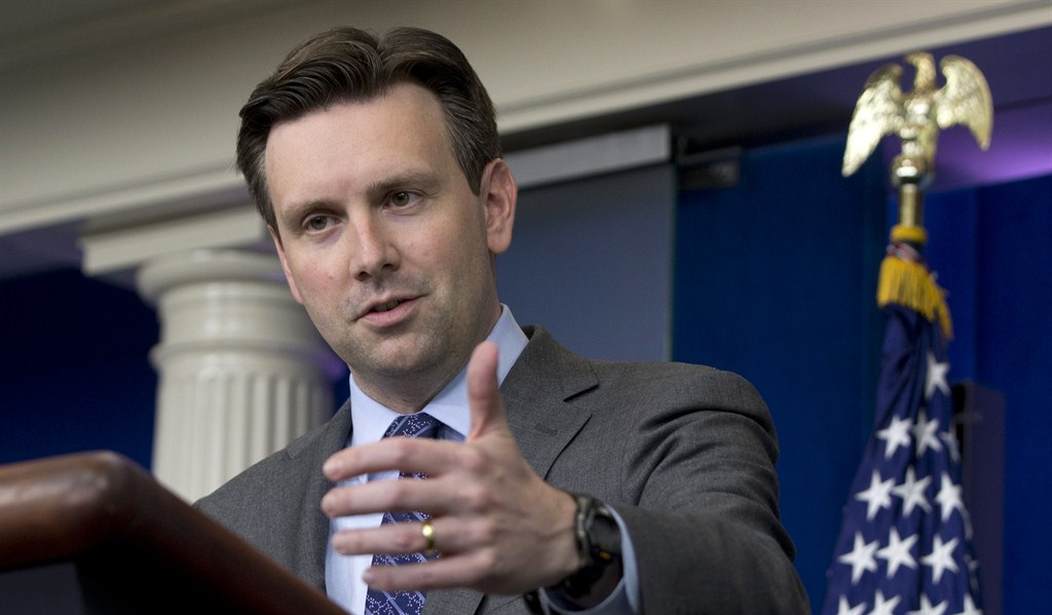
The situation in Iraq and Syria appears to be quickly unraveling as ISIS gains ground and continues sacking cities. Nevertheless, White House Press Secretary Josh Earnest confirmed (and reaffirmed) on Thursday that such territorial losses are not going to induce the president to change his stated strategy.
“What this administration will continue to do is to implement the strategy that the president has laid out, which is to build up the capacity of local fighters on the ground in Iraq and in Syria to take the fight against [ISIS],” he said. “But they will have the strong support of the United States and the coalition of 60 countries that the president leads.”
“And they’ll have that support in the form of offering training and equipment to those local fighters,” he continued. “They’ll be able to get some battlefield advice from coalition personnel that are deployed to Iraq, and they will—importantly—have the support of coalition military air power.”
And yet, this strategy doesn’t appear to be working. The cities of Ramadi and Palmyra have already fallen, raising major questions about how the White House is prosecuting the war.
Earnest, however, suggested a lack of troops—and training—is the chief reason for all the “setbacks,” not the strategy itself.
“We’ve acknowledged for a year now that our efforts in Syria to build up a ground force that can work closely with the coalition is going to take some time,” he said. "There is no natural force that’s there. So there is an active training mission that’s taking place to fill this force.”

“But the president is not going to be in a position where he is going to consider a large scale, US military deployment,” he added. “And for those who are calling on a change in strategy, I would encourage them to be specific. I don’t think that they will find a lot of support on the part of the American people for a large-scale deployment of military resources to essentially re-invade Iraq—or invade Syria.* The president does not believe that would be in the best interests of the United States.”
Contrast the tone of the press secretary’s comments this afternoon to what two national security experts said earlier today in front of the Senate Armed Services committee. There is a very stark difference.
*Fact check: That's not necessarily true.






Join the conversation as a VIP Member