


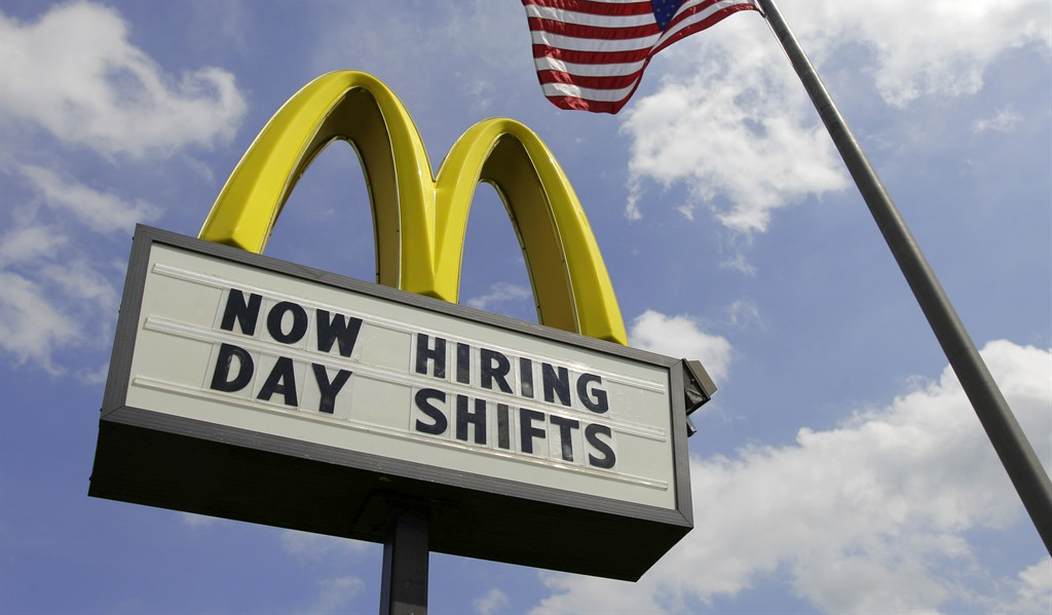
If your singular objective is to kill jobs then by all means, Seattle, go for it:
Washington already has the nation's highest state minimum wage at $9.19 an hour. Now, there's a push in Seattle, at least, to make it $15.
That would mean fast food workers, retail clerks, baristas and other minimum wage workers would get what protesters demanded when they shut down a handful of city restaurants in May and others called for when they demonstrated nationwide in July.
So far, the City Council and mayoral candidates have said they'd consider it in the famously liberal city. One said, however, that it may not be soon.
Venture capitalist Nick Hanauer said there's no time to waste. What the nation needs is money in the hands of regular consumers. "A higher minimum wage is a very simple and elegant solution to the death spiral of falling demand that is the signature feature of our economy," he said.
Some businesses advocates say a higher minimum wage will make it harder for companies in Seattle to survive. They cite Wal-Mart, which has all but refused to accept a Washington, D.C., decision to raise the minimum wage to $12.50 an hour in big box stores.
A higher minimum wage eliminates low wage jobs because that's how small businesses cut costs and that ends up hurting the people it was supposed to benefit, according to the U.S. Chamber of Commerce.
It’s important for Seattle residents to consider and debate the unintended consequences of hiking the city's minimum wage law more than thirty percent. Yes, it must be exceedingly difficult, say, for a single mother of two earning $9.19 an hour to make ends meet. But minimum wage jobs are (ideally) designed for teenagers and youngsters looking for opportunity and experience. Thus raising the minimum wage will almost certainly guarantee that unemployment rates will rise over time as the total cost of maintaining workers increases. After all, we’ve seen this happen before. And don’t forget that most Americans working minimum wage jobs aren’t necessarily living in poverty either -- a point social justice advocates perhaps too often overlook (via the Wall Street Journal):
The reduction in jobs for youths might be an acceptable price to pay if a higher minimum wage delivered other important benefits. Many people believe, for instance, that it helps low-income families. Here, too, the evidence is discouraging. There is no research supporting the claim that minimum wages reduce the proportion of families living in poverty.Research I've done with William Wascher of the Federal Reserve Board and Mark Schweitzer of the Cleveland Fed indicates that minimum wages increase poverty.
How can this be? Because the relationship between being a low-wage worker and living in a poor family is remarkably weak. Many low-wage teenagers and young adults are in higher-income families, and many poor families have no workers.
According to recent data from a study by Richard Burkhauser and Joseph Sabia, 34% of minimum-wage workers were in families with incomes exceeding three times the poverty line ($22,050 for a family of four) -- roughly the top half of the income distribution. Only 17% were in poor families.
Recommended

There are better ways to help grow the middle class than a compulsory wage increase. Nonetheless, I do believe that raising the minimum wage is a well-intentioned, if misguided, public policy rooted in social justice. But before the City Council takes up this proposal, they should at the very least take the time to examine what some of the unintended consequences will be. And they could start, perhaps, by listening to Nobel Prize winning economist Milton Friedman discuss the subject.







Join the conversation as a VIP Member