







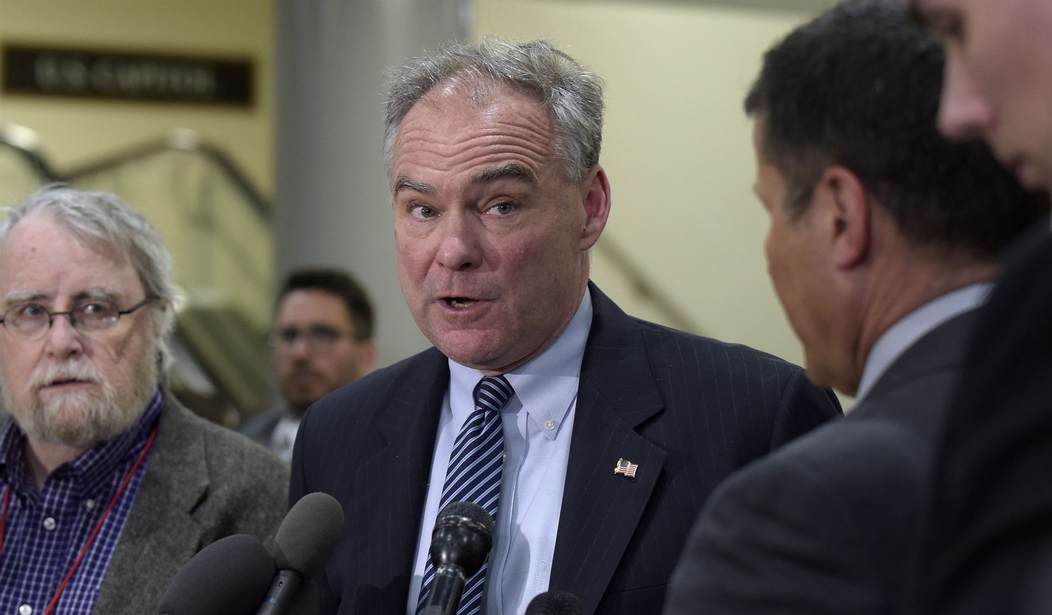
A Democratic-led effort to restrict President Trump's wartime powers was rejected by the Senate on Friday. Sens. Tim Kaine (D-VA) and Tom Udall (D-NM), who introduced the amendment, wanted it tacked on to this year's National Defense Authorization Act (NDAA). Specifically, their amendment was intended to require Trump to seek congressional authorization to take military action against Iran.
The vote is still open, but since over 40 senators have now voted against it, it can't reach the necessary 60-vote threshold. Senate Majority Leader Mitch McConnell went in to Cocaine Mitch mode and blamed the Democrats' effort on "Trump Derangement Syndrome."
“None of our Democratic friends would be supporting this if there was a Democratic president,” McConnell said. “This is clearly within the bounds of measured response that have not been micromanaged by Congress in the past.”
Still, four Republicans, Sens. Mike Lee (UT), Susan Collins (ME), Jerry Moran (KS), and Rand Paul (KY), voted in favor of the amendment.
Trump nearly struck back at Iran last week following two acts of aggression. The regime was reportedly responsible for an attack on two oil tankers in the Strait of Hormuz and later shot down an unmanned U.S. surveillance drone. With 10 minutes until retaliatory launch time, Trump pulled back on the order because he had learned that the strike would kill 150 Iranians.
He did promise, however, after an insulting tête-à-tête with Iranian President Hassan Rouhani, that if Iran strikes the U.S., it can expect "overwhelming force."
....Iran’s very ignorant and insulting statement, put out today, only shows that they do not understand reality. Any attack by Iran on anything American will be met with great and overwhelming force. In some areas, overwhelming will mean obliteration. No more John Kerry & Obama!
— Donald J. Trump (@realDonaldTrump) June 25, 2019

Join the Conversation
VIP members get the ability to comment on articles.