







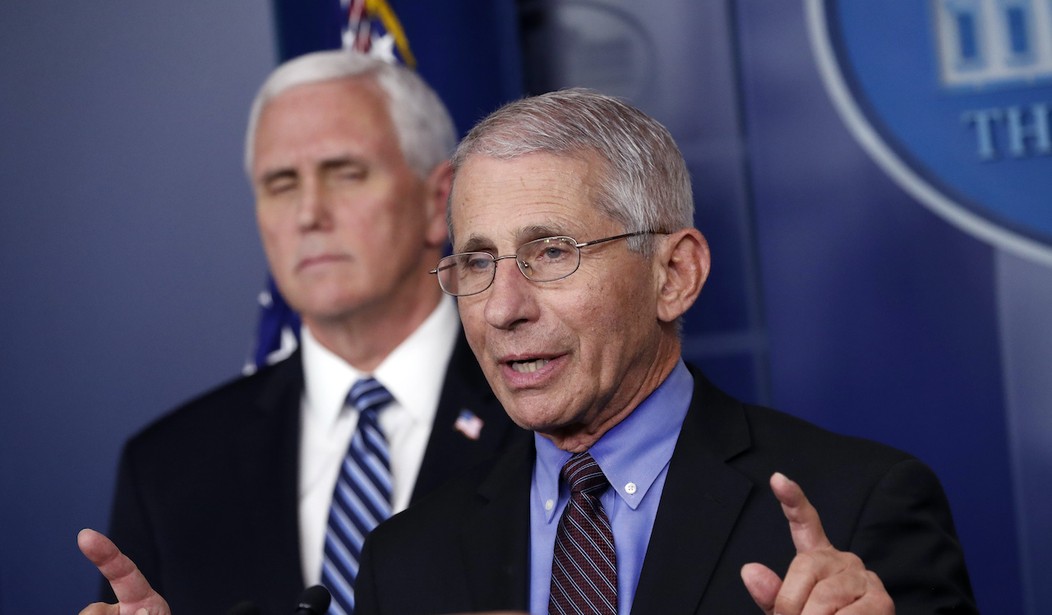
When the Ebola outbreak took place back in 2014, Dr. Anthony Fauci slammed "draconian" quarantines that had been ordered for those who traveled through Newark, JFK and O'Hare International Airports. According to Fauci, there were other mitigation efforts that were far more effective than requiring people to lock themselves in one place.
The head of the National Institute of Health (NIH) was concerned that doctors and other medical professionals would decline to volunteer in West Africa because they would be required to quarantine when they returned to the United States.
"The first thing we need to do is make sure the primary goal is to protect the American people but there are ways to do that that may not necessarily have to go that far," Fauci told MSNBC's Chuck Todd back in 2014.
Fauci said he didn't want to "criticize" the decisions that New Jersey Gov. Chris Christie (R-NJ) and Andrew Cuomo (D-NY) made about mandatory quarantines.
"We have to be careful that there are unintended consequences. The best way to stop this epidemic is to help the people in West Africa. We do that by sending people over there, not only from the USA but from other places," he explained. "We need to treat returning people with respect and make sure they're – they're really heroes. The idea that we're being a little bit draconian, there are other ways to protect. There's monitoring. There's direct monitoring. There's active monitoring. We don't necessarily need to do [quarantines]."
When asked what he would recommend to the governors of Virginia and Georgia, who have two international airports that receive passengers from West Africa, Fauci had a word of advice – and it's one we've heard repeatedly – to "go with the science."
"That's what we're trying to do here in our government, go with the science. The science tells us that people who are not sick, if you do not come into contact with body fluids, if someone comes back from wherever, Liberia, and they're well, they are no danger to anyone," Fauci explained.
The NIH head reminded Todd that Americans had virtually no risk of contracting Ebola unless they encountered someone who was sick and they had the infected person's body fluids on them.
Flashback: In 2014, Dr. Fauci warns “Draconian” Ebola quarantines will have “unintended consequnces”
— Tom Elliott (@tomselliott) February 20, 2021
“Go with the science” he advises instead. pic.twitter.com/bK3VS9wAgI
There are a couple of essential things to note: Ebola wasn't transmitted through asymptomatic carriers the way the Wuhan coronavirus is. Ebola also has a higher death rate. The death rate for Ebola was more than 50 percent, while coronavirus-related deaths in the United States are less than two percent.
Either way, Dr. Fauci needs to take his advice and "go with the science." The science from the coronavirus thus far shows us that the virus is more contagious but is not nearly as deadly as Ebola.
The problem Americans have with listening to the "experts" is they keep changing their minds on things. Fauci can't decide whether or not he backs masks. We went from no masks to wearing masks, to not wearing them, to now they're recommending two to three masks at a time. If masks were effective, why does California have such a high number of cases when they mandated masks early on in the pandemic?
Lockdowns have been proven to be ineffective as well. Places like California and Michigan have had heavy lockdowns and their cases have remained fairly high.
But the main problem Americans have: the goalposts have shifted. At first, we were told to lock down for 15 days to slow the spread. The idea was to give the medical system time to catch up so enough people would be treated. The system needed time to produce more PPE and develop ventilators (which weren't all that necessary). Then it was extended to 30 days. Then some states did 90 days. And now the goal is to prevent people from ever getting sick at all.



Join the Conversation
VIP members get the ability to comment on articles.